

Law Enforcement Training for Mental Health Crisis Response Act of 2021 This bill authorizes the Office of Justice Programs within the Department of Justice to award grants to law enforcement and corrections agencies for behavioral health crisis response training.
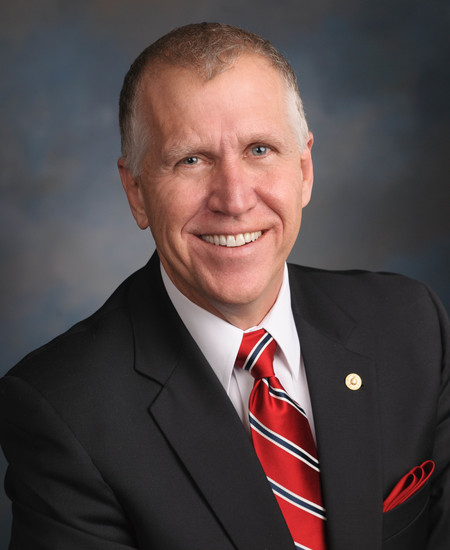
Sen. Thom Tillis
Sponsored bills
Stopping Harmful Offers on Platforms by Screening Against Fakes in E-commerce Act of 2021 or SHOP SAFE Act of 2021 This bill makes an electronic commerce platform liable for infringement of a registered trademark by a third-party seller of goods that implicate health and safety unless the platform takes certain actions. Specifically, the platform may be contributorily liable if the seller uses a counterfeit mark in connection with selling, offering, or advertising such goods on the platform. The platform may avoid such liability by taking certain actions before the infringing act, including (1) requiring the seller to have a registered agent or a verified address for service of process in the United States, (2) verifying the seller's identity and contact information, (3) requiring the seller to agree to not use counterfeit marks with goods sold on the platform, (4) implementing technical measures to prescreen listings on the platform and remove listings for goods being sold with a counterfeit mark, and (5) implementing policies to remove and ban repeat offenders.
This resolution addresses issues regarding Jews in the United States and anti-Israel rhetoric. Specifically, the Senate condemns hatred and violence against Jews; denounces the anti-Israel rhetoric of elected officials; rejects as biased, incomplete, and inaccurate information promulgated by the news media in the United States about Israel and the Israeli government's efforts to protect its citizens from terrorism; celebrates the contributions of American Jews to our nation, culture, values, and way of life; and reaffirms its intent to ensure that Jews in the United States are treated with dignity and respect and receive the full protection of the law owed to them as U.S. citizens.
Conrad State 30 and Physician Access Reauthorization Act This bill modifies the Conrad 30 Waiver program, which incentivizes qualified foreign physicians to serve in underserved communities. It also extends statutory authority for the program for three years from this bill's enactment. Aliens coming to the United States under a J-1 nonimmigrant visa to receive medical training typically must leave the country and reside for two years abroad before being eligible to apply for an immigrant visa or permanent residence. The Conrad program waives this requirement for individuals who meet certain qualifications, including serving for a number of years at a health care facility in an underserved area. The bill increases the number of waivers that a state may obtain each fiscal year from 30 to 35 if a certain number of waivers were used the previous year, and provides for further adjustments depending on demand. An alien physician may be employed at an academic medical center to meet the Conrad program's employment requirements if the alien's work is in the public interest, even if the medical center is not in an underserved area. Employment contracts for alien physicians under the Conrad program shall contain certain information, such as the maximum number of on-call hours per week the physician shall have to work. Certain alien physicians (along with the physician's spouse and children) shall be exempt from the direct annual numerical limits on immigration, including those physicians that have met certain requirements related to visas for physicians to serve in underserved areas.
This resolution congratulates the students, families, teachers, administrators, and staff of public charter schools across the United States for (1) making ongoing contributions to public education, (2) making impressive strides in closing the academic achievement gap in U.S. schools, and (3) improving and strengthening the public school system. The resolution supports the ideals and goals of the 22nd annual National Charter Schools Week.
Protecting Communities and Preserving the Second Amendment Act of 2021 This bill reauthorizes a grant program, requires the Department of Justice (DOJ) to take specified actions, creates new criminal offenses, and makes several other changes related to the sale, transfer, and possession of firearms. For example, the bill modifies and reauthorizes grants under the NICS (National Instant Criminal Background Check System) Improvement Amendments Act of 2007, requires DOJ to establish the Nationwide Project Exile Expansion Program to prosecute violations of federal firearms laws, establishes a task force within DOJ to investigate and prosecute cases of convicted felons and fugitives from justice who illegally attempt to purchase a firearm, removes certain restrictions on interstate firearms transactions, and creates stand-alone criminal offenses for trafficking in firearms and straw purchasing of firearms.
Agricultural Security Risk Review Act This bill expands the membership of the Committee on Foreign Investment in the United States to include the Secretary of Agriculture. (The committee reviews the national security implications of certain foreign investments in U.S. businesses or real estate, including critical infrastructure or technologies.)
Reaching America's Rural Minority Businesses Act of 2021 This bill authorizes the Minority Business Development Agency to establish rural business centers at historically Black colleges and universities to assist rural minority businesses with issues such as broadband adoption, advanced manufacturing, and entrepreneurship.
No Stolen Trademarks Honored in America Act This bill modifies the bar against U.S. courts enforcing or validating trademarks that were confiscated by the Cuban government. The bill prohibits U.S. courts from enforcing or validating such confiscated trademarks if the mark had been used in connection with a confiscated business or asset. Currently, the prohibition applies only if the confiscated trademark is being asserted in the United States by a Cuban national. Under the bill, the prohibition shall not apply if the original trademark owner, or a successor, has expressly consented to the enforcement action. The prohibition shall apply only if the entity asserting the trademark rights knew or should have known, when it acquired the rights, that the mark was the same or substantially similar to one connected to a confiscated business or asset.
Protecting Our Well-being by Expanding Russian Sanctions Act or the POWERS Act This bill expands existing sanctions against foreign persons engaged in certain activities related to the Nord Stream 2 and TurkStream pipelines, two Russian pipelines that were constructed to supply natural gas to Europe. Currently, these sanctions apply to foreign persons that (1) provided pipe-laying vessels for the construction of either pipeline, (2) facilitated certain transactions for such vessels, (3) provided certain underwriting services or insurance for such vessels, or (4) provided certain services for such vessels or Nord Stream 2. Under this bill, these sanctions must also apply to any foreign person that engaged in any transaction with such sanctioned persons. The bill also reinstates any sanctions that were previously waived with respect to Nord Stream 2 AG (the company established to construct and operate the pipeline) or any of its corporate officers. Such reinstated sanctions may not be waived except by an act of Congress.