Coronavirus Unemployment Benefits Tax Relief Act This bill excludes from gross income, for income tax purposes, up to $10,200 of unemployment compensation received by an individual in a taxable year beginning in 2020.
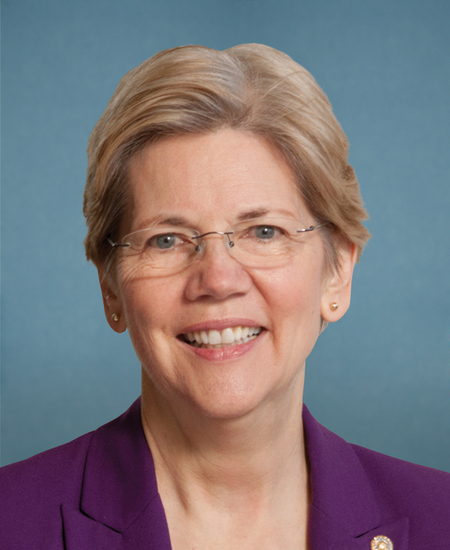
Sen. Elizabeth Warren
Sponsored bills
COVID HCBS Relief Act of 2021 This bill temporarily increases the applicable Federal Medical Assistance Percentage (i.e., federal matching rate) under Medicaid for certain approved home- and community-based services that are provided between October 1, 2020, and September 30, 2022. As a condition for receiving the increased rate, a state must agree to undertake activities to improve the delivery of such services during and after the public health emergency relating to COVID-19 (i.e., coronavirus disease 2019), such as by providing additional benefits to home health workers and by helping individuals who were relocated to nursing facilities during the emergency move back to their homes.
Anti-Racism in Public Health Act of 2021 This bill establishes within the Centers for Disease Control and Prevention (CDC) a National Center on Antiracism and Health and a law enforcement violence prevention program. Among other activities, the new center must declare racism a public health crisis, collect and analyze data, and administer research and grant programs to address racism and its impact on health and well-being. Additionally, the bill specifically directs the CDC's National Center for Injury Prevention and Control, in coordination with the Department of Justice and other relevant stakeholders, to carry out the law enforcement violence prevention program by conducting research and supporting other activities pertaining to law enforcement violence and public health.
Stop Subsidizing Multimillion Dollar Corporate Bonuses Act This bill extends the $1 million limit on the deductibility of executive compensation to all employees of publicly traded corporations.
End Taxpayer Subsidies for Drug Ads Act This bill prohibits a tax deduction for expenses relating to direct-to-consumer advertising of prescription drugs. Direct-to-consumer advertising is any dissemination, by or on behalf of a sponsor of a prescription drug product, of an advertisement that is in regard to the drug product and primarily targeted to the general public.
Public Health Emergency Privacy Act This bill imposes privacy, confidentiality, and security requirements on the use and disclosure of COVID-19 (i.e., coronavirus disease 2019) emergency health data. This is data that is linked to an individual or device, such as test results. The requirements apply to organizations that collect, use, or disclose emergency health data electronically or that manage websites or applications for contact tracing and other COVID-19 response activities. These organizations must provide notice of privacy and other policies. They must also ensure the accuracy of, prevent discrimination based on, and limit disclosure of the data. If an organization collects data from at least 100,000 individuals, it must publicly report additional information about how it uses and discloses the data. Furthermore, the bill prohibits the use of emergency health data for commercial advertising or in ways that restrict access to opportunities, services, and other accommodations. It also prohibits government entities and organizations from using this data to infringe on the right to vote. The Department of Health and Human Services must report on the civil rights impact of the collection, use, and disclosure of health data. The bill provides for enforcement by the Federal Trade Commission, states, and a private right of action. It further specifies that certain dispute resolution mechanisms, such as arbitration, are unenforceable with respect to disputes arising under the bill.
Environmental Justice Mapping and Data Collection Act of 2021 This bill establishes an interagency Environmental Justice Mapping Committee that must create a tool to identify environmental justice communities. Environmental justice communities are communities with significant representation of communities of color, low-income communities, or tribal and indigenous communities that experience, or are at risk of experiencing, higher or more adverse human health or environmental effects, as compared to other communities. The Environmental Protection Agency (EPA) must establish an environmental justice data repository to maintain the data collected by the committee. The EPA must make the repository available to regional, state, local, and tribal governments.
Vote at Home Act of 2021 This bill expands voting by mail in federal elections and provides for automatic voter registration through state motor vehicle authorities. Specifically, the bill prohibits states from imposing additional conditions or requirements on the eligibility of individuals to cast ballots by mail in federal elections, except states may impose a deadline for returning a ballot. Further, states must mail ballots to individuals registered to vote in a federal election not later than two weeks before the election. In addition, the U.S. Postal Service must carry ballots for federal elections expeditiously and free of postage. Finally, the bill provides for automatic voter registration of individuals through state motor vehicle authorities.
Reopen and Rebuild America's Schools Act of 2021 This bill provides support for long-term improvements to public elementary and secondary school facilities. First, the bill sets forth allocations to states and establishes a need-based grant program for local educational agencies (LEAs) to improve school facilities. Further, the bill specifies allowable uses of grant funds, including carrying out major repairs, improving indoor air quality, and making facilities accessible to disabled individuals. Additionally, the bill requires LEAs that receive funds for new construction, modernization, or renovation projects to comply with hazard-resistance building codes and performance criteria under the WaterSense program of the Environmental Protection Agency. Further, the bill requires LEAs to adopt certain green practices (environmental standards) and requires the use of iron, steel, and manufactured products that are made in the United States (Buy America). The bill restores school infrastructure tax credit bonds. The bill also sets forth reporting requirements, including annual reports on grant program projects and a report by the Government Accountability Office that requires a study of the geographic distribution of projects, the impact of projects on student and staff health and safety, and the accessibility of projects to high-poverty schools. Next, the bill extends through FY2026 the Impact Aid Construction program. Finally, the bill establishes a grant program to assist LEAs with repairing or replacing concrete foundations affected by pyrrhotite (an iron sulfide material linked to crumbling foundations).
Build America's Libraries Act This bill establishes and provides funds through FY2024 for the Build America's Libraries Fund, from which the Institute of Museum and Library Services (IMLS) must allocate funding to states and, through them, need-based grants to libraries to make long-term improvements to library facilities. The IMLS must also award grants to Indian tribes and organizations that primarily serve and represent Native Hawaiians. Specifically, the bill requires each state that receives an allocation, and each library that receives a grant, to carry out certain activities to improve library facilities. These activities include constructing and renovating library facilities, investing in infrastructure projects to improve internet access and connectivity, improving indoor air quality, and making facilities accessible to individuals with disabilities. The bill also outlines administrative and oversight provisions, including by requiring library projects to use iron and steel products that are produced in the United States.