

Police Training and Independent Review Act of 2021 This bill authorizes the Department of Justice to award grants to states that (1) require law enforcement officers to be trained on fair and impartial policing (e.g., diversity and anti-bias training), and (2) require an independent prosecutor to be appointed to investigate and prosecute an alleged offense involving the use of deadly force by a law enforcement officer that results in a death or injury.
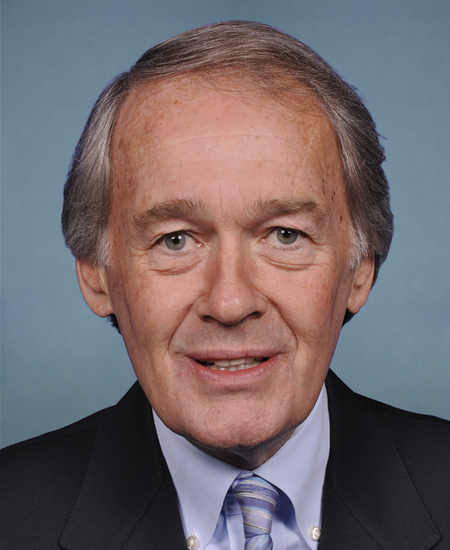
Sen. Edward J. Markey
Sponsored bills
Work Opportunities and Resources to Keep Nonprofit Organizations Well Act or the WORK NOW Act This bill requires the Department of the Treasury to establish a grant program to provide emergency relief to certain nonprofit organizations, prioritizing organizations that provide services related to the COVID-19 (i.e., coronavirus disease 2019) pandemic. Organizations receiving funding must use not less than 60% of these funds to hire former and new employees.
COVID - 19 Hate Crimes Act This bill requires a designated officer or employee of the Department of Justice (DOJ) to facilitate the expedited review of COVID-19 (i.e., coronavirus disease 2019) hate crimes and reports of COVID-19 hate crimes. It defines COVID-19 hate crime as a violent crime that is motivated by two things: (1) the actual or perceived characteristic (e.g., race or ethnicity) of any person, and (2) the actual or perceived relationship to the spread of COVID-19 of any person because of that characteristic. The bill requires DOJ to issue guidance for state and local law enforcement agencies on how to establish online hate crime reporting processes in multiple languages and how to expand culturally competent education campaigns. Additionally, DOJ and the Department of Health and Human Services must issue guidance on best practices for mitigating racially discriminatory language in describing the COVID-19 pandemic.
Educational Equity Challenge Grant Act of 2021 This bill establishes a program through which the Department of Education must award grants to eligible entities (e.g., state and local educational agencies) to address students' academic, social, emotional, mental, behavioral, and physical health needs related to the COVID-19 (i.e., coronavirus disease 2019) pandemic.
This bill requires that the provision of Wi-Fi access on school buses be made eligible for support under the E-Rate program, which allots broadband discounts to schools and libraries.
This resolution recognizes the centennial of the Tulsa Race Massacre of 1921. The resolution acknowledges the historical significance of this event as one of the largest single instances of state-sanctioned violence against Black people in American history; honors the lives and legacies of the estimated 300 Black individuals who were killed during the massacre and the nearly 9,000 who were left homeless and penniless; condemns efforts to cover up the truth and shield the white community, especially government officials, from accountability; condemns the continued legacy of racism and white supremacy against Black people in the United States, particularly in the form of police brutality; encourages education about the massacre, the history of white supremacy that fueled the massacre, and subsequent attempts to deny or cover up the massacre, in all elementary and secondary education settings and in institutions of higher education; and recognizes the commitment of Congress to acknowledge and learn from the history of racism and racial violence to reverse the legacy of white supremacy and fight for racial justice.
Hello Girls Congressional Gold Medal Act of 2021 This bill provides for the award of a single Congressional Gold Medal in honor of the female telephone operators of the Army Signal Corps, commonly known as the Hello Girls , in recognition of their military service, devotion to duty, and 60-year struggle for veterans' benefits and recognition as soldiers.
Enhancing North Korea Humanitarian Assistance Act This bill addresses humanitarian concerns related to sanctions on North Korea. The Office of Foreign Assets Control shall take one or more specified actions relating to U.S. sanctions on North Korea, such as (1) expanding the current humanitarian exception to such sanctions to include items that meet basic human needs and are not subject to the Export Administration Regulations, or (2) exempting certain nonsensitive items for humanitarian operations from specific licensing requirements. For the purposes of such sanctions, personal computers for authorized humanitarian activities by nongovernmental organizations shall not be considered luxury goods. The Department of State shall direct the U.S. representative to the United Nations (UN) to urge the UN to (1) make it less burdensome for nongovernmental organizations to apply for humanitarian exemptions to UN sanctions on North Korea, and (2) speed up approval for such applications. The State Department shall devise a strategy to expedite and simplify the process for U.S. passport holders to obtain permission to travel to North Korea to provide humanitarian assistance.
Connecting America's Active Transportation System Act This bill directs the Department of Transportation (DOT) to carry out an active transportation investment program to provide competitive grants to state, local, and regional government entities, and Indian tribes to construct projects that connect walking and bicycling infrastructure within and between communities, metropolitan regions, or states. The bill sets forth various limitations on the use of funds by DOT, including that it must obligate at least 30% of funds to projects that connect people with public transportation, businesses, workplaces, schools, residences, recreation areas, and other community activity centers; set aside at least $3 million to provide planning grants for eligible entities; and set aside at least $2 million to cover the costs of administration, research, technical assistance, communications, and training activities under the program. The federal share of grants must not exceed 80% of the total project cost. However, DOT may increase the federal share to 100% for disadvantaged communities with a poverty rate of over 40%.
Tar Sands Tax Loophole Elimination Act This bill expands the definition of crude oil for purposes of the excise tax on petroleum and petroleum products to include any bitumen or bituminous mixture, any oil derived from a bitumen or bituminous mixture (tar sands), and any oil derived from kerogen-bearing sources (oil shale). The bill also authorizes the Department of the Treasury to classify as crude oil or as a petroleum product subject to such tax any fuel feedstock or finished fuel product transported by pipeline, vessel, railcar, or tanker truck if (1) such classification is consistent with the definition of oil under the Oil Pollution Act of 1990, and (2) such fuel feedstock or finished fuel product is produced in sufficient commercial quantities as to pose a significant risk of hazard in the event of a discharge.