

Maddy summaryThe VSAFE Act of 2025 creates a new "Veterans Scam and Fraud Evasion Officer" within the Department of Veterans Affairs to combat fraud targeting veterans. This position serves as the central point of contact for veterans, families, and caregivers, responsible for developing fraud prevention communication, training VA staff, promoting the VSAFE Fraud Hotline and website, and coordinating with agencies like the IRS and DOJ. The bill requires the officer to monitor fraud metrics, establish consistent guidance for identifying and reporting scams, and consult with veterans' organizations. It does not authorize new full-time staff and includes a minor extension of a pension payment deadline (Section 3).
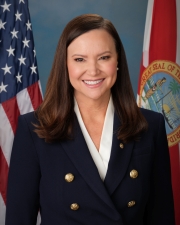
Sen. Ashley Moody
Sponsored bills
Maddy summaryThis bill requires federal agencies to report annually on major projects that are either significantly delayed or exceed their original budget by over $1 billion. Covered agencies (including Executive departments and independent regulatory bodies) must submit detailed reports for each "covered project," including cost changes, schedule delays, contractor information, and explanations for budget overruns. The Office of Management and Budget will compile these reports into a public annual document for Congress and the public. The bill does not change funding or stop projects - it only mandates transparency about large-scale federal spending.
Maddy summaryThis bill, titled the Land Grant Research Prioritization Act of 2026, amends existing federal agricultural law to establish specific research and extension grant priorities for land-grant universities. It directs funding toward four main areas: advanced mechanized harvesting technologies, particularly for specialty crops; artificial intelligence applications in agriculture to improve specialty crop production; methods for managing and eradicating invasive plant and animal species; and aquaculture techniques for valuable aquatic species. The legislation allows the Secretary of Agriculture to prioritize grants in these areas when awarding funding to land-grant institutions for research and extension projects.
Maddy summaryThis bill amends the Higher Education Act to recognize home-schooled students as high school graduates for federal student aid eligibility. It changes the definition in Section 484(d) to state that a student completing secondary education in a home school setting treated as a home or private school under state law is considered a high school graduate. This directly affects home-schooled students seeking federal financial aid for college. The key provision is a new definition that removes prior barriers to eligibility based on educational setting, aligning federal recognition with state-level home school classifications.
Maddy summaryThe SHARKED Act of 2025 establishes a 7-year task force under the Commerce Secretary to address shark interactions with fishing operations and humans. The task force, including fishery council representatives, shark behavior researchers, and state agencies, will identify research priorities (like causes of increased shark interactions and non-lethal deterrents), develop management strategies, and create educational materials for fishermen. It amends the Magnuson-Stevens Act to fund specific shark depredation research projects focused on reducing harmful interactions. The bill directly affects coastal fisheries managers, researchers, and fishing communities by directing coordinated action on shark-human interactions, without altering existing protections under the Endangered Species Act.
Maddy summaryThis bill, known as the TAP Promotion Act, would allow representatives from recognized veterans service organizations to join presentations that inform service members about benefits they can access after leaving the military. These presentations are part of the Transition Assistance Program, which helps veterans prepare for civilian life, and the law requires that they be standardized and approved by the Department of Veterans Affairs before being used. The bill also mandates that the presentations include information on how veterans service organizations can help with filing benefit claims, while prohibiting any effort to encourage members to join a specific organization. Additionally, the Department of Veterans Affairs must submit an annual report to Congress detailing which organizations participated in these sessions and how many service members attended.
Maddy summaryS 3922, the Traditional Cigar Manufacturing and Small Business Jobs Preservation Act of 2026, exempts specific types of cigars from most FDA regulations under the Federal Food, Drug, and Cosmetic Act. It directly affects traditional cigar manufacturers who produce cigars meeting strict criteria: 100% tobacco leaf construction (no filters or non-tobacco parts), weighing at least 6 pounds per 1,000 cigars, and made by hand or with limited machinery. The bill defines "traditional large and premium cigars" to exclude cigarettes and little cigars while ensuring these products are not subject to new FDA rules. This change aims to preserve jobs in the small business cigar manufacturing sector by reducing regulatory burden. The bill does not alter existing rules for other tobacco products.
Maddy summarySRES 607 is a non-binding Senate resolution commemorating the eighth anniversary of the February 14, 2018, mass shooting at Marjory Stoneman Douglas High School in Parkland, Florida, which killed 17 people. The resolution expresses the Senate's condolences to the victims' families, honors survivors, recognizes the Parkland community's resilience, and thanks first responders. It has no policy impact or funding provisions - it solely serves as a symbolic gesture of remembrance. The resolution was introduced on February 12, 2026, by Senators Scott of Florida and Moody.
Maddy summaryThe FUTURES Act (S 3855) establishes a formal U.S.-Israel Defense Technology Cooperation Initiative to accelerate joint development and integration of defense technologies. It directs the U.S. Secretary of Defense to identify Israeli-origin technologies for rapid adoption into American military systems, focusing on areas like counter-drone systems, missile defense, AI, cyber security, and directed energy. The bill authorizes $150 million annually (2027-2029) for this initiative, requiring regular reports to Congress on progress, technology transitions, and industry partnerships. This policy directly affects U.S. defense contractors, Israeli defense firms, and military acquisition programs by creating new pathways to incorporate Israeli innovations into U.S. systems.
Maddy summaryThis bill prohibits new oil and gas exploration, development, and production in specific offshore areas along Florida, Georgia, and South Carolina coasts. It bans leasing for these activities from enactment until June 30, 2032, covering the Eastern Gulf of Mexico (per the 2006 Gulf of Mexico Energy Security Act), the South Atlantic Planning Area, and the Straits of Florida Planning Area. Existing leases issued before the bill's enactment remain unaffected. The bill directly affects oil and gas companies seeking permits in these designated coastal zones.