

Help Students Vote Act This bill addresses voter registration of students who attend institutions of higher education (IHEs) that participate in federal student-aid programs. The bill also directs IHEs to use a specified portion of federal work-study grants to compensate students for civic engagement activities. Specifically, the bill (1) requires IHEs to make every reasonable effort to distribute voter registration applications to each of their students at least twice a year, (2) authorizes grants to IHEs that greatly exceed the requirements governing the distribution of voter registration applications, and (3) allows civil actions against IHEs that violate the requirements. In addition, the bill requires IHEs to use a specified portion of federal work-study grants to compensate students who are employed in civic engagement activities, including voter registration, nonpartisan voter engagement, and voter participation work.
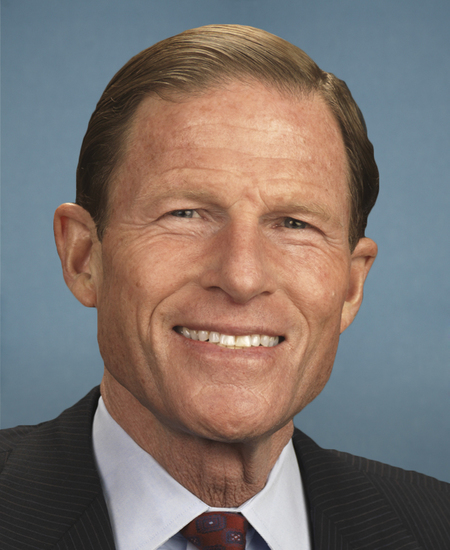
Sen. Richard Blumenthal
Sponsored bills
Equal Access to Abortion Coverage in Health Insurance Act of 2021 or the EACH Act of 2021 This bill requires federal health care programs to provide coverage for abortion services and requires federal facilities to provide access to those services. The bill also permits qualified health plans to use funds attributable to premium tax credits and reduced cost sharing assistance to pay for abortion services.
Jeanette Acosta Invest in Women's Health Act of 2021 This bill directs the Department of Health and Human Services to establish a series of programs to increase access to cancer screenings for women. These programs include demonstration projects to train certain health care providers to screen for breast and cervical cancer, and increase co-testing of human papillomavirus (HPV) and cervical cancer among populations that have disproportionate rates of cervical cancer.
Break Free From Plastic Pollution Act of 2021 This bill sets forth requirements and incentives to reduce the production of a variety of products and materials, including plastics, and increase efforts to collect, recycle, or compost products and materials. The bill makes certain producers of products (e.g., packaging, paper, single-use products, beverage containers, or food service products) fiscally responsible for collecting, managing, and recycling or composting the products after consumer use. In addition, the bill establishes (1) minimum percentages of products that must be reused, recycled, or composted; and (2) an increasing percentage of recycled content that must be contained in beverage containers. Beginning on January 1, 2023, the bill phases out a variety of single-use products, such as plastic utensils. The bill also sets forth provisions to encourage the reduction of single-use products, including by establishing programs to refund consumers for returning beverage containers and by establishing a tax on carryout bags. The bill creates a temporary moratorium on new or expanded permits for certain facilities that manufacture plastics until regulations are updated to address pollution from the facilities. The Environmental Protection Agency (EPA) must publish guidelines for a national standardized labeling system for recycling and composting receptacles. Producers must include labels on their products that are easy to read and indicate whether the products are recyclable, compostable, or reusable. The EPA must also ensure that certain clothes washers have filtration units as required by this bill. Finally, the bill establishes limitations on the export of plastic waste to other countries.
This bill requires the Joint Committee on the Library to enter into an agreement to obtain a statue of Shirley Chisholm, the first African American woman elected to Congress. The committee shall place the statue in a permanent public location in the U.S. Capitol.
Baby Food Safety Act of 2021 This bill imposes certain safety requirements on infant and toddler food. The bill establishes maximum levels of certain toxic elements (cadmium, and lead, mercury, and inorganic arsenic) allowable in infant and toddler food, defined as food intended to be sold for children up to 36 months old. The Food and Drug Administration (FDA) shall periodically review and, if necessary, further lower these levels. The FDA may also establish limits on other toxic elements upon review of relevant health and dietary data. Furthermore, facilities that manufacture, process, pack, or hold infant and toddler food must have certain controls and plans to ensure that their food complies with the limits on toxic elements established by this bill. Such facilities shall also make publicly available certain information, including results from tests for toxic elements in their infant and toddler foods. The bill also expands the FDA's authority to require a recall of adulterated or misbranded food to include infant and toddler food that exceeds limits on toxic elements. The Centers for Disease Control shall carry out a public awareness campaign about the risks of toxic elements in infant and toddler food. The FDA shall commission research on agricultural methods that minimize levels of toxic heavy metals in crops.
This bill makes changes to facilitate data sharing between the Supplemental Nutrition Assistance Program (SNAP) and programs that subsidize communication services to verify eligibility for applicable programs. Specifically, the Federal Communications Commission (FCC) must award grants to states and tribes for establishing or modifying connections between databases with information regarding benefit programs (e.g., SNAP) and the National Lifeline Eligibility Verifier to verify eligibility for the Lifeline program (which subsidizes telephone and internet services for low-income individuals) and the Emergency Broadband Benefit Program (which subsidizes broadband services for those who suffered income loss during the COVID-19 pandemic and other eligible households). The bill also reauthorizes through FY2026 the fund that supports the Emergency Broadband Benefit Program. In addition, the FCC must establish an automated connection to share data between the National Lifeline Eligibility Verifier and the National Accuracy Clearinghouse for SNAP. The FCC must coordinate with the Department of Agriculture to establish the connection.
Tax Assistance for Crumbling Foundations Act This bill repeals the tax rule in effect through 2025 that limits the deduction for personal casualty losses to losses attributable to a federally declared disaster.
Aid to Homeowners with Crumbling Foundations Act of 2021 This bill requires the Department of Housing and Urban Development to provide grants for states to assist residential building owners in repairing or replacing concrete foundations that have deteriorated due to pyrrhotite (an iron sulfide mineral).
Gun Records Restoration and Preservation Act This bill amends several appropriations laws to remove limitations on the authority of the Bureau of Alcohol, Tobacco, Firearms and Explosives to conduct activities related to the administration of federal firearms laws. Specifically, the bill removes provisions that limit the use of firearms tracing data, limit the disclosure of data under the Freedom of Information Act, prohibit imposing a requirement that gun dealers conduct a physical inventory, prohibit consolidating or centralizing records maintained by federal firearm licensees (e.g., gun dealers), and require national instant criminal background check records to be destroyed within 24 hours.