

Global Magnitsky Human Rights Accountability Extension Act This bill extends through December 31, 2034, the authority of the President to impose sanctions on foreign persons involved in certain gross violations of internationally recognized human rights and significant acts of corruption.
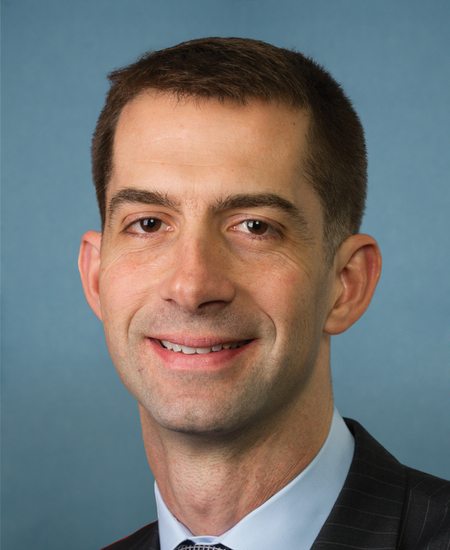
Sen. Tom Cotton
Sponsored bills
This joint resolution nullifies the rule titled Patient Protection and Affordable Care Act; Updating Payment Parameters, Section 1332 Waiver Implementing Regulations, and Improving Health Insurance Markets for 2022 and Beyond , which was issued by the Centers for Medicare & Medicaid Services and the Department of the Treasury on September 27, 2021. The rule expands the open enrollment period for individual health coverage and rescinds the previous interpretation of certain requirements relating to Section 1332 waivers (also known as State Innovation Waivers or State Relief and Empowerment Waivers).
Military Spouse Hiring Act This bill expands the Work Opportunity Tax Credit (WOTC) to include the hiring of a qualified military spouse. (The WOTC permits employers who hire individuals who are members of a targeted group such as qualified veterans, ex-felons, or long-term unemployment recipients to claim a tax credit equal to a portion of the wages paid to those individuals.) A qualified military spouse is any individual who is certified by the designated local agency as being (as of the hiring date) a spouse of a member of the Armed Forces.
Employee Rights Act This bill makes various changes with respect to the collective bargaining process and labor relations. For example, the bill permits an employer to refuse to collectively bargain with a union within 90 days prior to the expiration of a collective bargaining agreement if the employer receives evidence that the majority of the employees in the bargaining unit do not support the union. The bill requires support from a majority of the employees in the bargaining unit (not just a majority of the employees voting) when electing union representation. The bill also requires unions to provide bargaining unit employees with the right to vote by secret ballot, including when voting whether to engage in a strike or refusal to work. Further, union dues, fees, assessments, and other contributions may be used for only collective bargaining or contract administrative functions. Additionally, the bill establishes a process for nullifying executive orders that the Office of Management and Budget determines are likely to result in an employer ordering a plant closure or mass layoff.
This bill revokes certain waivers of sanctions relating to Iran's nuclear activity, including for (1) the modernization or redesign of the Arak reactor, and (2) the preparation or modification of centrifuge cascades at the Fordow facility. The bill also prohibits the President from issuing a new waiver relating to such activities.
This joint resolution nullifies the rule issued by the Centers for Disease Control and Prevention on February 3, 2021, that requires the use of face masks on planes, trains, buses, and other public conveyances and at transportation hubs to prevent the transmission of COVID-19.
"Six Triple Eight" Congressional Gold Medal Act of 2021 This bill provides for the award of a Congressional Gold Medal to the women of the 6888th Central Postal Directory Battalion (commonly known as the Six Triple Eight) in recognition of their pioneering military service, devotion to duty, and contributions to increase the morale of personnel stationed in the European theater of operations during World War II.
Ukraine Supplemental Appropriations Act, 2022 This bill provides FY2022 supplemental appropriations for various activities related to Ukraine, including funding for the Department of Energy to respond to the situation in Ukraine, assistance for refugees from Ukraine, and assistance to Ukraine through the Foreign Military Financing Program.
Defending American Courts Act This bill imposes limitations relating to a person (i.e., individual or entity) that seeks to use an injunction from a foreign tribunal to restrict a patent infringement claim in the United States. For example, if the person asserting such a foreign injunction has been found liable for patent infringement in a U.S. court, that court shall, with certain exceptions, make specified presumptions that generally increase the likelihood of the court (1) increasing the damages awarded in the case, and (2) awarding attorney fees to the patent owner.
This resolution condemns violence and threats of violence against historically Black colleges and universities (HBCUs) and reaffirms the federal government's commitment to combating violence against HBCU students, faculty, and staff.