

Tree Spiking Mitigation Act of 2021 This bill directs the Forest Service and the Bureau of Land Management (BLM) to coordinate to take necessary actions to ensure the detection, identification, and, as determined to be appropriate, mitigation of tree spiking devices located on federal lands. A tree spiking device includes spikes, nails, or other objects hammered, driven, fastened, or otherwise placed into or on any timber to impede logging. To carry out such activities, the Forest Service and the BLM shall prioritize areas in which (1) incidences of tree spiking devices have occurred, or (2) the Forest Service and the BLM suspect that there are tree spiking devices. No later than 90 days after the enactment of this bill, the Forest Service and the BLM shall, where appropriate, update safety guidelines and training protocols to include the awareness, detection, identification, and mitigation of tree spiking devices.
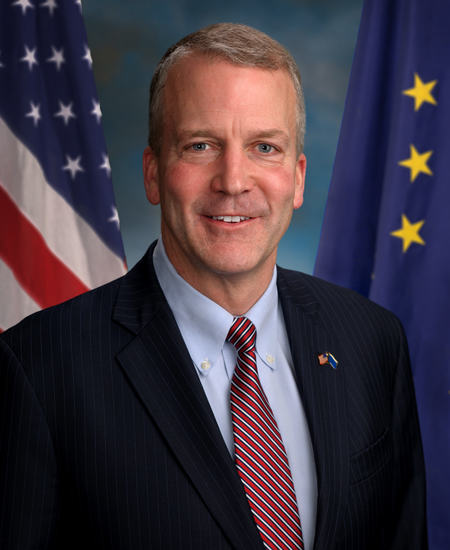
Sen. Dan Sullivan
Sponsored bills
Tribal Economic Development Act of 2021 This bill amends provisions relating to tribal economic development (TED) bonds issued to promote community development projects in Alaskan Indian tribal areas. Specifically, the bill increases the national tribal economic development bond limitation to $4 billion. It also eliminates the requirement that TED bond proceeds be used solely on Indian reservations and permits bond proceeds to be used for economic development by any qualified Native user which includes any tribal entity, Alaska Native Corporation, and entity that is majority-owned and controlled by an Indian tribe or Alaska Native Corporation. The bill also allows third parties to guarantee the repayment of TED bonds.
This bill treats certain disability payments and other payments made by Indian tribes or Native Corporations to children as the earned income of such children. This exempts such income from the kiddie tax which taxes the unearned income of children at the parent's marginal tax rate.
Guaranteeing Healthcare Access to Personnel Who Served Act This bill addresses the administration and provision of health care to veterans through the Department of Veterans Affairs (VA) and non-VA providers. First, the bill provides statutory authority for the eligibility thresholds for when a veteran must receive non-VA care under the Veterans Community Care Program (VCCP) for primary care, mental health care, noninstitutional extended care services, specialty care, or specialty services. Additionally, the bill establishes access to care standards for non-VA care under the VCCP, meaning a veteran's appointment must be within specified distances and time frames. Among other requirements, the VA must also implement an 18-month pilot program to allow certain veterans to use a website or mobile application to request, schedule, and confirm medical appointments with VCCP providers; ensure that VCCP third party administrators and credentials verification organizations comply with specified requirements to help ensure that certain health care providers are excluded from providing non-VA health care services; develop a strategic plan to ensure the effectiveness of the telehealth technologies and modalities delivered by the VA; and establish an online health care education portal for veterans. The bill requires the Government Accountability Office to report on (1) the VA program under which third parties provide transportation for veterans who are seeking VA services or benefits, (2) VA telehealth services, and (3) the VA's Foreign Medical Program. Finally, the Paperwork Reduction Act does not apply to the voluntary collection of information during research conducted by the Veterans Health Administration.
Safeguard Tribal Objects of Patrimony Act of 2021 This bill prohibits the exportation of Native American cultural items and archaeological resources that were illegally obtained; provides for the return of such items, including voluntary returns; and establishes and increases related criminal penalties. The bill requires the Department of the Interior and the Department of State to each designate a liaison to facilitate and hold trainings and workshops on the voluntary return of human remains and cultural items. Additionally, Interior must refer individuals and organizations to Indian tribes and Native Hawaiian organizations to facilitate the voluntary return of human remains and cultural items; convene an interagency working group; and convene a Native working group consisting of representatives of Indian tribes and Native Hawaiian organizations to provide advice on issues concerning the return of, and illegal trade in, human remains and cultural items. The bill also increases from 5 years to 10 years the maximum prison term for an individual convicted of selling, purchasing, using for profit, or transporting for sale or profit human remains or cultural items that were illegally obtained.
Certainty for General Aviation Pilots Act of 2021 This bill deems that individuals who provide flight instruction or testing (including phased testing of experimental aircraft) are not operating an aircraft carrying persons or property for hire. Under current law, individuals must generally obtain a regulatory exemption or other authority to deviate from regulatory requirements to provide compensated flight training or testing.
Bree's Law This bill reauthorizes through FY2026 certain adolescent health demonstration projects, and it changes their focus from reducing violence among minority males to reducing teen dating violence. The bill also establishes an interagency work group to examine and report on federal efforts for reducing and preventing teen dating violence.
This resolution designates June 2021 as National Post-Traumatic Stress Awareness Month and June 27, 2021, as National Post-Traumatic Stress Awareness Day. The resolution supports (1) the education of members of the Armed Forces, veterans, their families, and the public about post-traumatic stress; and (2) efforts by the Department of Veterans Affairs and the Department of Defense to foster cultural change around the issue of post-traumatic stress. The resolution also encourages the leadership of the Armed Forces to support treatment of members of the Armed Forces who suffer from post-traumatic stress.
Securing the Homeland from International Entrants with Life-threatening Diseases Act or the SHIELD Act This bill suspends for one year the admission and parole into the United States of certain categories of individuals who are from or were recently in a country that fails to meet certain criteria related to COVID-19. This restriction applies to certain individuals entering the United States from Mexico or Canada through a port of entry or U.S. Border Patrol station and (1) whose country of origin has not been categorized by the Centers for Disease Control and Prevention as a low-risk country for COVID-19, or (2) who was in such a country at any time in the 30 days before arriving in the United States. The bill exempts certain individuals from this restriction, including U.S. citizens and lawful permanent residents, members of the Armed Forces, and persons from a foreign country who arrive at a designated port of entry with valid travel documents. The Department of Homeland Security shall transport barred individuals to a foreign location, such as an individual's country of origin, to the extent practicable.
Federal Permitting Reform and Jobs Act This bill revises and makes permanent Title 41 of the Fixing America's Surface Transportation (FAST) Act, commonly known as FAST-41. FAST-41 revised the environmental review and permitting process to expedite certain infrastructure projects.