Maddy summaryThe Firearm Freedom Act of 2026 removes the federal ban on the possession and transfer of machineguns by repealing a specific section of the United States Code. This change would allow individuals who currently possess these weapons to keep them and would enable the legal transfer of machineguns between private citizens. The bill directly affects existing owners of machineguns and would alter the rules governing how these firearms can be sold or given away. By eliminating this restriction, the legislation aims to expand the types of firearms that are legally transferable under federal law.
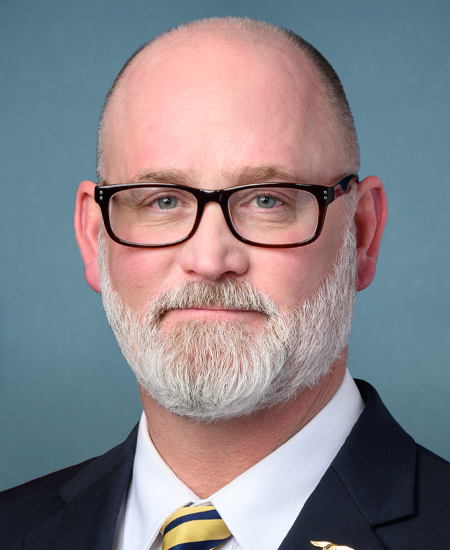
Rep. Derrick Van Orden
Sponsored bills
Maddy summaryThis bill authorizes the U.S. Mint to produce commemorative $5 gold and $1 silver coins marking the 25th anniversary of the September 11, 2001, terrorist attacks. The coins must feature designs honoring victims and first responders (including the inscription "Never Forget") and will be sold only during 2027-2028. All surcharges ($35 per gold coin, $10 per silver coin) collected from sales will fund the National September 11 Memorial and Museum at the World Trade Center, with no net cost to the federal government. The coins are legal tender but primarily intended for collectors, not circulation.
Maddy summaryThe Smithsonian American Women’s History Museum Act authorizes the creation of a new Smithsonian museum dedicated to women’s history, to be located within the National Mall Reserve in Washington, D.C. If the site is managed by another federal agency, the bill requires that agency to transfer the land after notifying Congress and relevant committees. The museum must ensure exhibits and programs accurately represent diverse women’s experiences by consulting a broad range of experts and community voices. The Smithsonian will submit biennial reports to Congress detailing how the museum meets these representation standards.
Hemp Planting Predictability Act This bill extends by two years the implementation of changes to the regulation of hemp products, which reimpose certain federal controls over some hemp products. Specifically, Congress enacted the FY2026 agriculture appropriations act (P.L. 119-37) on November 12, 2025. Effective November 12, 2026, the act modifies the statutory definition of hemp products that are considered to be lawful. This bill extends the effective date to November 12, 2028. As background, the 2018 farm bill excluded hemp from the Controlled Substances Act definition of marijuana and defined hemp . As a result, hemp and hemp-derived products at or below the 0.3% delta-9 tetrahydrocannabinol (THC, the psychoactive component of marijuana) concentration threshold were no longer regulated as Schedule I controlled substances and registration with the Drug Enforcement Administration was no longer required to cultivate or handle hemp and hemp-derived products. However, hemp remained subject to Department of Agriculture and Food and Drug Administration regulation. The 2025 changes to the definition of hemp, include changing the limit to a total THC concentration of not more than 0.3% on a dry weight basis rather than only delta-9 THC, explicitly including industrial hemp, excluding seeds from a cannabis plant that exceed a certain THC concentration, and excluding various types of hemp-derived cannabinoid products. Cannabinoids refer to unique chemical compounds that are found in hemp and marijuana (e.g., THC) and are known to exhibit a range of psychological and physiological effects.

Maddy summaryThis bill modifies the Department of Veterans Affairs' Veterans Readiness and Employment (VR&E) program, which provides job training and education benefits to eligible veterans. It allows the VA to bar certain benefits for veterans convicted of assaulting VA employees and extends VR&E eligibility for some veterans who haven't found employment after training. The bill also sets a $250,000 cap on federal funds for a rehabilitation program, with future adjustments, and requires VA Secretary approval for equipment purchases exceeding $5,000. Additionally, it prevents veterans from concurrently receiving disability compensation based on individual unemployability while participating in a VR&E program and allows subsistence allowances to be based on a veteran's residence in certain cases.
Maddy summaryHR 6802, the CLEAR Act of 2025, blocks the Forest Service from enforcing a specific rule (89 Fed. Reg. 92808, November 25, 2024) related to law enforcement and criminal prohibitions. The bill directly prevents the Department of Agriculture’s Forest Service from implementing or administering this regulation. It does not create new policy but halts enforcement of an existing rule, affecting how the Forest Service operates under that specific provision. The bill is procedural, focusing solely on stopping the rule’s application without altering broader law enforcement authority.
Maddy summaryThe Veterans’ Transition to Trucking Act of 2025 amends the GI Bill to allow the Secretary of Veterans Affairs to approve multi-state trucking apprenticeship programs for veterans using their educational benefits. This directly affects veterans seeking to transition into trucking careers and apprenticeship programs operating across multiple states. The key mechanism changes the law so the Secretary can act as a "State approving agency" for these programs, eliminating the need for separate state approvals. This streamlines access to trucking training without requiring veterans to navigate individual state requirements.
Maddy summaryThis resolution formally recognizes the critical role of the United States Special Operations Forces community in national defense and expresses support for the designation of SOF Week. The bill highlights the specialized training, dangerous missions, and unique contributions of these military units and their families to the nation's security. By passing this measure, the House of Representatives aims to honor the bravery and dedication of SOF personnel while acknowledging the importance of their annual conference.
Maddy summaryThis bill requires the Department of Veterans Affairs (VA) to partner with private sector stakeholders to identify high-growth emerging tech industries (like AI and semiconductors) and relevant training programs for veterans. It mandates the VA to prominently include these opportunities in veterans' transition programs and on its website, and to create a 90-day expedited process for approving qualifying education courses. The bill also updates existing VA programs by replacing "high technology" with "high technology or emerging technology" in key sections, ensuring emerging tech fields are explicitly included. The provisions expire on September 30, 2027.
Maddy summaryThe BEACON Act of 2026 establishes two grant programs to improve treatment for veterans with chronic mild traumatic brain injury (mTBI). It authorizes $30 million over three years for grants to nonprofits, academic institutions, and health providers to develop and test non-drug neurorehabilitation approaches, focusing on mental health outcomes, suicide risk reduction, and long-term recovery. The bill requires grantees to prioritize patient-centered care, conduct clinical studies, and partner with VA facilities, with each grant capped at $5 million annually. A separate $10 million annual program funds independent research on TBI treatments, requiring third-party analysis and annual reports to Congress. The pilot programs expire after three years, with evaluations to determine future expansion.