

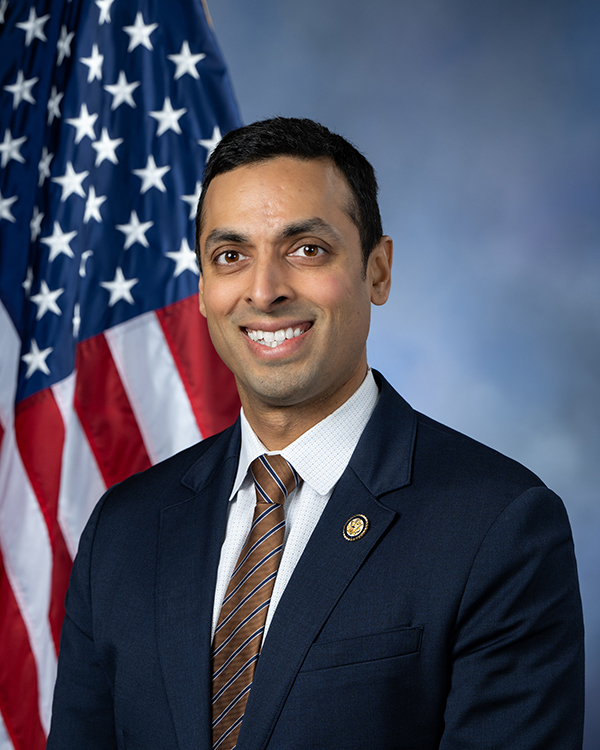
Photo of Suhas Subramanyam
D United States House · District 10 · Virginia On the 2026 ballot

Rep. Suhas Subramanyam

Compare
Total votes
650
all sessions
Attendance
100%
2 missed
Higher than 90% of chamber peers
With party
96%
of cast votes
Near the chamber average
Bipartisan score
2%
crosses aisle rarely
Near the chamber average
Sponsored
426
bills & resolutions
Near the chamber average
Committees
8
assignments
426 bills and resolutions

Sponsored bills

Total
426
Primary
43
Co-sponsor
383
This page
426
matching current filters
Co-sponsor HR 8211
In committee · Oregon House · Co-sponsor
Army Security Agency Monument Act

Maddy summaryThis bill authorizes the placement of a monument at Arlington National Cemetery to honor veterans of the Army Security Agency who served between 1945 and 1976. The monument will be designed with approval from the Secretary of the Army and the National Army Security Agency Association, and the association will be responsible for funding the site preparation, construction, and ongoing maintenance. If no suitable space exists within the cemetery, the monument may be placed outside the entrance instead. The legislation defines the covered service periods using existing legal definitions for World War II, the Korean conflict, and the Vietnam era.

In committee Apr 27, 2026 1 co-sponsor
Primary HR 8493
In committee · Oregon House · Lead sponsor
Peer Support for Our First Responders Act of 2026

Maddy summaryThe Peer Support for Our First Responders Act of 2026 directs the Department of Health and Human Services to create a temporary working group focused on improving mental health support for law enforcement officers and first responders. This group will examine current peer-to-peer behavioral health programs, considering the unique challenges faced by these workers, and develop updated recommendations for Congress on reducing suicide risk and addressing substance use. The committee will include representatives from federal agencies, local governments, and organizations, as well as law enforcement officers and first responders with direct experience in these programs. Within one year of passing, the group must publish a report with evidence-based findings and minimum standards for effective support, then submit specific proposals to Congress on how to integrate these services into broader healthcare systems. The working group will dissolve after completing its report, though the Secretary may request to reconvene it later if new updates are deemed necessary.

In committee Apr 23, 2026 0 co-sponsors
Primary HR 8492
In committee · Oregon House · Lead sponsor
Public Safety UAS Readiness Act

Maddy summaryThe Public Safety UAS Readiness Act establishes a grant program to help fire departments, law enforcement agencies, and emergency medical services train their personnel on operating drones for public safety missions. Funded by up to $10 million annually from 2026 to 2029, these grants can be used to develop training curriculums, purchase compliant drones, and cover administrative costs related to the programs. Recipients must submit detailed plans outlining their safety protocols, risk management strategies, and data privacy measures, with a priority given to agencies in high-risk areas or underserved regions that currently lack drone training capacity. To ensure quality, the act requires that training materials be maintained by recognized nonprofit organizations and mandates annual reporting on the number of trained personnel and drone deployments to Congress.

In committee Apr 23, 2026 0 co-sponsors
Co-sponsor HR 8170
In committee · Oregon House · Co-sponsor
MATCH Act

Maddy summaryThe MATCH Act requires U.S. agencies to align export controls on semiconductor manufacturing equipment with allied nations to prevent adversaries from accessing critical technology. It mandates a 150-day period for diplomatic efforts to secure countrywide denial policies from allied suppliers, after which U.S. jurisdiction would extend to equipment exported from countries not complying with these controls. The bill specifically targets semiconductor manufacturing equipment that the U.S. cannot currently produce in high volume and includes a list of Chinese companies deemed to warrant comprehensive restrictions. If allies fail to implement matching controls, the Act would allow the U.S. to regulate equipment exported from non-compliant allied countries and restrict servicing of restricted items at facilities in adversary nations. The legislation includes a sunset provision that expires five years after enactment, with annual reporting requirements to Congress on progress and compliance.

In committee Apr 22, 2026 1 co-sponsor
Co-sponsor HR 5543
In committee · Oregon House · Co-sponsor
Baltic Security Assessment Act of 2025

Maddy summaryHR 5543, the Baltic Security Assessment Act of 2025, requires the U.S. State and Defense Departments to submit a report within 180 days of enactment. The report will assess emerging military, cyber, hybrid, and political threats to Estonia, Latvia, and Lithuania, including the roles of Russia, Belarus, China, Iran, and other actors. It will also evaluate U.S. and NATO military presence in the region, opportunities for defense cooperation, and recommendations to strengthen deterrence, cybersecurity, and democratic resilience in the Baltic countries. This bill directly affects U.S. foreign policy and defense planning regarding the Baltics, but does not create new programs or funding.

In committee Apr 22, 2026 1 co-sponsor
Primary HR 8427
In committee · Oregon House · Lead sponsor
Congressional Pension Integrity Act of 2026

Maddy summaryThe Congressional Pension Integrity Act of 2026 prohibits Members of Congress from receiving annuity or retired pay based on their service if they are convicted of specific offenses committed while in office. The bill adds a new section to federal law that bars pension payments for individuals convicted of crimes including rape, sexual assault, sexual abuse of a minor, certain sex trafficking offenses, crimes of violence, and various federal crimes related to bribery, elections, theft, fraud, and obstruction of justice. Additionally, the legislation allows for denial of pension benefits if the House of Representatives determines that a Member engaged in sexual misconduct with an officer or employee under their supervision. These provisions apply to current and former Members and their survivors, with the ban taking effect for the Congress following the bill's enactment.

In committee Apr 21, 2026 0 co-sponsors
Co-sponsor HR 7973
In committee · Oregon House · Co-sponsor
Momnibus Act

Maddy summaryThe Momnibus Act is a comprehensive legislative bill designed to improve maternal health outcomes across the United States by addressing social determinants of health, expanding access to care, and reducing disparities among pregnant and postpartum individuals. The bill establishes a federal task force to coordinate efforts between agencies and stakeholders to eliminate preventable maternal mortality and severe morbidity, while providing sustained funding to community-based organizations to address nonclinical factors like housing, nutrition, and transportation. Key provisions include extending WIC eligibility to 24 months postpartum, creating grants to grow and diversify the perinatal workforce, implementing respectful maternity care training for all healthcare employees, and establishing compliance programs to track and address bias in maternity care settings. The legislation also includes specific measures for incarcerated mothers, veterans, and vulnerable populations affected by climate change, alongside funding for maternal mental health services and technology-enabled care models to expand access in underserved areas.

In committee Apr 20, 2026 1 co-sponsor
Co-sponsor HR 7380
In committee · Oregon House · Co-sponsor
IRAN Act

Maddy summaryHR 7380, the IRAN Act, aims to improve internet access for Iranian citizens by directing U.S. agencies to support secure connectivity tools. It requires the State Department to coordinate digital freedom efforts, update strategies to evaluate VPNs and Direct-to-Cell (DTC) technology, and ensure sanctions enforcement doesn’t block these tools for Iranians. The bill also mandates the FCC to prevent licensees from geo-blocking Iran’s satellite/DTC coverage (except for network security) and directs the State Department to report on coverage issues. Additionally, it authorizes $15 million annually for cybersecurity training and digital safety tools for Iranian journalists, activists, and civil society. The law explicitly states it does not override existing sanctions or require U.S. companies to sell services in Iran.

In committee Apr 20, 2026 1 co-sponsor
Co-sponsor HCONRES 40
Failed · Oregon House · Co-sponsor
Directing the President, pursuant to section 5(c) of the War Powers Resolution, to remove United States Armed Forces from hostilities with Iran.

Maddy summaryThis concurrent resolution (HCONRES 40) directs the President to remove U.S. military forces from hostilities with Iran, as required by the War Powers Resolution. It applies directly to U.S. Armed Forces deployed in conflict with Iran, except for forces needed to defend the U.S. or allies from imminent attack. The bill mandates removal unless the President complies with War Powers Resolution reporting requirements for self-defense actions, without needing new congressional authorization. As a procedural resolution, it does not create new law but compels executive action under existing legal framework.

Failed Apr 16, 2026 1 co-sponsor
Co-sponsor HRES 1178
In committee · Oregon House · Co-sponsor
Commemorating the 5-year remembrance of the April 15, 2021, mass shooting at a FedEx Ground facility in Indianapolis, Indiana, and denouncing all forms of anti-Asian hate, including the resurgence of xenophobic and anti-immigrant rhetoric.

Maddy summaryThis resolution commemorates the fifth anniversary of the April 15, 2021, mass shooting in Indianapolis that killed eight people, including four members of the Sikh community, and denounces anti-Asian hate and xenophobic rhetoric. It formally condemns violence and discrimination against South Asian Americans, Arabs, Hindus, Muslims, and Sikhs, while also criticizing white supremacist ideology and anti-immigrant policies. The bill calls for expanded federal hate crime data collection and prevention programs, restoration of immigration processing, and reaffirms the government's commitment to protecting civil rights. As a House resolution, it expresses congressional sentiment and recommendations rather than enacting new laws or regulations.

In committee Apr 15, 2026 1 co-sponsor
Showing 71 to 80 of 426 bills
Previous 1 7 8 9 43 Next