

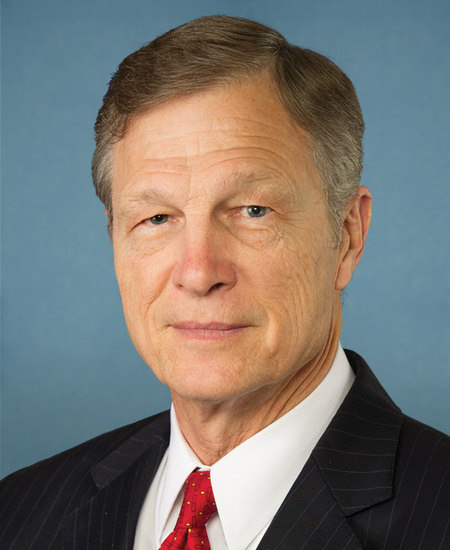
Photo of Brian Babin
R United States House · District 36 · Texas On the 2026 ballot

Rep. Brian Babin

Compare
Total votes
2,818
all sessions
Attendance
98%
63 missed
Near the chamber average
With party
94%
of cast votes
Higher than 75% of chamber peers
Bipartisan score
3%
crosses aisle rarely
Lower than 76% of chamber peers
Sponsored
1,283
bills & resolutions
Near the chamber average
Committees
4
assignments
1,283 bills and resolutions

Sponsored bills

Total
1,283
Primary
44
Co-sponsor
1,239
This page
1,283
matching current filters
Co-sponsor HR 3699
In committee · Oregon House · Co-sponsor
Energy Choice Act

Maddy summaryThis bill prevents state or local governments from banning or restricting energy connections (like installation, modification, or access) based on the type or source of energy, such as electricity, natural gas, or renewable fuels. It directly affects consumers choosing energy providers and energy companies seeking to offer services. The key provision prohibits local laws, regulations, or policies that limit energy services sold in interstate commerce, covering all energy types listed in the bill’s definitions. It does not create new programs but limits regulatory authority at the state or local level. The law aims to ensure open access to diverse energy sources without source-based restrictions.

In committee Feb 4, 2026 1 co-sponsor
Co-sponsor HR 3474
In committee · Oregon House · Co-sponsor
Federal Mechanical Insulation Act

Maddy summaryThis bill amends federal energy conservation law to require federal agencies to consider mechanical insulation as a standard energy-saving measure during building evaluations. It defines "mechanical insulation property" as materials that reduce energy loss in mechanical systems while meeting ASHRAE 90.1 standards, including insulation placed in service with those systems. The law adds mechanical insulation to the list of measures agencies must evaluate for potential installation in federal buildings as part of their required energy and water assessments. This directly affects federal agencies managing buildings, ensuring they formally assess this specific efficiency measure during routine evaluations.

In committee Feb 4, 2026 1 co-sponsor
Co-sponsor HR 2433
In committee · Oregon House · Co-sponsor
Reducing Medically Unnecessary Delays in Care Act of 2025

Maddy summaryThis bill requires Medicare plans (including Medicare Advantage and prescription drug plans) to base coverage decisions on medical necessity and evidence-based standards. It mandates that plans seek input from practicing physicians when creating or changing coverage rules, post all preauthorization requirements online in plain language, and publicly share statistics on approvals and denials. The bill also requires that adverse coverage decisions be made by licensed, board-certified physicians and prohibits denying coverage solely due to lack of evidence-based standards when none exist for a service. These changes aim to reduce unnecessary delays in care for Medicare beneficiaries by increasing transparency and clinical input in coverage decisions.

In committee Feb 4, 2026 1 co-sponsor
Co-sponsor HR 7300
In committee · Oregon House · Co-sponsor
Make Elections Great Again Act

Maddy summaryThe Make Elections Great Again Act (HR 7300) would require voters to present photo identification to cast ballots in person or by mail for federal elections, with limited exceptions for religious objections or military voters. It would establish new requirements for proving U.S. citizenship during voter registration, including documentary proof of citizenship and proof of state residency. The bill would change mail-in ballot procedures by requiring voters to request mail-in ballots (rather than universal mail-in voting), implementing barcode tracking for mail-in ballots, and setting strict deadlines for ballot receipt. These provisions would apply to all states for federal elections held in 2027 or later, affecting how voters register, vote in person, and submit mail-in ballots for federal office elections.

In committee Feb 2, 2026 1 co-sponsor
Co-sponsor HR 7296
In committee · Oregon House · Co-sponsor
SAVE America Act

Safeguard American Voter Eligibility Act or the SAVE America Act This bill requires individuals to provide documentary proof of U.S. citizenship when registering to vote, and requires photo identification to vote, in federal elections. Specifically, the bill prohibits states from accepting and processing an application to register to vote in a federal election unless the applicant presents documentary proof of U.S. citizenship. The bill specifies what documents are considered acceptable proof of U.S. citizenship, such as identification that complies with the REAL ID Act of 2005 that indicates U.S. citizenship. Further, the bill (1) prohibits states from registering an individual to vote in a federal election unless, at the time the individual applies to register to vote, the individual provides documentary proof of U.S. citizenship; and (2) requires states to establish an alternative process to demonstrate U.S. citizenship. Each state must take affirmative steps on an ongoing basis to ensure that only U.S. citizens are registered to vote, which shall include establishing a program to identify individuals who are not U.S. citizens using information supplied by certain sources. Additionally, states must remove noncitizens from their official lists of eligible voters. The bill (1) provides for a private right of action for certain violations, and (2) establishes criminal penalties for certain offenses. Individuals voting in federal elections must present an eligible photo identification document. An individual who votes by absentee ballot must submit a copy of their identification document with both the request for, and the submission of, the absentee ballot.

In committee Jan 30, 2026 1 co-sponsor
Co-sponsor HR 2516
In committee · Oregon House · Co-sponsor
Accreditation for College Excellence Act of 2025

Maddy summaryHR 2516, the Accreditation for College Excellence Act of 2025, prohibits accreditation agencies from requiring colleges to support specific political views, ideologies, or partisan positions. It explicitly prevents agencies from assessing institutions based on their commitment to any ideology or requiring adherence to statements of faith for religious institutions. The bill also limits federal criteria for accreditation to only what is necessary, ensuring colleges comply with their accreditor’s standards - not additional unrelated requirements. This directly affects all colleges seeking federal funding through accredited programs by clarifying permissible accreditation standards.

In committee Jan 13, 2026 1 co-sponsor
Co-sponsor HR 909
Passed · Oregon House · Co-sponsor
Crime Victims Fund Stabilization Act of 2025

Maddy summaryHR 909, the Crime Victims Fund Stabilization Act of 2025, modifies how funds from the False Claims Act are deposited into the Crime Victims Fund. It specifies that from 2025 through 2029, certain False Claims Act proceeds (specifically those for qui tam plaintiff payments and government damage reimbursements) cannot be deposited into the fund. This change directly affects the composition of the Crime Victims Fund by excluding these specific revenue streams during the specified period. The bill does not create new benefits or alter victim services; it only adjusts fund allocation rules for existing False Claims Act revenues.

Passed Jan 13, 2026 1 co-sponsor
Co-sponsor HR 6987
In committee · Oregon House · Co-sponsor
Public Charge Clarification Act of 2026

Maddy summaryThis bill clarifies and expands the definition of "public charge" for immigration purposes, affecting non-citizens applying for visas, admission, or adjustment of status. It defines a public charge as someone receiving certain government benefits (including SNAP, Medicaid, housing assistance, and income support programs) for more than 12 months within any 36-month period. The determination considers factors like age, health, assets, education, and family status in a holistic assessment, while exempting refugees, asylees, and military dependents. The bill requires the government to publish a comprehensive list of covered benefits within 180 days of enactment.

In committee Jan 8, 2026 1 co-sponsor
Co-sponsor HR 6881
In committee · Oregon House · Co-sponsor
WALZ Act

Maddy summaryHR 6881, titled the "WALZ Act" (a satirical placeholder name), is a procedural bill requiring the HHS Inspector General to investigate sudden payment increases in federal health and welfare programs. Specifically, it mandates an automatic investigation if total payments to HHS service providers rise by 10% or more over any six-month period compared to the prior six months. This applies directly to healthcare and social service providers receiving federal funds under HHS-administered programs, focusing solely on triggering an audit process for large payment fluctuations. The bill does not change program benefits or create new policies - it only establishes a procedural review mechanism for significant payment changes.

In committee Dec 18, 2025 1 co-sponsor
Showing 71 to 80 of 1,283 bills
Previous 1 7 8 9 129 Next