

Food Worker Pay Standards Act This bill prohibits the Department of Agriculture from purchasing any meat, meat food product, poultry, poultry food product, or processed food produced by workers in the United States who are compensated at a rate lower than the prevailing rate for wages and fringe benefits for such workers in their locality. The Department of Labor must determine the prevailing rates and in determining such rates shall take into account any applicable existing collective bargaining agreements in the locality. A prevailing rate established pursuant to this bill must not supersede a worker's wages and benefits agreed to in a collective bargaining agreement.
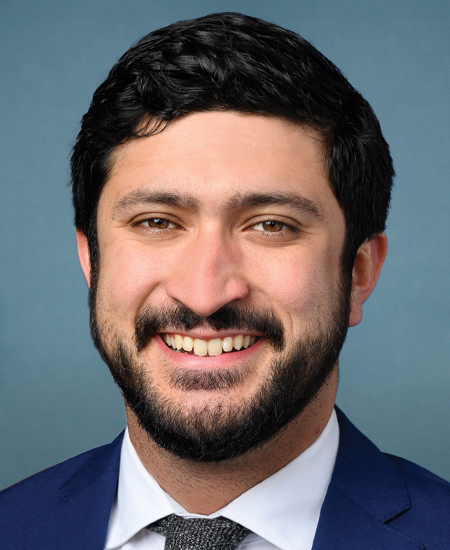
Rep. Greg Casar
Sponsored bills
Maddy summaryThe Unhoused Persons Bill of Rights (HRES 634) is a non-binding congressional resolution that outlines 19 specific civil and human rights for unhoused individuals, including the right to housing, healthcare, access to public facilities, and freedom from discrimination based on housing status. It calls for the federal government to commit to ending homelessness by 2027 through specific policy changes, including $20 billion from the defense budget for housing programs, expanded rental assistance, and improved access to healthcare services. The resolution requires federal agencies to implement measures such as 24-hour shelter access, removal of hostile architecture in public spaces, and improved data collection methods to better address homelessness. It also calls for the Department of Health and Human Services to declare the unhoused crisis a public health emergency and establishes legal protections for unhoused people against discrimination and harassment.
Maddy summaryThe CHARGE Act of 2023 modernizes U.S. electricity transmission planning and cost allocation to better support renewable energy integration and grid reliability. It requires transmission providers to conduct interregional planning every five years, allocate costs based on multiple benefits (including reduced consumer costs, renewable energy access, and grid resilience), and make hourly operational data publicly available. The bill establishes an Office of Transmission within the Federal Energy Regulatory Commission (FERC) and creates an Independent Transmission Monitor to oversee planning processes. These changes aim to reduce costs for consumers, improve grid reliability, and support the transition to cleaner energy sources through concrete regulatory reforms.
Maddy summaryThis bill would reform credit reporting practices by shortening the time negative information stays on consumer credit reports (to 4-7 years instead of 7-10 years), removing medical debt from credit reports, and requiring faster removal of fully paid or settled debts. It would provide credit restoration for victims of predatory mortgage lending, defrauded private education loan borrowers, and those experiencing financial abuse. The bill also expands identity theft protections including 1-year and 7-year fraud alerts, security freezes, and free credit monitoring for certain vulnerable consumers. These changes would directly affect consumers with credit reports, credit reporting agencies, and creditors who rely on credit information for lending and other decisions.
Maddy summaryHJRES 84 designates August 20 as "Slavery Remembrance Day" to commemorate the arrival of the first enslaved Africans in what is now Virginia on August 20, 1619. The resolution urges the President to issue an annual proclamation encouraging Americans to observe the day with ceremonies and activities reflecting on slavery's history. It specifically honors 21 Black Congress members from the Reconstruction Era as honorary cosponsors and calls for acknowledging the enduring impacts of slavery. As a symbolic resolution, it does not create new laws or directly affect any group beyond establishing an annual observance.
Maddy summaryThe ACHE Act requires the National Institute of Environmental Health Sciences to study health impacts of mountaintop removal coal mining on communities near mining sites in Kentucky, Tennessee, West Virginia, and Virginia. It temporarily halts all new federal permits for such mining until a health risk determination is made, while mandating ongoing pollution monitoring (water, air, soil) at existing sites with monthly public reporting. The bill directly affects coal mining companies operating in designated steep-slope regions of those four states. Key provisions include the health study, permit moratorium, and public monitoring requirements, which end once the health risk determination is published.
Maddy summaryThis bill establishes a federal pilot program to help homeless individuals access SNAP (Supplemental Nutrition Assistance Program) benefits. It authorizes $12.5 million annually (2024-2029) to fund grants for community organizations, homeless service providers, and public housing agencies to provide direct outreach, application assistance, transportation to SNAP offices, and staff training. The program specifically targets barriers like lack of documentation and awareness, focusing on helping homeless households enroll in SNAP by connecting them with existing resources. Grantees must report annually on outcomes, including the number of homeless individuals served and enrollment impacts. The pilot runs for up to 5 years, with funds supplementing (not replacing) existing state/local programs.
This concurrent resolution opposes actions that undermine Israel's future as a Jewish, democratic state. The resolution expresses that democracy is at the core of the special relationship between the United States and Israel, and that Congress stands with all Israelis seeking to defend liberal democracy, judicial review, and independent political institutions.
Maddy summaryThis bill aims to reduce corporate concentration in agriculture by imposing a moratorium on large agribusiness mergers and requiring retroactive review of past mergers that may have harmed competition. It mandates that large meatpackers purchase at least 50% of livestock through spot market sales from nonaffiliated farmers, restores mandatory country of origin labeling for beef, pork, and dairy products, and increases funding for beginning, retiring, and socially disadvantaged farmers. The legislation targets unfair practices by large processors and retailers, requiring transparency in pricing and preventing anti-competitive behavior that has driven down farmer income. It directly affects small-scale farmers, ranchers, and rural communities by strengthening their bargaining power in agricultural markets. The bill's provisions aim to reverse decades of consolidation that have driven down farmer income while increasing food prices for consumers.
Maddy summaryHR 4987, the Democracy Restoration Act of 2023, would restore voting rights for people with felony convictions who are living in their communities (not incarcerated), directly affecting approximately 4.6 million disenfranchised Americans. The bill requires states to automatically restore voting rights upon completion of sentences, including probation or parole, without requiring payment of fines or fees. It mandates notification to individuals about their restored voting rights and prohibits states from conditioning voting rights on payment of legal financial obligations. The legislation addresses the disproportionate impact of voting restrictions on racial minorities, particularly Black and Latino communities, who face significantly higher rates of disenfranchisement. This bill would apply to all federal elections held on or after its enactment date.