Employee Retention Tax Credit Reinstatement Act This bill provides for a reinstatement of the employee retention tax credit through 2021. The credit was established to compensate employers whose businesses were negatively impacted by the COVID-19 pandemic for wages paid to their employees.
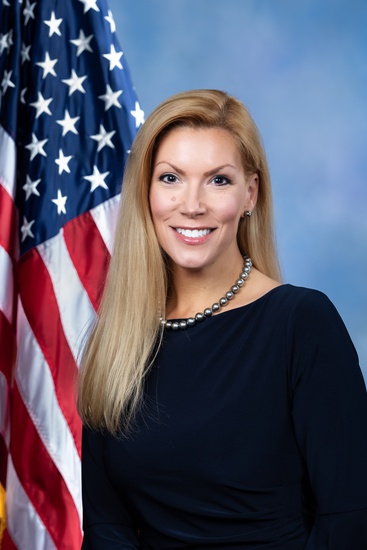
Rep. Beth Van Duyne
Sponsored bills
Eliminating Global Market Distortions to Protect American Jobs Act of 2021 This bill addresses unfair trade practices by making various changes to U.S. antidumping and countervailing duty law. Antidumping provides relief to U.S industries and workers that are materially injured or threatened with injury due to imports of like products sold in the U.S. market at less than fair value, while countervailing duty provides such relief from imports of products subsidized by a foreign government or public entity. Specifically, the bill establishes a process for successive antidumping and countervailing duty investigations. Successive investigations may be concurrent (an ongoing investigation of the same product from different countries) or recently completed (not more than two years before the date of the initiation of the successive investigation). Further, the bill establishes a time line for the Department of Commerce to issue determinations in successive investigations. Among other provisions, the bill authorizes Commerce to apply countervailing duty law to subsidies provided by a foreign government or public entity to a company operating in a different country, use another method for calculating the cost of production in specific circumstances, and require importers to provide a certification that the imported merchandise is not subject to an antidumping or countervailing duty order. Additionally, the bill establishes procedures for Commerce to conduct circumvention inquiries, including by specifying the deadlines for preliminary and final determinations. The bill repeals the Softwood Lumber Act of 2008, which addresses the importation of softwood lumber and softwood lumber products.

Parents Bill of Rights Act This bill outlines various rights of parents and guardians regarding the elementary or secondary school education of their children. Among other requirements, the bill (1) directs local educational agencies to publicly post the curriculum for each elementary and secondary school grade level; and (2) requires schools to notify parents and guardians of their rights, including the right to review the school's curriculum and budget.
Maddy summaryHR 6020, the Supporting Medicare Providers Act of 2021, extends temporary Medicare payment increases for physicians through 2022 instead of ending them on January 1, 2022. It updates specific dates in Medicare law (Section 1848(t) of the Social Security Act) to maintain current payment rates for doctors treating Medicare patients. This directly affects physicians and clinics participating in Medicare who rely on these temporary payment adjustments. The bill makes no new policy changes but ensures existing payment levels continue for providers during 2022.
This resolution modifies requirements for written statements required of nongovernmental witnesses who appear before standing committees of the House of Representatives. Specifically, the resolution eliminates a requirement that a witness disclose whether they are a fiduciary of an organization or entity that has an interest in the subject matter of the hearing, in favor of a requirement that they disclose whether they are a fiduciary of an entity that has received payments from a specified foreign entity. The resolution also requires nongovernmental witnesses to disclose in their written statement certain contracts with specified foreign persons or entities. If the committee determines that a witness knowingly and willfully failed to truthfully comply with such disclosure requirements, the witness is prohibited from testifying before the committee for three years.
This bill prohibits the Small Business Administration from directly making a loan under the 7(a) Program, which authorizes loans and loan guaranties to small businesses that meet certain requirements.
This joint resolution nullifies a Department of Labor emergency temporary standard for preventing the transmission of COVID-19 in employment settings. Under the standard issued on November 5, 2021, employers with 100 or more employees must require their onsite employees to either be fully vaccinated against COVID-19 or undergo weekly COVID-19 testing.
Maddy summaryThis bill removes a temporary expiration date for telehealth coverage in health insurance plans. It amends two sections of the Internal Revenue Code to permanently allow health plans to cover telehealth services without the prior deadline of December 31, 2021. The key change makes existing telehealth coverage rules permanent for health insurance plans under federal tax law. This directly affects health insurance plans that provide telehealth benefits, ensuring they can continue covering these services without needing to renew temporary provisions. The bill does not change what telehealth services are covered, only makes the coverage rules permanent.
Eliminating Barriers to Rural Internet Development Grant Eligibility Act or the E-BRIDGE Act This bill authorizes the Department of Commerce to award economic development grants for public-private partnerships and certain consortiums to carry out specified broadband projects. Such projects shall be to provide, extend, expand, or improve high-speed broadband service through (1) planning, technical assistance, or training; (2) land acquisition or development; or (3) acquisition, construction, or improvement of facilities. When reviewing grant applications, Commerce must take into account the geographic diversity of grant allocation, including consideration of underserved markets. Title to real or personal property acquired or improved with grant funds, or another acceptable possessory interest, must be vested in a public partner or eligible nonprofit organization or association for the useful life of the project. In addition, Commerce may provide credit toward the nonfederal share of a broadband project's cost.
Advanced Air Mobility Coordination and Leadership Act This bill directs the Department of Transportation to establish an Advanced Air Mobility (AAM) interagency working group to plan and coordinate efforts related to the safety, operations, infrastructure, physical security, cybersecurity, and federal investment necessary to bolster the AAM ecosystem in the United States. Advanced Air Mobility refers to a transportation system that transports people and property by air between two points in the United States using aircraft, including electric aircraft or electric vertical take-off and landing aircraft, in both controlled and uncontrolled airspace.