

Trucker Bathroom Access Act This bill expands access to restroom facilities for certain commercial truck drivers, including drayage truck operators. Drayage truck operator means the driver of any in-use on-road vehicle with a gross vehicle weight rating of greater than 33,000 pounds operating on or transgressing through port or intermodal rail yard property for the purpose of loading, unloading, or transporting cargo, including containerized, bulk, or break-bulk goods. Specifically, the bill requires (1) retailers, warehouses, and other establishments to give commercial truck drivers access to existing restroom facilities when they are loading or delivering cargo; and (2) operators of ports and marine terminals to provide drayage truck operators with access to existing restrooms, additional restrooms if necessary, and parking while accessing such restrooms.
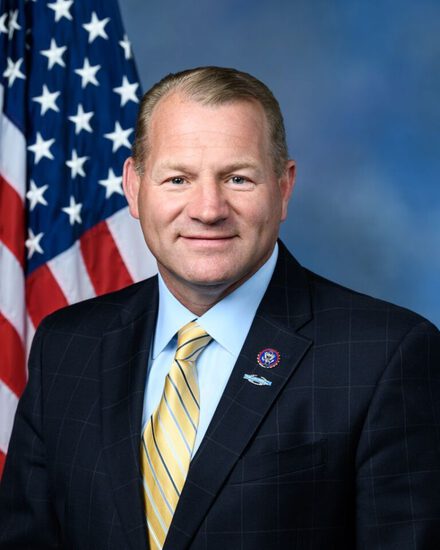
Rep. Troy E. Nehls
Sponsored bills
This joint resolution nullifies the interim final rule issued by the Department of Veterans Affairs (VA) titled Reproductive Health Services and published on September 9, 2022. The rule authorizes the VA to provide certain abortion-related care to veterans. The rule also applies to such care provided to beneficiaries covered under the Civilian Health and Medical Program of the Department of Veterans Affairs (CHAMPVA).
Domestic Preferences for Building America Act This bill prioritizes U.S. contractors with respect to certain federally funded infrastructure projects. Specifically, amounts made available through a program for federal financial assistance may be obligated for an infrastructure project with a value of $100 million or more only if the recipient of such amounts certifies that, in obligating the amounts subject to the occurrence of adequate competition, the recipient shall award contracts only to U.S. persons and qualified U.S. joint ventures; and the recipient shall not award contracts to an entity that is owned or controlled by a corporation based in a country that has been identified as a nonmarket economy country, was included by the U.S. Trade Representative (USTR) on the priority watch list, and is subject to certain monitoring by the USTR.
Truck Parking Safety Improvement Act This bill authorizes appropriations through FY2026 to the Department of Transportation (DOT) to provide parking for commercial motor vehicles on the federal-aid highway system. DOT must provide competitive grants to states, metropolitan planning organizations, local governments, and tribal governments for projects that improve the safety of commercial motor vehicle operators and provide parking for commercial motor vehicles on federal-aid highways or on a facility with reasonable access to such a highway or a freight facility. The federal share for a project carried out in accordance with the bill shall be up to 100%.
Agriculture Foreign Investment Transparency Act This bill revises reporting requirements related to acquisitions or transfers of certain agricultural land interests by foreign persons. Specifically, the bill (1) requires the Department of Agriculture to make all reports required under the Agricultural Foreign Investment Disclosure Act of 1978 (AFIDA) publicly available on its website, and (2) expands the material required to be reported under the AFIDA to include security interests and land leases of any period.
Promoting Local Management of the Lesser Prairie Chicken Act This bill prohibits any population of the lesser prairie-chicken ( Tympanuchus pallidicinctus ) in Kansas, Oklahoma, Texas, Colorado, or New Mexico from being listed as endangered or threatened under the Endangered Species Act of 1973 (ESA). The lesser prairie-chicken is a type of grouse. Currently, two distinct population segments (DPS) of the lesser prairie-chicken are listed under the ESA. The Southern DPS of the lesser prairie-chicken is listed as endangered and the Northern DPS is listed as threatened. The bill removes both populations from the list. In addition, the bill bans Interior from listing any population of the lesser prairie-chicken as endangered or threatened in the future.
Nuclear Regulatory Commission Survey Act or the NRC Survey Act This bill requires the inspector general of the Nuclear Regulatory Commission (NRC) to distribute surveys about NRC's efficiency and effectiveness. The inspector general must first draft and distribute an optional and anonymous survey to NRC's employees. If feasible, the inspector general must also draft and distribute a similar survey to stakeholders in the nuclear industry.
Maddy summaryHR 9314, the "No Federal Funding for Teacher’s Unions Act," prohibits federal funds from being provided to labor organizations whose members are education professionals, such as teachers in elementary, secondary, and higher education institutions. The bill directly affects teacher unions that receive federal funding, banning such support under the defined terms. Key provisions include a clear funding ban on these unions, with "education professionals" and "labor organizations" defined using existing laws from the Elementary and Secondary Education Act and the National Labor Relations Act. This policy change would prevent federal money from flowing to teacher unions for their operations or activities, without altering union membership rights or labor relations.
This joint resolution nullifies the final rule submitted by the Department of Homeland Security titled Public Charge Ground of Inadmissibility published on September 9, 2022. The 2022 final rule nullified an August 14, 2019, final rule. The 2019 final rule made it more likely that a non-U.S. national ( alien under federal law) would be denied admission or lawful permanent resident status because that individual is likely to become a public charge (i.e., receive certain public benefits). This joint resolution restores into effect the nullified 2019 final rule.
Maddy summaryHRES 1114 is a non-binding House resolution expressing support for recognizing "National Police Week" as a way to honor law enforcement officers across the United States. The resolution acknowledges the service and sacrifices of law enforcement officers, particularly those who have died in the line of duty, and specifically references 619 officers who died in 2021 as listed in the resolution. This resolution does not create new laws or allocate funds but serves as a symbolic gesture to encourage public recognition of law enforcement personnel. It calls for Americans to observe National Police Week by honoring officers and raising awareness about their essential role in community safety. The resolution was introduced by multiple members of Congress and referred to the Committee on the Judiciary.