

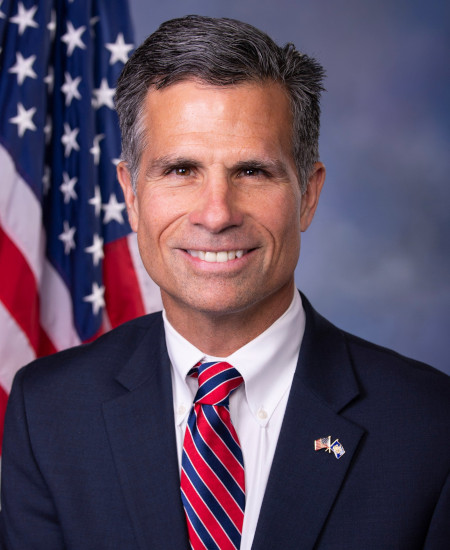
Photo of Daniel Meuser
R United States House · District 9 · Pennsylvania On the 2026 ballot

Rep. Daniel Meuser

Compare
Total votes
2,818
all sessions
Attendance
97%
95 missed
Lower than 80% of chamber peers
With party
96%
of cast votes
Near the chamber average
Bipartisan score
2%
crosses aisle rarely
Near the chamber average
Sponsored
1,140
bills & resolutions
Near the chamber average
Committees
6
assignments
1,140 bills and resolutions

Sponsored bills

Total
1,140
Primary
62
Co-sponsor
1,078
This page
1,140
matching current filters
Co-sponsor HR 1947
In committee · Oregon House · Co-sponsor
TREAT PTSD Act

Maddy summaryThis bill requires the VA and Department of Defense to provide stellate ganglion block therapy to eligible veterans and active-duty military members diagnosed with PTSD who have given informed consent after learning about the treatment's risks and benefits. It applies specifically to veterans enrolled in VA care and service members in the TRICARE program who meet the diagnosis and consent criteria. The bill mandates that VA and DoD update their joint clinical guidelines within 180 days to include this therapy option and its clinical indicators. The policy change takes effect 180 days after enactment, making this therapy a covered benefit through existing VA and military healthcare systems.

In committee Mar 27, 2025 1 co-sponsor
Co-sponsor HR 2369
In committee · Oregon House · Co-sponsor
PHIT Act of 2025

Maddy summaryThe PHIT Act of 2025 allows taxpayers to deduct certain fitness-related expenses as medical costs on their federal tax returns. It directly affects individuals and families who pay for qualifying physical activity programs, such as gym memberships, fitness classes, or approved equipment. Key provisions include setting annual limits ($1,000 per person or $2,000 for joint returns), defining eligible fitness facilities (excluding golf courses or private clubs), and specifying that equipment must be used exclusively for physical activity. The bill amends the Internal Revenue Code to treat these expenses as deductible medical costs, effective for taxable years after its enactment.

In committee Mar 26, 2025 1 co-sponsor
Co-sponsor HR 2350
In committee · Oregon House · Co-sponsor
Cellphone Jamming Reform Act of 2025

Maddy summaryThe Cellphone Jamming Reform Act of 2025 allows state and federal correctional facilities to operate jamming systems that block cell signals from entering or leaving the facility, specifically targeting contraband devices used by inmates. It directly affects prisons and jails by enabling them to disrupt unauthorized wireless communications without FCC approval, provided the jamming is limited to housing areas within the facility. Key requirements include state facilities covering all costs themselves, consulting with local law enforcement before implementation, and notifying the Bureau of Prisons. The law aims to address security risks from smuggled phones while restricting jamming to only necessary areas and requiring transparency.

In committee Mar 26, 2025 1 co-sponsor
Co-sponsor HR 1344
In committee · Oregon House · Co-sponsor
Dennis and Lois Krisfalusy Act

Maddy summaryThis bill amends a provision of law governing eligibility for Department of Veterans Affairs headstones, markers, and burial receptacles. It removes a requirement that a veteran must have died on or after November 11, 1998, to qualify for these burial benefits. By eliminating this date cutoff, the bill expands eligibility to veterans who died before that date. This change would directly affect veterans who died prior to November 11, 1998, and their families, allowing them to receive these burial benefits.

In committee Mar 26, 2025 1 co-sponsor
Co-sponsor HR 2325
In committee · Oregon House · Co-sponsor
CEMAC Act

Maddy summaryHR 2325, the CEMAC Act, requires the U.S. to withhold its voting support at the International Monetary Fund (IMF) for any CEMAC member state until the IMF publicly clarifies that funds paid by oil companies to the Bank of Central African States (BEAC) for site rehabilitation cannot count toward a country's foreign exchange reserves. This directly affects U.S. oil and gas companies operating in the CEMAC region, as the bill aims to prevent CEMAC countries from misusing these restoration funds as reserves - a practice the IMF has not properly addressed. The key mechanism is the U.S. withholding its vote on IMF quota increases or special financial assistance for CEMAC nations until this IMF clarification occurs. The bill does not alter CEMAC's regulation but pressures the IMF to correct a policy that risks billions in oil investment.

In committee Mar 25, 2025 1 co-sponsor
Co-sponsor HJRES 59
In committee · Oregon House · Co-sponsor
Disapproving the rule submitted by the Bureau of Consumer Financial Protection relating to "Overdraft Lending: Very Large Financial Institutions".

This joint resolution nullifies the final rule issued by the Consumer Financial Protection Bureau titled Overdraft Lending: Very Large Financial Institutions and published on December 30, 2024. The rule revises provisions regarding charges for insufficient funds in a customer’s bank account (i.e., overdrafts) at very large financial institutions. Under the rule, these institutions must (1) cap overdraft charges at $5; (2) with justification, cap charges at a higher amount; or (3) handle overdrafts as credit and comply with applicable Truth in Lending Act disclosure requirements.

In committee Mar 21, 2025 1 co-sponsor
Co-sponsor HR 2257
In committee · Oregon House · Co-sponsor
National Fallen Firefighters Memorial Coin Act

Maddy summaryHR 2257 authorizes the U.S. Mint to produce three commemorative coins (a $5 gold coin, a $1 silver coin, and a half-dollar) to honor fallen firefighters, with specific quantity limits and specifications. The bill requires a surcharge ($35 for gold, $10 for silver, $5 for half-dollar) on each coin sold, which is directed entirely to the National Fallen Firefighters Foundation to support its programs. The coins must be issued in 2026, will be legal tender, and the government must recover all costs through sales before distributing funds to the Foundation. This is a commemorative coin program, not a direct legislative policy change affecting broader public programs.

In committee Mar 21, 2025 1 co-sponsor
Co-sponsor HR 1577
In committee · Oregon House · Co-sponsor
Stop Fentanyl Money Laundering Act of 2025

Maddy summaryThis bill gives the Treasury Secretary authority to identify foreign financial institutions or transactions as primary money laundering concerns for fentanyl trafficking, requiring U.S. domestic financial institutions to implement specific anti-money laundering measures. It mandates updated advisories for banks to identify Chinese professional money laundering schemes facilitating fentanyl trafficking, incorporating three existing financial crime advisories. The bill also requires the Financial Crimes Enforcement Network to issue guidance for reporting suspicious transactions linked to transnational criminal organizations trafficking narcotics. These provisions directly affect U.S. banks and financial agencies by imposing new reporting obligations and compliance requirements related to fentanyl-related money laundering.

In committee Mar 21, 2025 1 co-sponsor
Co-sponsor HR 2192
In committee · Oregon House · Co-sponsor
Air America Act of 2025

Maddy summaryThe Air America Act of 2025 authorizes one-time payments of $40,000 to individuals who worked for Air America or its affiliated companies for at least five years during 1950-1976, or to their surviving spouses, children, or dependents. Additional payments of $8,000 per full year beyond five years are allowed. The program is capped at $60 million total funding, with claims required within two years of final regulations. Payments are a single lump sum with no ongoing benefits, and the bill explicitly states it does not create new entitlements beyond this one-time award.

In committee Mar 18, 2025 1 co-sponsor
Co-sponsor HR 2126
In committee · Oregon House · Co-sponsor
FOCA Act of 2025

Maddy summaryThe FOCA Act of 2025 prohibits federal agencies from requiring or banning contractors from using union agreements in construction project bids or contracts. It directly affects federal agencies, contractors, and subcontractors working on federally funded or assisted construction projects (like buildings or infrastructure). The law requires bid documents to not favor or penalize contractors based on whether they have union agreements, aiming to promote open competition and prevent discrimination. This changes how agencies structure bids but does not affect union agreements themselves. The bill applies to all new contracts and subcontracts after enactment, with limited exemptions only for public health/safety emergencies or national security.

In committee Mar 14, 2025 1 co-sponsor
Showing 221 to 230 of 1,140 bills
Previous 1 22 23 24 114 Next