

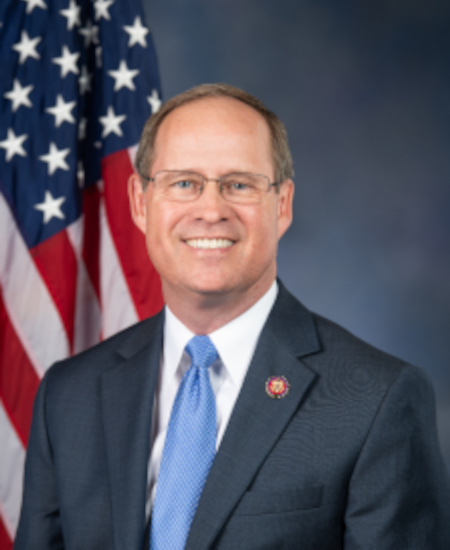
Photo of Gregory F. Murphy
R United States House · District 3 · North Carolina On the 2026 ballot

Rep. Gregory F. Murphy

Compare
Total votes
2,818
all sessions
Attendance
90%
273 missed
Lower than 91% of chamber peers
With party
95%
of cast votes
Higher than 83% of chamber peers
Bipartisan score
3%
crosses aisle rarely
Lower than 83% of chamber peers
Sponsored
821
bills & resolutions
Near the chamber average
Committees
8
assignments
821 bills and resolutions

Sponsored bills

Total
821
Primary
106
Co-sponsor
715
This page
821
matching current filters
Co-sponsor HR 7944
In committee · Oregon House · Co-sponsor
Semi-Trailer Tax Parity Act

Maddy summaryThe Semi-Trailer Tax Parity Act modifies federal tax rules to allow floor plan financing interest rules to apply to semi-trailers and their chassis. This change directly affects businesses that finance semi-trailers for commercial use, such as trucking companies and logistics firms. The bill amends the Internal Revenue Code to include semi-trailers in the category of property eligible for specific interest deduction treatments previously reserved for other types of vehicles. This adjustment ensures that financing costs for semi-trailers are treated similarly to those for other commercial vehicles under existing tax provisions. The policy change takes effect for taxable years beginning after the bill is enacted.

In committee Mar 16, 2026 1 co-sponsor
Primary HRES 1112
In committee · Oregon House · Lead sponsor
Supporting the goals and ideals of "Deep Vein Thrombosis and Pulmonary Embolism Awareness Month".

Maddy summaryHRES 1112 is a symbolic resolution supporting March as "Deep Vein Thrombosis and Pulmonary Embolism Awareness Month" to raise public awareness about these preventable conditions. It directly affects the general public, especially high-risk groups like cancer patients, postpartum individuals, and those with mobility issues, by promoting education on DVT and PE prevention. The resolution has no policy or funding mechanisms - it simply expresses congressional support for awareness efforts and recognizes the significance of addressing these conditions that cause an estimated 60,000-100,000 U.S. deaths annually. As a non-binding resolution, it does not create new laws or alter existing policies.

In committee Mar 12, 2026 0 co-sponsors
Co-sponsor HR 7931
In committee · Oregon House · Co-sponsor
IDA Act of 2026

Maddy summaryThis bill, known as the Improving Dental Administration Act of 2026, would allow certain state laws about dental benefits to override federal rules under the Employee Retirement Income Security Act. It directly affects states that have their own regulations governing dental insurance and benefit plans for employees. The key provision creates an exemption that takes effect 18 months after the bill is enacted, permitting state laws related to dental benefit administration to apply even if they differ from federal requirements. The exemption only applies to state laws that do not conflict with existing federal laws in the Employee Retirement Income Security Act.

In committee Mar 12, 2026 1 co-sponsor
Co-sponsor HR 7863
In committee · Oregon House · Co-sponsor
Promoting Fairness for Medicare Providers Act of 2026

Maddy summaryThis bill, titled the Promoting Fairness for Medicare Providers Act of 2026, changes how Medicare pays for certain surgical procedures performed in doctors' offices when those procedures involve expensive medical supplies. Starting in 2027, Medicare will pay office-based facilities 80% of the amount it would pay for the same procedures performed in ambulatory surgical centers, with additional rules for device-intensive procedures. The bill defines which procedures qualify based on supply costs exceeding $500 and requires participating doctors' offices to agree to accept these payment amounts as full payment. The list of covered procedures will be reviewed annually beginning in 2028, with the Secretary of Health and Human Services able to add or remove procedures based on supply cost thresholds that adjust for inflation.

In committee Mar 9, 2026 1 co-sponsor
Co-sponsor HR 7602
In committee · Oregon House · Co-sponsor
State of Men’s Health Act

Maddy summaryHR 7602, the State of Men’s Health Act, requires the Government Accountability Office (GAO) to study U.S. men’s health disparities and submit a report to Congress within one year of enactment. It also mandates the Department of Health and Human Services (HHS) to establish an Office of Men’s Health within 18 months to coordinate existing federal programs focused on preventive care for men, including screenings for prostate cancer, mental health, and cardiovascular issues. The bill does not authorize new funding; all activities must use existing appropriations. This legislation directly affects all men in the United States by aiming to improve health outcomes through better coordination of current federal health initiatives.

In committee Feb 20, 2026 1 co-sponsor
Co-sponsor HR 1319
In committee · Oregon House · Co-sponsor
Modern Worker Empowerment Act

This bill specifies a legal standard for determining whether an individual is considered an independent contractor rather than an employee for the purposes of federal labor laws that address issues such as the federal minimum wage, overtime compensation, and collective bargaining. The rights and protections provided by these laws exclusively apply to employees. Under the bill, an individual is considered an independent contractor if (1) another individual or entity does not exercise significant control over the details of how the individual's work is performed, without regard to any control the other individual or entity may exercise over the final result of the work performed; and (2) while performing such work, the individual has opportunities and risks inherent with entrepreneurship (for example, the discretion to exercise professional judgment). The bill also sets forth factors that may not be used to determine whether an individual is an employee. Specifically, factors such as whether another individual or entity requires the individual to meet certain legal, health and safety, insurance, or performance requirements may not be used to make such a determination.

In committee Feb 20, 2026 1 co-sponsor
Co-sponsor HR 7520
In committee · Oregon House · Co-sponsor
Efficiency Adjustment Delay Act

Maddy summaryThis bill delays a Medicare payment adjustment for physicians' services until 2030. It prevents the implementation of a 2025 rule that would have adjusted Medicare payment rates based on efficiency metrics for doctors' work. The delay requires the Secretary to submit a report to Congress by 2027 assessing whether a future one-time adjustment to these payment rates is necessary, with specific conditions for any future implementation. The bill does not cancel the adjustment but postpones it, while maintaining existing payment update percentages for Medicare physician services. It directly affects physicians and Medicare providers who rely on these payment structures.

In committee Feb 12, 2026 1 co-sponsor
Co-sponsor HR 7450
In committee · Oregon House · Co-sponsor
Disaster Zone Energy Affordability and Investment Act

Maddy summaryThis bill modifies tax credit rules to help businesses recover after disasters. It allows businesses operating in designated disaster areas to treat certain unused tax credits (carryforwards) as transferrable credits against current tax liability, rather than letting them expire. Specifically, it applies to taxpayers making eligible expenditures for business operations in areas with a major disaster declaration after December 31, 2023, or a state-declared disaster meeting specific criteria. The change affects businesses in affected zones by providing immediate tax relief for qualifying expenses incurred within two years of the disaster declaration. It does not involve energy policy or new funding, but adjusts existing tax credit rules for disaster recovery.

In committee Feb 9, 2026 1 co-sponsor
Co-sponsor HR 3474
In committee · Oregon House · Co-sponsor
Federal Mechanical Insulation Act

Maddy summaryThis bill amends federal energy conservation law to require federal agencies to consider mechanical insulation as a standard energy-saving measure during building evaluations. It defines "mechanical insulation property" as materials that reduce energy loss in mechanical systems while meeting ASHRAE 90.1 standards, including insulation placed in service with those systems. The law adds mechanical insulation to the list of measures agencies must evaluate for potential installation in federal buildings as part of their required energy and water assessments. This directly affects federal agencies managing buildings, ensuring they formally assess this specific efficiency measure during routine evaluations.

In committee Feb 4, 2026 1 co-sponsor
Co-sponsor HR 2433
In committee · Oregon House · Co-sponsor
Reducing Medically Unnecessary Delays in Care Act of 2025

Maddy summaryThis bill requires Medicare plans (including Medicare Advantage and prescription drug plans) to base coverage decisions on medical necessity and evidence-based standards. It mandates that plans seek input from practicing physicians when creating or changing coverage rules, post all preauthorization requirements online in plain language, and publicly share statistics on approvals and denials. The bill also requires that adverse coverage decisions be made by licensed, board-certified physicians and prohibits denying coverage solely due to lack of evidence-based standards when none exist for a service. These changes aim to reduce unnecessary delays in care for Medicare beneficiaries by increasing transparency and clinical input in coverage decisions.

In committee Feb 4, 2026 1 co-sponsor
Showing 51 to 60 of 821 bills
Previous 1 5 6 7 83 Next