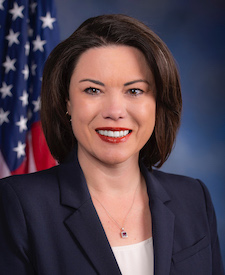
Photo of Angie Craig
D United States House · District 2 · Minnesota

Rep. Angie Craig

Compare
Total votes
2,818
all sessions
Attendance
98%
60 missed
Near the chamber average
With party
93%
of cast votes
Near the chamber average
Bipartisan score
4%
crosses aisle rarely
Near the chamber average
Sponsored
1,825
bills & resolutions
Higher than 96% of chamber peers
Committees
1
assignment
1,825 bills and resolutions

Sponsored bills

Total
1,825
Primary
87
Co-sponsor
1,738
This page
1,825
matching current filters
Co-sponsor HR 3164
In committee · Oregon House · Co-sponsor
Ensuring Community Access to Pharmacist Services Act

Maddy summaryThis bill would add pharmacist services to Medicare Part B coverage for beneficiaries, specifically covering pharmacist-led testing and treatment for illnesses like flu, COVID-19, or strep throat during public health emergencies. It defines covered services as those performed under state law, often requiring collaboration with a physician, and sets payment at 80% of the lesser of the actual charge or 85% of physician payment rates. Pharmacists would be prohibited from balance billing for these services, ensuring Medicare beneficiaries pay only their standard copayment. The changes would take effect January 1, 2026.

In committee May 21, 2026 1 co-sponsor
Co-sponsor HR 1993
Passed · Oregon House · Co-sponsor
25th Anniversary of 9/11 Commemorative Coin Act

Maddy summaryThis bill authorizes the U.S. Mint to produce commemorative $5 gold and $1 silver coins marking the 25th anniversary of the September 11, 2001, terrorist attacks. The coins must feature designs honoring victims and first responders (including the inscription "Never Forget") and will be sold only during 2027-2028. All surcharges ($35 per gold coin, $10 per silver coin) collected from sales will fund the National September 11 Memorial and Museum at the World Trade Center, with no net cost to the federal government. The coins are legal tender but primarily intended for collectors, not circulation.

Passed May 21, 2026 1 co-sponsor
Primary HRES 1306
In committee · Oregon House · Lead sponsor
Recognizing "National Public Works Week" and the essential contributions of public works professionals.

Maddy summaryThis resolution formally recognizes National Public Works Week, which takes place from May 17 to May 23, 2026, to honor the work of public works professionals. It highlights the essential roles these workers play in maintaining critical infrastructure like roads, bridges, and water systems, as well as their contributions to emergency response efforts. The measure also expresses support for initiatives aimed at strengthening the public works workforce and increasing public awareness of the importance of infrastructure maintenance.

In committee May 20, 2026 0 co-sponsors
Co-sponsor HR 8914
In committee · Oregon House · Co-sponsor
No Taxpayer-Funded Settlement Slush Funds Act of 2026

Maddy summaryThe No Taxpayer-Funded Settlement Slush Funds Act of 2026 prohibits the use of federal money to pay specific settlements involving high-ranking government officials and their close associates. It bars payments to the President, Vice President, their immediate families, cabinet members, senior executive staff, political appointees, and individuals connected to these roles, as well as any entity owned by the President or Vice President. Additionally, the bill restricts settlements related to claims about the January 6 Capitol attack, foreign election interference, or previously dismissed lawsuits, while requiring Treasury reports for large settlements and allowing the government to seek repayment if rules are broken.

In committee May 20, 2026 1 co-sponsor
Co-sponsor HR 7024
In committee · Oregon House · Co-sponsor
Hemp Planting Predictability Act

Hemp Planting Predictability Act This bill extends by two years the implementation of changes to the regulation of hemp products, which reimpose certain federal controls over some hemp products. Specifically, Congress enacted the FY2026 agriculture appropriations act (P.L. 119-37) on November 12, 2025. Effective November 12, 2026, the act modifies the statutory definition of hemp products that are considered to be lawful. This bill extends the effective date to November 12, 2028. As background, the 2018 farm bill excluded hemp from the Controlled Substances Act definition of marijuana and defined hemp . As a result, hemp and hemp-derived products at or below the 0.3% delta-9 tetrahydrocannabinol (THC, the psychoactive component of marijuana) concentration threshold were no longer regulated as Schedule I controlled substances and registration with the Drug Enforcement Administration was no longer required to cultivate or handle hemp and hemp-derived products. However, hemp remained subject to Department of Agriculture and Food and Drug Administration regulation. The 2025 changes to the definition of hemp, include changing the limit to a total THC concentration of not more than 0.3% on a dry weight basis rather than only delta-9 THC, explicitly including industrial hemp, excluding seeds from a cannabis plant that exceed a certain THC concentration, and excluding various types of hemp-derived cannabinoid products. Cannabinoids refer to unique chemical compounds that are found in hemp and marijuana (e.g., THC) and are known to exhibit a range of psychological and physiological effects.


In committee May 20, 2026 1 co-sponsor
Co-sponsor HR 7010
In committee · Oregon House · Co-sponsor
To amend the Agriculture, Rural Development, Food and Drug Administration, and Related Agency Appropriations Act, 2026, to delay the implementation of amendments made by such Act to the hemp production provisions of the Agricultural Marketing Act of 1946.

This bill extends by two years the implementation of changes to the regulation of hemp products, which reimpose certain federal controls over some hemp products. Specifically, Congress enacted the FY2026 agriculture appropriations act (P.L. 119-37) on November 12, 2025. Effective November 12, 2026, the act modifies the statutory definition of hemp products that are considered to be lawful. This bill extends the effective date to November 12, 2028. As background, the 2018 farm bill excluded hemp from the Controlled Substances Act definition of marijuana and defined hemp . As a result, hemp and hemp-derived products at or below the 0.3% delta-9 tetrahydrocannabinol (THC, the psychoactive component of marijuana) concentration threshold were no longer regulated as Schedule I controlled substances and registration with the Drug Enforcement Administration was no longer required to cultivate or handle hemp and hemp-derived products. However, hemp remained subject to Department of Agriculture and Food and Drug Administration regulation. The 2025 changes to the definition of hemp, include changing the limit to a total THC concentration of not more than 0.3% on a dry weight basis rather than only delta-9 THC, explicitly including industrial hemp, excluding seeds from a cannabis plant that exceed a certain THC concentration, and excluding various types of hemp-derived cannabinoid products. Cannabinoids refer to unique chemical compounds that are found in hemp and marijuana (e.g., THC) and are known to exhibit a range of psychological and physiological effects.
In committee May 20, 2026 1 co-sponsor
Co-sponsor HR 2722
In committee · Oregon House · Co-sponsor
VA Funding and Workforce Protection Act

Maddy summaryThis bill protects funding and staffing at the Department of Veterans Affairs (VA). It prevents the government from holding back or redirecting VA funds without new law, and requires the VA to notify Congress if funding shortfalls approach. The bill exempts the VA from hiring freezes through 2029, mandates reinstating veterans fired between 2025 and the bill’s enactment, and requires special legal authorization for layoffs (including probationary employees). The VA must also submit annual compliance reports to Congress.

In committee May 20, 2026 1 co-sponsor
Co-sponsor HRES 1301
In committee · Oregon House · Co-sponsor
Supporting the designation of May 29, 2026, as "Mental Health Awareness in Agriculture Day" to raise awareness around mental health in the agricultural industry and workforce and to continue to reduce stigma associated with mental illness.

Maddy summaryThis resolution designates May 29, 2026, as "Mental Health Awareness in Agriculture Day" to highlight mental health issues within the farming and agricultural workforce. It aims to reduce the stigma surrounding mental illness by acknowledging the unique stressors faced by producers and workers, such as unpredictable weather, labor shortages, and market fluctuations. The bill also draws attention to available support resources, specifically the Farm and Ranch Stress Assistance Network, and encourages the public to observe the day as a way to promote well-being in the industry.

In committee May 19, 2026 1 co-sponsor
Co-sponsor HR 8907
In committee · Oregon House · Co-sponsor
IMPACT to Save Moms Act

Maddy summaryThe IMPACT to Save Moms Act directs the Centers for Medicare & Medicaid Services to run a five-year demonstration project from 2027 to 2031, allowing states to test new payment models for maternity care under Medicaid and state child health plans. This initiative aims to improve health outcomes for pregnant and postpartum individuals, with a specific focus on reducing disparities among groups that experience higher rates of maternal mortality and severe complications. To achieve these goals, the project requires states to consider alternative payment structures that account for pregnancy risk levels, include diverse care teams with training on bias, and address social factors affecting health. The bill also mandates that the federal government evaluate the project's impact on health outcomes and spending, and submit a final report to Congress with recommendations on whether to expand the program nationwide.

In committee May 19, 2026 1 co-sponsor
Co-sponsor HR 8896
In committee · Oregon House · Co-sponsor
Loan Forgiveness for Educators Act of 2026

Maddy summaryThe Loan Forgiveness for Educators Act of 2026 expands existing federal student loan relief programs to offer full debt cancellation for teachers and early childhood educators who work in high-need schools or specific early childhood programs for five years. Under the bill, eligible educators can receive 100 percent forgiveness of their outstanding loans after completing five years of service, which may be consecutive or nonconsecutive, while also qualifying for monthly loan payments to be made by the government during their employment. The legislation defines "high need schools" as those with at least 30 percent of students from low-income families and includes various early childhood settings, while also extending benefits to parents who borrow PLUS loans for their qualifying children or who are educators themselves. To support implementation, the law requires the Department of Education to publish a list of eligible schools and programs, allows for self-certification in some early childhood roles, and ensures that educators who leave their positions early or are promoted within the same organization do not lose their eligibility for forgiveness.

In committee May 19, 2026 1 co-sponsor
Showing 71 to 80 of 1,825 bills
Previous 1 7 8 9 183 Next