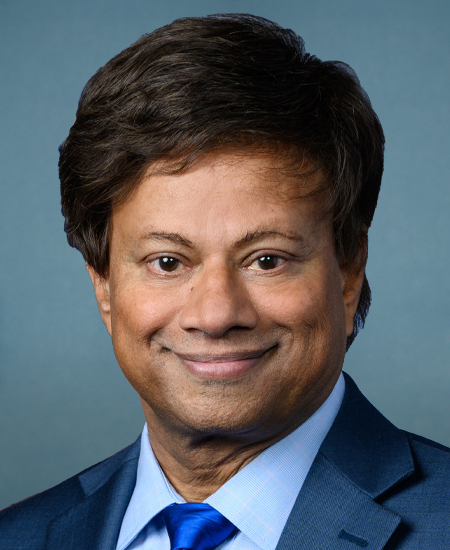
Photo of Shri Thanedar
D United States House · District 13 · Michigan

Rep. Shri Thanedar

Compare
Total votes
1,860
all sessions
Attendance
99%
12 missed
Near the chamber average
With party
97%
of cast votes
Near the chamber average
Bipartisan score
2%
crosses aisle rarely
Near the chamber average
Sponsored
1,672
bills & resolutions
Higher than 98% of chamber peers
Committees
4
assignments
1,672 bills and resolutions

Sponsored bills

Total
1,672
Primary
68
Co-sponsor
1,604
This page
1,672
matching current filters
Co-sponsor HR 309
In committee · Oregon House · Co-sponsor
National Law Enforcement Officers Remembrance, Support, and Community Outreach Act

National Law Enforcement Officers Remembrance, Support and Community Outreach Act. [ sic ] This bill temporarily directs the Department of the Interior to award a grant to the National Law Enforcement Officers Memorial Fund for the expenses associated with operating and enhancing the community outreach, public education, and officer safety and wellness programs of the National Law Enforcement Museum.

In committee Aug 20, 2026 1 co-sponsor
Co-sponsor HRES 1484
In committee · Oregon House · Co-sponsor
Recognizing the nonprofit sector and the contributions of nonprofit employees, and expressing support for August 17, 2026, to be designated as "National Nonprofit Day".

Maddy summaryThis House resolution formally recognizes the contributions of the roughly 1.3 million nonprofit organizations and their more than 12 million employees in the United States. It highlights that these groups serve as trusted community partners, often helping federal programs operate more efficiently while employing a significant portion of the workforce. The bill expresses support for designating August 17, 2026, as National Nonprofit Day to honor this sector's role in feeding, healing, and educating people across the country.

In committee Aug 17, 2026 1 co-sponsor
Primary HR 10105
In committee · Oregon House · Lead sponsor
Stop ICE Price Gouging Act

Maddy summaryThe Stop ICE Price Gouging Act caps the prices of goods sold in commissaries at immigration detention facilities, limiting markups to 5 percent for essential items like hygiene products and communication supplies, and 35 percent for nonessential items. The bill prohibits additional service fees, commissions, or revenue-sharing arrangements between contractors and government agencies. If a detainee is overcharged, the agency must provide a refund, or if that is not possible due to transfer or release, the excess funds are deposited into a new Detainee Welfare Fund dedicated to purchasing recreational, educational, and electronic items for detainees. Enforcement involves regular audits by the Department of Homeland Security Inspector General and quarterly compliance reports submitted to Congress, while allowing states to maintain stricter price limits if they exist.

In committee Aug 14, 2026 0 co-sponsors
Co-sponsor HR 5334
Passed · Oregon House · Co-sponsor
Lindsey O. Graham Sanctioning Russia and Iran Act of 2026

Maddy summaryHR 5334, the SEED Act of 2025, expands the existing educator expense deduction under federal tax law to explicitly include early childhood educators. It revises the Internal Revenue Code to cover expenses for "early childhood educators" and broadens the educational levels affected to include "pre-kindergarten through grade 12." This change allows early childhood educators (such as preschool teachers) to deduct work-related expenses like classroom supplies and professional development costs, which they previously could not claim under the existing deduction for "kindergarten through grade 12" teachers. The amendment applies to expenses incurred in taxable years beginning after December 31, 2024.

Passed Aug 10, 2026 1 co-sponsor
Co-sponsor HR 3633
Passed · Oregon House · Co-sponsor
Digital Asset Market Clarity Act

Maddy summary# Summary of Digital Commodities and Blockchain Technology Regulatory Framework This comprehensive legislation establishes a new regulatory framework specifically for digital commodities and blockchain technology, creating a balanced approach that protects investors while fostering innovation. ## Key Components 1. **New Regulatory Structure**: - Creates new categories for digital commodity exchanges, brokers, and dealers under the Commodity Futures Trading Commission (CFTC) - Establishes "qualified digital asset custodians" as a new regulatory category - Defines "mature blockchain systems" with special regulatory treatment 2. **Core Requirements**: - Mandates segregation of customer assets and strict custody requirements - Requires robust risk management systems - Sets capital requirements for digital commodity brokers and dealers - Establishes new disclosure and reporting obligations - Defines "blockchain control persons" with special restrictions on selling digital commodities 3. **Innovation-Focused Provisions**: - Creates a "Strategic Hub for Innovation and Financial Technology" (FinHub) at the SEC - Establishes "LabCFTC" as a dedicated innovation lab within the CFTC - Provides exemptions for SEC-registered entities from certain CFTC requirements - Includes provisions for expedited hiring of digital commodities experts 4. **Studies and Research**: - Mandates studies on decentralized finance (DeFi) - Requires a study on non-fungible tokens (NFTs) - Directs a study on financial literacy among digital commodity holders - Requires a study on tokenized securities and derivatives 5. **Exclusions**: - Excludes decentralized finance activities from regulation - Excludes certain blockchain-related activities from regulatory requirements The legislation aims to create a functional regulatory framework that acknowledges the unique benefits and risks of digital commodities while ensuring investor protection, preventing market manipulation, and promoting the responsible development of this emerging technology within the United States. It seeks to prevent the shift of digital commodity development to less regulated countries by establishing a clear, balanced regulatory path.


Passed Aug 8, 2026 1 co-sponsor
Co-sponsor HR 10063
In committee · Oregon House · Co-sponsor
Green New Deal for Public Housing Act

Maddy summaryThe Green New Deal for Public Housing Act directs the Department of Housing and Urban Development to provide grants to public housing agencies and tribal entities for the comprehensive rehabilitation, energy upgrades, and modernization of public housing stock. These funds are intended to transform properties into zero-carbon homes by installing renewable energy systems, electrifying appliances, and repairing infrastructure, while also establishing workforce development programs that offer training, apprenticeships, and stipends to residents and local low-income workers. The bill mandates strict labor standards, including prevailing wages and the use of U.S.-made materials, and requires agencies to maintain or increase the total number of public housing units while prioritizing resident participation through elected councils and community engagement processes.

In committee Aug 6, 2026 1 co-sponsor
Co-sponsor HR 10040
In committee · Oregon House · Co-sponsor
No TSA Data for ICE Act

Maddy summaryThis bill, titled the No TSA Data for ICE Act, prohibits the Transportation Security Administration from sharing passenger data with U.S. Customs and Border Protection or U.S. Immigration and Customs Enforcement. It specifically bars these agencies from using TSA information or data from private brokers to perform immigration enforcement functions. Additionally, the legislation prevents the denial, suspension, or early termination of Trusted Traveler programs like PreCheck and Global Entry if an individual's participation in First Amendment-protected activities is the reason. The law defines the restricted data as personally identifiable information about flight passengers obtained from the TSA or private sector entities.

In committee Aug 4, 2026 1 co-sponsor
Co-sponsor HR 9986
In committee · Oregon House · Co-sponsor
Read for Reentry Act of 2026

Maddy summaryThe Read for Reentry Act of 2026 directs the Comptroller General of the United States to conduct a study on library services within state and federal prisons. This report will examine who currently has access to these services, how they are funded, and the demographic characteristics of incarcerated individuals who use them. The study will also analyze specific outcomes related to recidivism, parole compliance, workforce placement, and disciplinary infractions for those released from facilities offering library programs. Ultimately, the bill aims to gather data to inform Congress about the current state and impact of prison libraries.

In committee Jul 30, 2026 1 co-sponsor
Co-sponsor HR 9983
In committee · Oregon House · Co-sponsor
Lori Jackson-Nicolette Elias Domestic Violence Survivor Protection Act

Maddy summaryThe Lori Jackson-Nicolette Elias Domestic Violence Survivor Protection Act aims to reduce intimate partner homicides by strengthening federal laws that prevent abusers from accessing firearms while restraining orders are active. It expands the definition of "intimate partner" to include dating partners and clarifies that emergency or temporary restraining orders must also trigger gun restrictions. The bill requires courts to automatically issue firearm surrender orders when a protection order is granted, mandating that abusers turn in their guns within 24 hours and prohibiting them from buying new ones for the duration of the order. Additionally, the legislation creates a new grant program to help states and local governments implement these surrender procedures and partner with domestic violence service providers.

In committee Jul 30, 2026 1 co-sponsor
Primary HR 10007
In committee · Oregon House · Lead sponsor
Environmental Health Workforce Act of 2026

Maddy summaryThe Environmental Health Workforce Act of 2026 aims to address staffing shortages in public health by requiring the Department of Health and Human Services to create model standards for credentialed environmental health workers and develop a strategic plan to train and retain them. This legislation directs the government to study best practices in six specific states regarding worker training and credentialing, while also expanding the Public Service Loan Forgiveness program to include full-time employment as an environmental health worker. The bill defines environmental health workers as professionals who assess environmental hazards and enforce safety guidelines, ensuring that efforts to strengthen this workforce are based on concrete policy changes rather than speculation.

In committee Jul 30, 2026 0 co-sponsors
Showing 11 to 20 of 1,672 bills