Harlem Hellfighters Congressional Gold Medal Act This bill provides for the award of a Congressional Gold Medal to the 369th Infantry Regiment, commonly known as the Harlem Hellfighters, in recognition of their bravery and outstanding service during World War I.
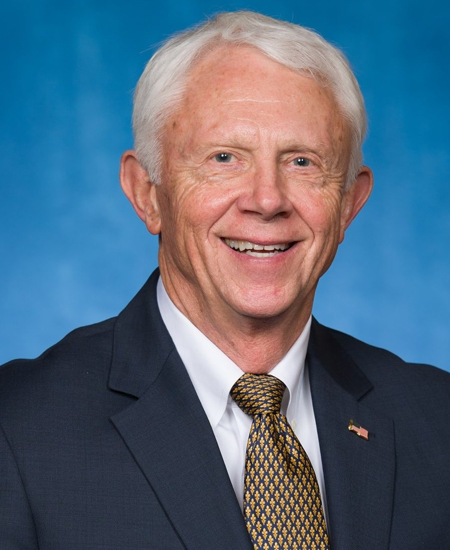
Rep. Jack Bergman
Sponsored bills
Puppies Assisting Wounded Servicemembers for Veterans Therapy Act or the PAWS for Veterans Therapy Act This bill implements a program and a policy related to service dog therapy for veterans. Specifically, the bill requires the Department of Veterans Affairs (VA) to implement a five-year pilot program to provide canine training to eligible veterans diagnosed with post-traumatic stress disorder as an element of a complementary and integrative health program. Eligible veterans are those who are enrolled in the VA health care system and have been recommended for participation by a qualified mental health care provider or clinical team. The VA must seek to enter agreements containing specified elements with accredited nongovernmental entities that have demonstrated ability to provide canine training. Veterans who participate in the program are authorized to adopt the dog they assisted in training if their health provider determines it is in the best interest of the veteran. The VA must establish processes to document and track the progress of participating veterans with respect to health benefits and improvements. The Government Accountability Office must brief Congress and submit a report on the program. The bill also authorizes the VA to provide service dogs to veterans with mental illnesses, regardless of whether they have a mobility impairment.
Tree Spiking Mitigation Act of 2021 This bill directs the Forest Service and the Bureau of Land Management (BLM) to coordinate to take necessary actions to ensure the detection, identification, and, as determined to be appropriate, mitigation of tree spiking devices located on federal lands. A tree spiking device includes spikes, nails, or other objects hammered, driven, fastened, or otherwise placed into or on any timber to impede logging. To carry out such activities, the Forest Service and the BLM shall prioritize areas in which (1) incidences of tree spiking devices have occurred, or (2) the Forest Service and the BLM suspect that there are tree spiking devices. No later than 90 days after the enactment of this bill, the Forest Service and the BLM shall, where appropriate, update safety guidelines and training protocols to include the awareness, detection, identification, and mitigation of tree spiking devices.
This resolution expresses that the House of Representatives opposes adverse punishment or discharge that is not honorable for service members whose discharge results from choosing not to receive the COVID-19 vaccine.
Resilient Federal Forests Act This bill modifies and sets forth provisions regarding forest management activities on National Forest System, public, and tribal lands. The bill provides for, among other things the Departments of Agriculture (USDA) and Interior to conduct fireshed management projects in fireshed management areas, certain categorical exclusions for various purposes, the balancing of the short- and long-term effects of forest management activities while considering injunctive relief, USDA and Interior to establish their own discretionary arbitration pilot programs as an alternative dispute resolution process for forest management activities, increasing the maximum term for a stewardship end result contract to 20 years, demonstration projects to support the development and commercialization of biochar on Indian forest lands or rangelands and in nearby communities by providing reliable supplies of feedstock from federal lands, the decommissioning of certain Forest Service Roads within designated high fire-prone areas, repealing of the Eastside Screens requirements on National Forest System lands, making the Northwest Forest Plan Survey and Manage Mitigation Measure Standards and Guidelines inapplicable to any National Forest System lands or public lands, development of a protection plan for giant sequoia trees on National Forest System lands and public lands, and permanent rights of access to the Oregon and California Railroad grant lands and the Coos Bay Wagon Road grant lands for private landowners issued reciprocal road rights-of-way.

This resolution condemns the Chinese Communist Party and its violation of the human rights of the people of China.
Big Tech Accountability for Broadband Act This bill requires the Federal Communications Commission (FCC) to promulgate regulations requiring covered businesses to contribute to the federal universal service support mechanism. A covered business is a business offering an online platform (e.g., a social media platform) that has (1) more than 30 million U.S. users or 300 million worldwide users, and (2) more than $10 billion in global revenue. The federal universal service support mechanism collects money from telecommunications companies and uses it to expand broadband access and infrastructure, especially in unserved and underserved areas. In promulgating such regulations, the FCC must consider including a mechanism that prohibits a telecommunications carrier from requiring a customer to pay charges related to universal service support contributions if the customer is considered unserved or underserved with respect to broadband internet access.
Supporting Trucking Efficiency and Emission Reductions Act or the STEER Act This bill requires the Department of Energy to establish a voucher program for expenses associated with retrofitting certain heavy-duty trucks with emission-reducing technologies.
Alexander Lofgren Veterans in Parks (VIP) Act This bill makes the America the Beautiful-National Parks and Federal Recreational Lands Pass available, without charge, to members of the Armed Forces, veterans, and Gold Star Families. The pass covers the entrance fee and standard amenity recreation fee for all federal recreational lands and waters.
Protecting Patients from Medicaid Fraud Act This bill requires state Medicaid programs to consult with the Centers for Medicare & Medicaid Services (CMS) about provider screening and oversight requirements if they have not already opted to do so. Additionally, states that are not in compliance with these screening and oversight requirements must submit progress reports to the CMS annually.