

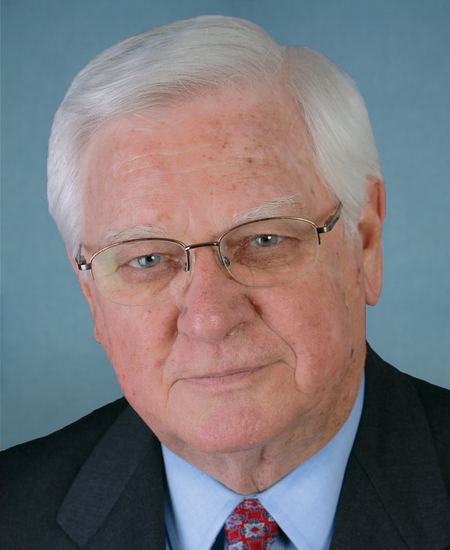
Photo of Harold Rogers
R United States House · District 5 · Kentucky On the 2026 ballot

Rep. Harold Rogers

Compare
Total votes
2,818
all sessions
Attendance
97%
85 missed
Near the chamber average
With party
92%
of cast votes
Near the chamber average
Bipartisan score
4%
crosses aisle rarely
Near the chamber average
Sponsored
271
bills & resolutions
Lower than 97% of chamber peers
Committees
4
assignments
271 bills and resolutions

Sponsored bills

Total
271
Primary
15
Co-sponsor
256
This page
271
matching current filters
Co-sponsor HR 236
In committee · Oregon House · Co-sponsor
Federal Employee Return to Work Act

Maddy summaryThis bill requires federal employees who telework at least one day weekly (or 20% of their time under alternative schedules) to be paid at the "Rest of U.S." locality pay rate without future adjustments. It excludes employees who telework daily, those with disabilities receiving accommodations, Foreign Service members, law enforcement officers, and military personnel on active duty. Covered employees will no longer receive annual pay adjustments under standard federal pay schedules. The policy takes effect at the start of the first full fiscal year after the bill becomes law. It directly affects federal workers meeting the telework threshold, altering their pay structure based on location.

In committee Jan 7, 2025 1 co-sponsor
Co-sponsor HR 82
Signed into law · Oregon House · Co-sponsor
Social Security Fairness Act of 2023

Maddy summaryHR 82, the Social Security Fairness Act of 2023, repeals two provisions that reduce Social Security benefits for certain government workers. It eliminates the Government Pension Offset (GPO), which cuts spousal or survivor benefits for people with pensions from jobs not covered by Social Security (like federal or state government roles), and the Windfall Elimination Provision (WEP), which lowers retirement benefits for those with similar pensions. The law takes effect for benefits paid after December 2023, requiring the Social Security Administration to adjust benefit calculations to remove these reductions. This change directly affects public-sector employees who previously had their Social Security benefits reduced due to their government pensions.

Signed into law Jan 5, 2025 1 co-sponsor
Primary HRES 4
Passed · Oregon House · Lead sponsor
Authorizing the Clerk to inform the President of the election of the Speaker and the Clerk.

Maddy summaryThis is a procedural resolution (HRES 4) for the 119th Congress, authorizing the House Clerk to formally notify the President that Mike Johnson (LA) was elected Speaker and Kevin McCumber (IL) was elected Clerk. It directs the Clerk to send this official notification to the President of the United States. The resolution has no policy provisions or direct impact on constituents; it simply completes a routine House leadership confirmation step required by law. This is a standard administrative action following the opening of a new congressional session.

Passed Jan 3, 2025 0 co-sponsors
Co-sponsor HR 174
In committee · Oregon House · Co-sponsor
Consequences for Social Security Fraud Act

Maddy summaryHR 174 adds new grounds for inadmissibility and deportability related to specific fraud offenses. It targets non-citizens convicted of, or admitting to, Social Security fraud (using false account numbers/cards), identification document fraud, or fraud involving pandemic-era loans or grants (like those under the Small Business Act or American Rescue Plan). The bill amends immigration law to make such individuals ineligible for entry into the U.S. or subject to removal. It directly affects non-citizens who commit these defined offenses, not general fraud cases. The policy change is limited to these specific fraud categories tied to federal pandemic programs and Social Security/ID documents.

In committee Jan 3, 2025 1 co-sponsor
Co-sponsor HR 9096
In committee · Oregon House · Co-sponsor
Pharmacists Fight Back Act

Maddy summaryThe Pharmacists Fight Back Act (HR 9096) sets new rules for Pharmacy Benefits Managers (PBMs) working with federal health care programs like Medicare Part D and Medicaid. It requires PBMs to reimburse in-network pharmacies at a rate covering the drug's actual cost plus a small fee (capped at $25), and to reduce patient cost-sharing by at least 80% of rebates received from drug manufacturers. The bill bans PBMs from steering patients to specific pharmacies, charging patients more than pharmacies are paid, or using rebates to lower pharmacy payments after claims are processed. It also mandates public reporting of drug pricing data to improve transparency, ensuring patients and pharmacies receive fairer treatment under federal health programs.

In committee Dec 17, 2024 1 co-sponsor
Co-sponsor HR 8331
In committee · Oregon House · Co-sponsor
Essential Caregivers Act of 2024

Maddy summaryThe Essential Caregivers Act of 2024 requires nursing homes and similar facilities to allow residents to designate essential caregivers who provide emotional support or assistance with daily activities. During emergencies when regular visitation is restricted, facilities must permit at least one essential caregiver access to residents daily and cannot deny access without following specific procedures. Facilities may deny access for a maximum of 7 days during emergencies (or 14 days with state approval), and must provide a written explanation and appeal process if access is denied. The bill establishes a 48-hour appeal process for residents and caregivers to challenge denials, with facilities required to prove violations during appeals. This law applies to Medicare skilled nursing facilities, Medicaid nursing facilities, intermediate care facilities, and certain inpatient rehabilitation facilities.

In committee Dec 17, 2024 1 co-sponsor
Co-sponsor HR 4712
In committee · Oregon House · Co-sponsor
Patient Right to Shop Act

Maddy summaryHR 4712, the Patient Right to Shop Act, prohibits group health plans and health insurance issuers from including contract terms that block third-party tools helping patients compare prescription drug costs. The bill specifically targets contracts with pharmacy benefit managers (PBMs), requiring that plans cannot restrict access to information needed for tools showing all patient costs - like copays, coinsurance, cash prices, or mail-order options. It directly affects patients (who gain clearer cost comparisons), health plans, insurers, and PBMs. The law does not create new tools but ensures existing cost-comparison tools can function by preventing contractual barriers, while clarifying it doesn’t override existing privacy rules like HIPAA.

In committee Dec 17, 2024 1 co-sponsor
Co-sponsor HR 4073
In committee · Oregon House · Co-sponsor
Duty Drawback Clarification Act

Maddy summaryHR 4073, the Duty Drawback Clarification Act, clarifies U.S. tariff classifications for imported whiskies by creating specific subheadings in the Harmonized Tariff Schedule. It replaces a single tariff line with eight new subheadings that categorize whiskies by type (Irish/Scotch, Bourbon, Rye, or "Other") and container size (under or over 4 liters), each with a uniform duty rate of $2.04 per liter. This change directly affects whiskey importers and manufacturers who must now classify products using these new codes when entering goods into U.S. commerce. The bill streamlines duty calculation and drawback claims (refunds of duties on imported goods later exported) by standardizing the tariff structure for whiskey categories.

In committee Dec 17, 2024 1 co-sponsor
Co-sponsor HR 3882
In committee · Oregon House · Co-sponsor
Leveling the Playing Field 2.0 Act

Maddy summaryThe Leveling the Playing Field 2.0 Act (HR 3882) updates U.S. trade law to better address international trade practices that disadvantage American businesses. It establishes special rules for handling multiple investigations of the same merchandise (called "successive investigations"), requiring the Commerce Department to consider previous injury determinations when making new findings. The bill also creates mechanisms to address market distortions from foreign government subsidies, including currency undervaluation, and strengthens procedures to prevent duty evasion through certification requirements for importers. These changes primarily affect foreign exporters of goods subject to U.S. antidumping and countervailing duty investigations, as well as U.S. importers of those goods.

In committee Dec 17, 2024 1 co-sponsor
Co-sponsor HR 3730
In committee · Oregon House · Co-sponsor
Rural Health Clinic Burden Reduction Act

Maddy summaryThis bill simplifies regulations for rural health clinics (RHCs) by reducing administrative burdens. It allows RHCs to contract with physician assistants and nurse practitioners (instead of requiring direct employment), updates the definition of "rural" to exclude areas with 50,000+ residents, and removes outdated lab service requirements by requiring only "prompt access" to clinical labs. These changes directly affect RHCs, enabling them to more flexibly staff and operate while complying with state practice laws. The amendments take effect January 1, 2024, applying to services provided on or after that date.

In committee Dec 17, 2024 1 co-sponsor
Showing 81 to 90 of 271 bills
Previous 1 8 9 10 28 Next