

Maddy summaryHR 698, the Assault Weapons Ban of 2023, prohibits the sale, manufacture, transfer, and possession of specific firearms and ammunition devices commonly referred to as "assault weapons" and "large capacity magazines" in interstate commerce. The bill defines "semiautomatic assault weapons" to include rifles like AR-15s and AK-47s, as well as firearms with specific features such as folding stocks, pistol grips, threaded barrels, and detachable magazines holding more than 15 rounds. It exempts law enforcement, military, antique firearms, and weapons already lawfully owned before the law's enactment (known as "grandfathered" weapons). The bill also requires new identification markings on these weapons and large capacity magazines, and adds background check requirements for transfers of grandfathered weapons.
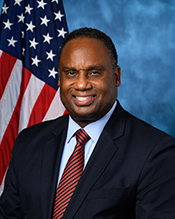
Rep. Jonathan L. Jackson
Sponsored bills
This bill establishes a student loan deferment and forgiveness program for physicians who provide mental and behavioral health services (including substance abuse prevention and treatment services) to racial and ethnic minority groups and low-income individuals. To carry out the program, the Department of Health and Human Services must pay the outstanding principal and interest (up to a maximum limit) on specified federal student loans for eligible physicians who work in qualifying employment. While participating in the program, physicians do not need to pay the principal of their loans but must pay any interest that accrues. To be eligible, physicians must complete a mental or behavioral health professions degree or certificate at a minority-serving institution of higher education. Physicians must also provide mental and behavioral health services for five consecutive years while working either (1) as solo practitioners where at least 30% of patients receive Medicaid and at least 50% of patients are members of racial and ethnic minority groups; or (2) at institutions that accept Medicaid and where at least 50% of patients served by the institution are members of racial and ethnic minority groups.
Maddy summaryThis bill prohibits the Department of Veterans Affairs from changing its anesthesia care policies to allow nurse anesthetists (CRNAs) to provide anesthesia independently without a physician anesthesiologist. It specifically blocks implementation of a 2016 proposed rule that would have expanded CRNAs' authority in VA facilities. The law maintains current requirements that physician anesthesiologists must oversee or provide anesthesia care for veterans during surgical procedures. Emergency orders for veteran safety during surgery remain permitted under the bill's exception clause.
Maddy summaryThe Universal School Meals Program Act of 2023 would establish a universal school meals program providing free breakfast and lunch to all children enrolled in participating schools, regardless of family income. Key provisions include eliminating income-based eligibility requirements for school breakfast and lunch programs, setting specific reimbursement rates ($2.80 for breakfast and $4.63 for lunch with annual inflation adjustments), and prohibiting schools from collecting debt for unpaid meals or "shaming" students. The bill also replaces references to "free or reduced price" with "economically disadvantaged students" in related laws and establishes new methods for identifying children from low-income backgrounds. This legislation would directly affect all public schools participating in the National School Lunch Program and School Breakfast Program.
Maddy summaryThis bill removes a barrier for college students seeking food assistance by amending the SNAP program rules. It directly affects students enrolled at least half-time in recognized colleges or training programs, who were previously automatically ineligible unless they met separate requirements. The key change eliminates the prior restriction (in section 6(e)) that barred most higher education students from SNAP, allowing them to qualify under the new provision in section 3(m)(5)(F). The changes take effect January 2, 2024.
Maddy summaryThe Closing the Meal Gap Act of 2023 amends the Food and Nutrition Act to update how SNAP (Supplemental Nutrition Assistance Program) benefits are calculated. It replaces the "thrifty food plan" with a "low-cost food plan" based on a specific 4-person family diet, requiring the government to reevaluate this plan by 2029 and every 5 years after. The bill also updates medical expense deductions, eliminates time limits on benefits, and allows Puerto Rico to join SNAP with specific transition requirements. These changes directly affect SNAP recipients, particularly in Puerto Rico, Hawaii, and Alaska, by adjusting benefit calculations to better reflect current food costs.
Maddy summaryHRES 459 is a resolution expressing the House of Representatives' support for designating June 2, 2023, as "National Gun Violence Awareness Day" and June 2023 as "National Gun Violence Awareness Month." It encourages the public to wear orange, promote gun safety awareness, and discuss community safety measures during this time, particularly highlighting the summer months when gun violence often increases. The resolution references statistics on gun violence deaths and pays tribute to victims like Hadiya Pendleton, but does not create new laws or impose requirements.
Maddy summaryHR 3713 creates federal grants to fund comprehensive school-based mental health programs for students in grades K-12, including those in Bureau of Indian Education schools. It requires partnerships between schools and community mental health providers to deliver trauma-informed, culturally appropriate services addressing suicide risk, grief, violence, and trauma exposure. The bill authorizes $300 million annually (2024-2027) for these programs, mandating privacy protections under HIPAA and FERPA, and requires annual reporting on program effectiveness.
Maddy summaryThis bill creates a new grant program under the Public Health Service Act to provide emergency funding for health care facilities during declared emergencies (like pandemics or natural disasters). It authorizes grants to public or private nonprofit health care facilities and home health agencies to pay hazardous duty compensation to eligible health care workers - such as nurses, medical technicians, and facility cleaners - performing essential on-site work. Grants can cover up to $13 per hour in hazard pay (capped at $25,000 annually per worker) or fund safety measures like personal protective equipment and alternative transit. The program requires the Secretary of Health and Human Services to determine if work or commutes are hazardous during emergencies.
Maddy summaryThis bill requires schools to train staff on administering naloxone (an opioid overdose reversal drug) and expands access to naloxone for schools and communities. It increases funding for prevention programs targeting fentanyl-laced substances, including school education and community outreach, and mandates research on fentanyl's health effects and new treatments. The bill also strengthens penalties for fentanyl trafficking, including longer prison terms for deaths linked to fentanyl-laced drugs, and directs law enforcement to prioritize disrupting fentanyl supply chains. It directly affects schools, public health programs, law enforcement, and communities impacted by the opioid crisis.