This resolution honors the life and legacy of Rush Limbaugh and commends him for his devotion to the United States.
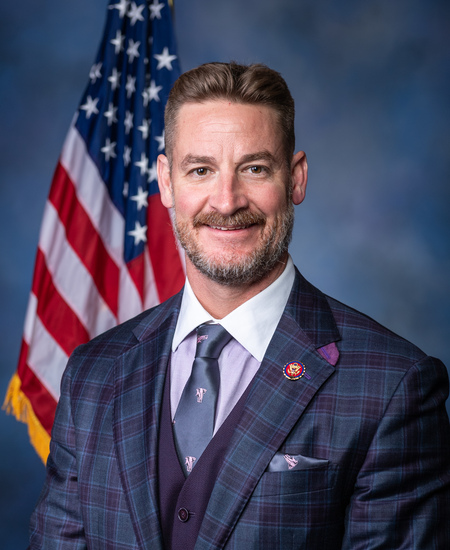
Rep. W. Gregory Steube
Sponsored bills
Iran Hostages Congressional Gold Medal Act This bill requires the Speaker of the House of Representatives and the President pro tempore of the Senate to arrange for the award of a Congressional Gold Medal commemorating the bravery and endurance of the 53 hostages of the Iran Hostage Crisis. Following its award, the medal shall be given to the National Museum of American History of the Smithsonian Institution for display and research. The Department of the Treasury must strike duplicate medals in silver for presentation to a hostage (or the personal representative of a deceased hostage), and Treasury may also strike and sell duplicate medals in bronze.
Easy Access to Mail Act This bill establishes procedures for the U.S. Postal Service (USPS) regarding the use of centralized delivery of the mail with respect to residential housing units. Specifically, the bill provides that, for any housing development with respect to which the primary mode of mail delivery is any such mode except for centralized delivery on the date of this bill's enactment, the USPS may not change such mode of delivery to centralized delivery; and prohibits the USPS from requiring centralized delivery with respect to any housing development constructed after this bill's enactment without prior approval from the local legislative body, or, in the absence of a local legislative body, the legislature of the state with jurisdiction over the affected property. If approval for centralized delivery is granted, at least 60 days before commencing such delivery the local postmaster shall provide (1) written notice to any other units of local government and any planning commissions located within the applicable county; and (2) a period of 60 days for public comment from residents, property owners, and home builders within such county regarding the use of centralized delivery at the applicable housing development. The Postal Regulatory Commission shall ensure that the USPS does not change any USPS policy in effect on the date of enactment that would result in a disproportionate negative affect on rural, lower income, elderly, disabled, or predominately minority communities.

Creating Hope and Opportunity through Increased Choice in Education Act or the CHOICE Act This bill directs the Department of Education to make grants to parents of eligible students for certain education-related expenses. Eligible student refers to a student who (1) is served by a local educational agency that will not provide in-person instruction in a manner consistent with the 2019-2020 school year, and (2) is from a household with a household income that is less than 200% of the reduced-price lunch rate income. Grant funds may be used for tuition and fees for private elementary or secondary schools, private tutoring, home school expenses, or educational materials.
Managing Predators Act This bill gives states the authority to manage the populations of gray wolves and to determine if the wolves are endangered or threatened species. Specifically, the bill permanently removes the populations of gray wolf in Wisconsin, Michigan, Minnesota, and Wyoming from the federal endangered and threatened species list. In addition, the bill revises requirements for the gray wolf in any state other than Wisconsin, Michigan, Minnesota, and Wyoming. If the population of the gray wolf, as estimated by such state, is at or above a population goal established by the state, then the Department of the Interior may not make a determination that the wolf in such state is an endangered or threatened species.
Improving Confidence in Veterans' Care Act This bill prescribes oversight requirements for the Department of Veterans Affairs (VA) regarding health care professionals at VA medical centers. Specifically, the bill requires the VA to ensure each VA medical center consistently compiles, verifies, and reviews specified documentation for each VA health care professional (including contractors). The VA shall ensure that specified health care professionals hold an active Drug Enforcement Administration registration. Each VA medical center must implement (1) monitoring of the performance and quality of the health care delivered by each health care professional at the center, and (2) reviews of such care if an individual notifies the VA of any potential concerns relating to a failure to meet generally accepted standards of clinical practice. The bill imposes notification requirements in situations where the VA substantiates a concern relating to the clinical competency of, or quality of care delivered by, a current or former VA health care professional. The VA is prohibited from entering into a settlement agreement relating to an adverse action against a VA health care professional if such agreement includes terms that require the VA to conceal certain information from the employee's personnel file. Such prohibition does not apply to adverse actions determined to be prohibited personnel practices. The VA must provide mandatory training, at least biannually, to employees of each medical center who are responsible for specified tasks (e.g., those who are responsible for compiling, validating, or reviewing the credentials of VA health care professionals).
This joint resolution nullifies the action of the District of Columbia Council in approving the Minor Consent for Vaccinations Amendment Act of 2020, enacted by the council on December 23, 2020, and transmitted on February 1, 2021, to Congress pursuant to the District of Columbia Home Rule Act. The act authorizes a minor, 11 years of age or older, to consent to receive a vaccine if the minor is capable of meeting the informed consent standard and the vaccine is recommended by the United States Advisory Committee on Immunization Practices and will be provided in accordance with its recommended immunization schedule.
Safe Bases Act This bill provides statutory authority for the Department of Defense (DOD) to allow a service member to carry a concealed firearm while on any military installation. DOD must establish a single authority within the department to issue permits for this purpose. To be eligible for a permit, the service member must be on active duty and must not be prohibited under federal law from purchasing, owning, or possessing a firearm.
Religious Insignia on Dog Tags Act This bill directs the Department of Defense (DOD) to allow trademarks owned or controlled by DOD to be combined with religious insignia on commercial identification tags (i.e., dog tags) and to be sold by lawful trademark licensees. The bill applies retroactively to September 13, 2013.
No taxpayer funding for United Nations Human Rights Council Act This bill prohibits the Department of State from making contributions to the United Nations Human Rights Council, either as a percentage of the U.S. contribution to the regular budget of the United Nations or as a voluntary contribution to the council.