

This joint resolution reinstates provisions of District of Columbia (DC) tax law to conform with federal tax law. As background, DC generally automatically adopts changes to federal tax law (known as rolling conformity). Therefore, upon enactment of the 2025 reconciliation act (commonly known as the One Big Beautiful Bill Act), many of its tax provisions became DC law. DC subsequently enacted its own legislation (the DC Income and Franchise Tax Conformity and Revision Temporary Amendment Act of 2025) that decoupled DC tax law from these federal provisions. This joint resolution nullifies the DC legislation, thereby generally realigning DC tax law with the tax provisions of the 2025 reconciliation act. Specifically, the joint resolution reinstates for DC provisions that • increase the higher basic standard deduction; • increase deductible charitable cash contributions (for taxpayers who take the standard deduction); • establish a $6,000 tax deduction for taxpayers 65 years and older; • allow a tax deduction of qualified tips, qualified overtime pay, and qualified car loan interest; • authorize an elective 100% depreciation allowance for nonresidential real property; and • authorize businesses to deduct 100% of research and experimental costs retroactive to tax year 2022. The DC legislation also amended several other provisions of DC tax law, including restoring the DC child tax credit. The joint resolution negates these changes.
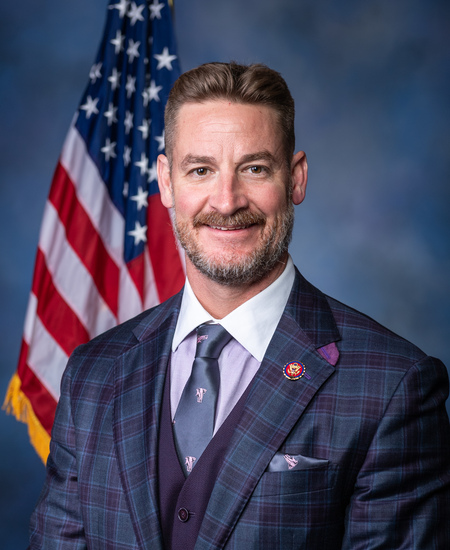
Rep. W. Gregory Steube
Sponsored bills
Protection of Women in Olympic and Amateur Sports Act This bill requires certified national governing bodies (NGBs) of amateur sports (e.g., USA Gymnastics) to prohibit a person whose sex is male from participating in an amateur athletic competition that is designated for females, women, or girls. Under the bill, male means an individual who has, had, will have—or would have, but for a developmental or genetic anomaly or historical accident—the reproductive system that at some point produces, transports, and utilizes sperm for fertilization.
Maddy summaryThe REPAIR Act requires motor vehicle manufacturers to provide car owners and independent repair shops with full access to vehicle data and repair information, prohibiting technological or legal barriers that restrict this access. It mandates that manufacturers share vehicle-generated data, critical repair information, and tools on equal terms with dealers and authorized service providers, without requiring consumers to use specific brands of parts or tools. The law establishes an advisory committee to monitor implementation and ensure fair competition in vehicle repair, while giving the Federal Trade Commission authority to enforce these requirements as unfair or deceptive practices. This legislation directly affects car owners, independent repair facilities, aftermarket parts manufacturers, and motor vehicle manufacturers by shifting control of repair information and data from manufacturers to consumers.
Maddy summaryThis bill modifies tax credit rules to help businesses recover after disasters. It allows businesses operating in designated disaster areas to treat certain unused tax credits (carryforwards) as transferrable credits against current tax liability, rather than letting them expire. Specifically, it applies to taxpayers making eligible expenditures for business operations in areas with a major disaster declaration after December 31, 2023, or a state-declared disaster meeting specific criteria. The change affects businesses in affected zones by providing immediate tax relief for qualifying expenses incurred within two years of the disaster declaration. It does not involve energy policy or new funding, but adjusts existing tax credit rules for disaster recovery.
Maddy summaryHR 7452, titled the "Air Quality Act" (though it addresses weather modification, not air quality), prohibits all weather modification activities in the U.S., including cloud seeding, geoengineering, and stratospheric aerosol injection, for individuals, companies, and federal agencies. It imposes criminal penalties of up to $100,000 or 5 years in prison per violation, plus civil fines of $10,000 per violation, and requires new reporting systems for aircraft involved in such activities and public complaints to the EPA. The bill repeals all existing federal laws, regulations, or executive orders authorizing weather modification and bans all federal research or experimentation on weather modification. It defines "weather modification" broadly to include any atmospheric alteration affecting weather, climate, or sunlight.
Maddy summaryHR 7451, the EXILE Act, would end the H-1B visa program for foreign workers in specialty occupations after fiscal year 2026. It amends immigration law to eliminate the H-1B program's continuation starting in 2027, setting a permanent annual cap of zero for new H-1B visas. This directly affects U.S. employers who currently sponsor H-1B workers (commonly in tech and professional services) and foreign workers seeking these visas. The bill’s key provision modifies the legal text to phase out the program by removing existing renewal language and inserting a permanent end date.
Maddy summaryThis bill denies tax credits for health insurance under the Affordable Care Act and Medicaid medical assistance to individuals convicted of sex offenses (as defined by the Adam Walsh Act). Specifically, it amends tax law to block refundable health care credits for sex offenders and adds a Medicaid provision allowing states to exclude sex offenders from receiving government-funded medical coverage. The policy directly affects sex offenders who would otherwise qualify for these federal benefits. The changes apply to tax years and Medicaid enrollments starting after the bill's enactment.
Maddy summaryHR 7356, the "No Federal Funds for Ballot Harvesting Act," amends the Help America Vote Act to block federal funding for election administration in states that permit third parties (non-voters) to collect and transmit mailed ballots for federal elections. It requires states to prohibit such collection by non-authorized individuals, with exceptions for election officials, USPS employees, and family/caregivers living with or assisting the voter. States failing to adopt this prohibition would lose federal funds for administering federal elections. The bill cites concerns about ballot chain-of-custody vulnerabilities and references the Supreme Court’s Brnovich ruling upholding state restrictions on ballot harvesting.
Maddy summaryThis bill permanently changes U.S. standard time zones by reducing the offset from UTC by 30 minutes across all regions. It amends the 1918 Calder Act to adjust time zone differences (e.g., changing "4 hours" to "3.5 hours" for the Eastern Time Zone) and repeals the 1966 Uniform Time Act, which currently governs daylight saving time rules. The change directly affects all U.S. time zones, shifting local times earlier by 30 minutes without altering daylight saving time schedules. The policy change takes effect 90 days after enactment, implementing a permanent adjustment to standard time.
Maddy summaryThe Riley Gaines Act allows female student athletes injured in women's sports competitions to sue schools or athletic associations that permitted biologically male athletes to compete in those events. It creates a legal pathway for victims to seek compensation for physical injuries, lost scholarships, or missed professional opportunities due to the inherent physiological advantages of male athletes. If a female athlete wins a lawsuit under this law, the court must also award them reasonable attorney fees. The bill directly affects institutions of higher education and athletic associations that oversee women's sports competitions.