

Educational Notification and Disclosure of Actions risking Loss of Life by Hazing Act or the END ALL Hazing Act This bill requires institutions of higher education (IHEs) that participate in federal student-aid programs to collect information and publicly report on hazing-related misconduct. Specifically, IHEs must prepare biannual reports and post the reports on their websites. The reports must include information on hazing-related misconduct committed by a student organization, including the name of the student organization that committed the violation, a description of the violation, and sanctions placed on the organization. Further, IHEs must report to campus police and law enforcement authorities within 72 hours of becoming aware of any allegation of hazing that involved serious bodily injury or a significant risk of serious bodily injury. The bill does not apply to foreign IHEs.
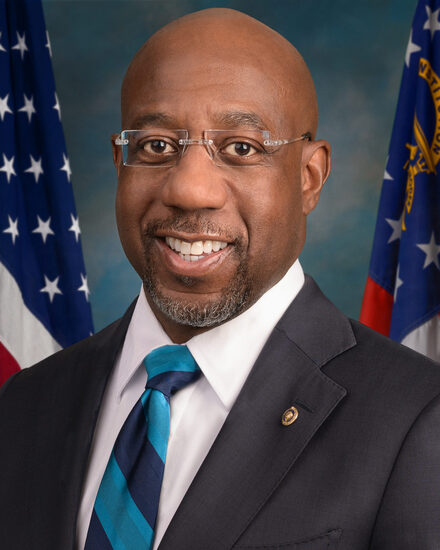
Sen. Raphael G. Warnock
Sponsored bills
Department of Veterans Affairs Employee Fairness Act of 2021 This bill repeals provisions excluding any matter or question concerning professional conduct or competence; peer review; or the establishment, determination, or adjustment of employee compensation from the applicability of collective bargaining rights for Veterans Health Administration employees.
Accessible, Affordable Internet for All Act This bill reauthorizes through FY2026, revises, and establishes grants and activities to promote access to telecommunications services, including broadband internet. The bill addresses digital equity and inclusion through grants and by requiring studies on barriers to adopting broadband services and related matters. The bill addresses broadband affordability and access. It (1) reauthorizes and expands programs that subsidize or support broadband services for, among others, eligible households, schools, and minority communities; and (2) establishes a program for expanding broadband service for underserved areas and community support organizations (e.g., religious organizations). Additionally, the Federal Communications Commission (FCC) must expand programs that verify an individual's eligibility for subsidized telecommunications services. The bill addresses matters concerning broadband data. The FCC must (1) issue rules for collecting pricing data and labels for disclosing information about broadband plans to consumers, and (2) collaborate and share data with federal agencies and stakeholders. The bill makes financing (e.g., low-interest loans) available to communities and public-private partnerships for broadband infrastructure investments and creates grants to establish or expand certain internet exchange facilities and submarine cable landing stations. Additionally, the Department of Transportation must require states to install conduits for broadband cables as part of certain highway projects. The bill also sets up a task force on nationwide dig once requirements (i.e., policies or practices to minimize excavations of highway rights-of-way when installing telecommunications infrastructure). Further, the bill preempts state laws that prohibit certain telecommunications service providers (e.g., public providers) from providing high-speed broadband services.
Assault Weapons Ban of 2021 This bill makes it a crime to knowingly import, sell, manufacture, transfer, or possess a semiautomatic assault weapon (SAW) or large capacity ammunition feeding device (LCAFD). The prohibition does not apply to a firearm that is (1) manually operated by bolt, pump, lever, or slide action; (2) permanently inoperable; (3) an antique; or (4) a rifle or shotgun specifically identified by make and model. The bill also exempts from the prohibition the following, with respect to a SAW or LCAFD: importation, sale, manufacture, transfer, or possession related to certain law enforcement efforts, or authorized tests or experiments; importation, sale, transfer, or possession related to securing nuclear materials; and possession by a retired law enforcement officer. The bill permits continued possession, sale, or transfer of a grandfathered SAW, which must be securely stored. A licensed gun dealer must conduct a background check prior to the sale or transfer of a grandfathered SAW between private parties. The bill permits continued possession of, but prohibits sale or transfer of, a grandfathered LCAFD. Newly manufactured LCAFDs must display serial number identification. Newly manufactured SAWs and LCAFDs must display the date of manufacture. The bill also allows a state or local government to use Edward Byrne Memorial Justice Assistance Grant Program funds to compensate individuals who surrender a SAW or LCAFD under a buy-back program.
This resolution recognizes the centennial of the Tulsa Race Massacre of 1921. The resolution acknowledges the historical significance of this event as one of the largest single instances of state-sanctioned violence against Black people in American history; honors the lives and legacies of the estimated 300 Black individuals who were killed during the massacre and the nearly 9,000 who were left homeless and penniless; condemns efforts to cover up the truth and shield the white community, especially government officials, from accountability; condemns the continued legacy of racism and white supremacy against Black people in the United States, particularly in the form of police brutality; encourages education about the massacre, the history of white supremacy that fueled the massacre, and subsequent attempts to deny or cover up the massacre, in all elementary and secondary education settings and in institutions of higher education; and recognizes the commitment of Congress to acknowledge and learn from the history of racism and racial violence to reverse the legacy of white supremacy and fight for racial justice.
Hello Girls Congressional Gold Medal Act of 2021 This bill provides for the award of a single Congressional Gold Medal in honor of the female telephone operators of the Army Signal Corps, commonly known as the Hello Girls , in recognition of their military service, devotion to duty, and 60-year struggle for veterans' benefits and recognition as soldiers.
American Dream Employment Act of 2021 This bill permits the compensation of congressional employees who hold a current employment authorization document that was issued pursuant to a grant of (1) deferred action, including under the Deferred Action for Childhood Arrivals Program; (2) deferred enforced departure; or (3) temporary protected status. (Generally, these programs and statuses allow eligible aliens to remain and work in the United States.)
Universal Giving Pandemic Response and Recovery Act This bill allows individual taxpayers who do not otherwise itemize their tax deductions a deduction in taxable years beginning in 2021 or 2022 for charitable contributions. The deduction is limited to one-third of the standard deduction allowed to such taxpayers.
Moving and Fostering Innovation to Revolutionize Smarter Transportation Act or the Moving FIRST Act This bill authorizes through FY2026 the Department of Transportation to award Strengthening Mobility and Revolutionizing Transportation grants to communities of varying sizes to promote technological innovation (e.g., autonomous vehicles, electric vehicles, and roadway electrification) in transportation systems.
Transportation Alternatives Enhancements Act This bill revises and reauthorizes the surface transportation block grant program (Transportation Alternatives Program) in the Department of Transportation. For example, states are allowed to allocate funds under the program to counties, metropolitan planning organizations, regional transportation planning organizations, and local governments.Additionally, metropolitan planning organizations that serve an urbanized area with a population of 200,000 or fewer are eligible for funding. The bill also adjusts the funding limits for states to improve the ability of applicants to access funding in an efficient and expeditious manner, and limits the transferability of funds under the program unless a state meets certain requirements.