

Small Business Taxpayer Bill of Rights Act of 2022 This bill modifies various tax enforcement procedures and requirements that affect small businesses and other taxpayers. The bill modifies requirements regarding awarding costs and fees to small businesses for administrative and court proceedings, the amounts of damages and penalties that are allowed for violating various tax laws, dispute resolution and appeal procedures, enforcing liens against principal residences, terminating Internal Revenue Service (IRS) employees for misconduct, reviews by the Department of the Treasury Inspector General for Tax Administration, and the release of an IRS levy due to economic hardship for business taxpayers. The bill also allows a tax deduction for a portion of a taxpayer's expenses for certain audits, prohibits ex parte communications between officers in the IRS Independent Office of Appeals and other IRS employees with respect to matters pending before the officers, establishes a 10-year term for the National Taxpayer Advocate, and repeals the requirement to submit a partial payment with an offer-in-compromise to settle a tax liability.
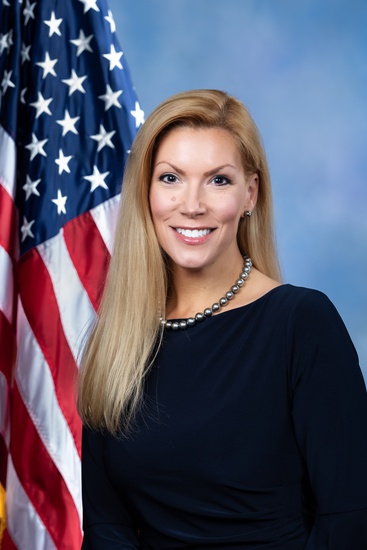
Rep. Beth Van Duyne
Sponsored bills
This resolution condemns the terrorist attack on Congregation Beth Israel in Colleyville, Texas, on January 15, 2022. It also expresses support for the affected community, commends the actions of law enforcement and emergency responders, and reaffirms a commitment to combat hate, bigotry, anti-Semitism, and violence against Jewish Americans.
Powering America through Domestic Energy Act or the PADE Act This bill requires the President to prohibit the importation of crude oil and petroleum products from Russia. In addition, the bill requires the President to obtain congressional approval before (1) declaring a moratorium on the use of hydraulic fracturing, or (2) withdrawing federal land from oil and gas leasing under mineral leasing laws.
American Energy Independence from Russia Act This bill addresses U.S. energy security, the production of oil and gas, and the importation and exportation of oil and gas. Specifically, the President must submit an energy security plan that (1) evaluates U.S. crude oil, petroleum products, and natural gas imports and exports; (2) assesses the energy security risks of such imports; and (3) includes strategies to encourage increased domestic production of crude oil, petroleum products, and natural gas to offset Russian imports. The bill also approves the TransCanada Keystone Pipeline in Phillips County, Montana for the import of oil from Canada to the United States. In addition, the bill grants the Federal Energy Regulatory Commission the authority to approve or deny applications for facilities to export natural gas from the United States to foreign countries or import natural gas from foreign countries. The President and federal agencies must obtain congressional approval before (1) prohibiting or substantially delaying certain new energy mineral leases or permits on federal lands, or (2) withdrawing certain federal lands from mineral and geothermal leasing activities. The Department of the Interior must resume issuing oil and gas leases on federal lands and offshore submerged lands in the Outer Continental Shelf as specified under the bill. Finally, the bill limits the drawdown of petroleum in the Strategic Petroleum Reserve until the Department of Energy develops a plan to increase the percentage of federal lands leased for oil and gas production.
Prohibition on Imports of Russian Oil Act This bill requires the President to prohibit the importation of petroleum products from Russia. Petroleum product means crude oil, residual fuel oil, or any refined petroleum product, including natural gas liquid product. Further, the bill authorizes the President to (1) modify or remove the prohibition for some or all petroleum products if the President notifies Congress that such modification or removal is appropriate given the situation in Ukraine, and (2) use appropriate authorities to impose civil or criminal penalties as necessary to enforce the prohibition.
This concurrent resolution expresses the sense of Congress that the International Criminal Court should immediately proceed with prosecuting Russian President Vladimir Putin with war crimes should any harm befall Ukrainian President Volodymyr Zelenskyy as a result of actions taken or directed by any Russian entity or authority.
This resolution expresses that the House of Representatives does not recognize Russia as the inheritor of the Union of Soviet Socialist Republics' seat as a permanent member on the U.N. Security Council, and encourages the Biden Administration to take all necessary action at the United Nations to remove Russia from its position as a permanent member of the Security Council.
Secure Our Ports Act of 2022 This bill prohibits an owner or operator of a U.S. port from entering into a contract with a Chinese, Russian, North Korean, or Iranian state-owned enterprise for the operation or management of such port. It also prohibits entering into a contract with any foreign entity for which a percentage is owned by one of those countries.
Bringing Oligarch Accountability Through Seizure Act or the BOATS Act This bill prohibits Russian vessels from entering or operating in the navigable waters of the United States or transferring cargo in any port or place under U.S. jurisdiction, except for national security purposes. Violation of this prohibition subjects a vessel to seizure and forfeiture. Any Russian vessel seized and forfeited to the United States shall be sold at an auction to any entity that is not affiliated with Russia. The proceeds of such auction may only be used for humanitarian aid to Ukraine that is provided by other member states of the North Atlantic Treaty Organization.
This joint resolution nullifies the rule titled Medicare and Medicaid Programs; Omnibus COVID-19 Health Care Staff Vaccination , which was issued by the Centers for Medicare & Medicaid Services on November 5, 2021. The rule requires health care providers, as a condition of Medicare and Medicaid participation, to ensure that staff are fully vaccinated against COVID-19.