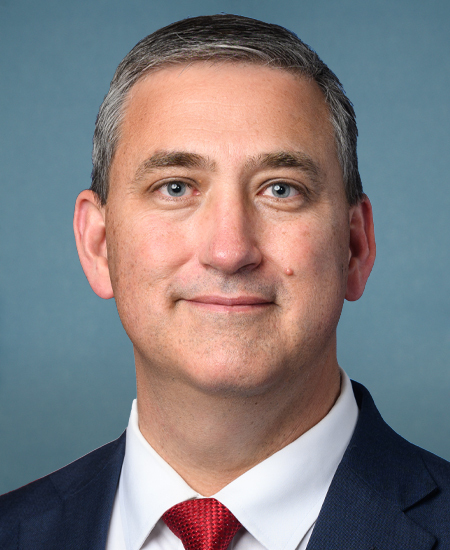
Photo of Nathaniel Moran
R United States House · District 1 · Texas On the 2026 ballot

Rep. Nathaniel Moran

Compare
Total votes
1,860
all sessions
Attendance
99%
19 missed
Near the chamber average
With party
95%
of cast votes
Higher than 96% of chamber peers
Bipartisan score
3%
crosses aisle rarely
Lower than 97% of chamber peers
Sponsored
518
bills & resolutions
Near the chamber average
Committees
5
assignments
518 bills and resolutions

Sponsored bills

Total
518
Primary
45
Co-sponsor
473
This page
518
matching current filters
Co-sponsor HR 2872
In committee · Ohio House · Co-sponsor
RESILIENCE Act of 2025

Maddy summaryHR 2872 (the RESILIENCE Act of 2025) amends the tax code to change how public utilities can deduct repair and maintenance costs for certain infrastructure. It requires utilities to reduce their taxable income by the same amount they deduct for these repairs on their financial statements, specifically for property owned by the utility and accounted for as depreciation. This applies to utilities owning infrastructure covered under Section 168(i)(10) of the tax code, aligning their tax deductions with financial reporting. The change takes effect for taxable years starting after December 31, 2024.

In committee Apr 10, 2025 1 co-sponsor
Co-sponsor HR 2819
In committee · Ohio House · Co-sponsor
DRIVE Act

Maddy summaryHR 2819, the DRIVE Act, prohibits the Federal Motor Carrier Safety Administration from requiring speed limiting devices on trucks weighing over 26,000 pounds operating in interstate commerce. This directly affects commercial truck drivers and carriers that operate large vehicles across state lines. The bill blocks the agency from implementing any rule mandating speed limiters that would cap these trucks' maximum speed. It prevents a potential new federal requirement for trucking companies without altering existing safety standards.

In committee Apr 10, 2025 1 co-sponsor
Co-sponsor HR 22
Passed · Ohio House · Co-sponsor
SAVE Act

Safeguard American Voter Eligibility Act or the SAVE Act This bill requires individuals to provide documentary proof of U.S. citizenship when registering to vote in federal elections. Specifically, the bill prohibits states from accepting and processing an application to register to vote in a federal election unless the applicant presents documentary proof of U.S. citizenship. The bill specifies what documents are considered acceptable proof of U.S. citizenship, such as identification that complies with the REAL ID Act of 2005 that indicates U.S. citizenship. Further, the bill (1) prohibits states from registering an individual to vote in a federal election unless, at the time the individual applies to register to vote, the individual provides documentary proof of U.S. citizenship; and (2) requires states to establish an alternative process under which an applicant may submit other evidence to demonstrate U.S. citizenship. Each state must take affirmative steps on an ongoing basis to ensure that only U.S. citizens are registered to vote, which shall include establishing a program to identify individuals who are not U.S. citizens using information supplied by certain sources. Additionally, states must remove noncitizens from their official lists of eligible voters. The bill allows for a private right of action against an election official who registers an applicant to vote in a federal election who fails to present documentary proof of U.S. citizenship. The bill establishes criminal penalties for certain offenses, including registering an applicant to vote in a federal election who fails to present documentary proof of U.S. citizenship.


Passed Apr 10, 2025 1 co-sponsor
Co-sponsor HR 2757
In committee · Ohio House · Co-sponsor
Medicare Audiology Access Improvement Act of 2025

Maddy summaryThis bill expands Medicare coverage to include audiology services provided by qualified audiologists without requiring a physician referral or supervision. Starting January 1, 2027, Medicare will pay 80% of the standard rate for these services, which include hearing and balance assessments and treatment. It specifically allows audiologists to legally provide these services under state law, as long as they are covered if provided by a physician. The bill does not expand the types of services covered beyond those already payable under Medicare as of December 31, 2026.

In committee Apr 9, 2025 1 co-sponsor
Co-sponsor HR 2794
In committee · Ohio House · Co-sponsor
NO FAKES Act of 2025

Maddy summaryThe NO FAKES Act of 2025 establishes legal rights for individuals to control how their voice and visual likeness are used in digital replicas, which are defined as highly realistic computer-generated representations readily identifiable as a specific person. The bill requires authorization from the individual or their designated right holder before using their likeness in digital replicas, with specific rules for minors (limiting licenses to 5 years) and post-mortem rights (allowing 10 years of protection with possible 5-year renewals). It creates civil liability for unauthorized use of digital replicas or for distributing products/services designed to create such replicas without authorization, with penalties ranging from $5,000 to $750,000 per violation depending on the entity involved. Online services are provided safe harbor protections if they follow procedures for handling takedown notices and have designated agents for copyright issues, while also including exemptions for news, commentary, criticism, and historical uses. The law preempts most state laws regarding digital likeness rights but has exceptions for certain historical uses, news, and sexually explicit content.

In committee Apr 9, 2025 1 co-sponsor
Co-sponsor HR 2788
In committee · Ohio House · Co-sponsor
End DWI Act of 2025

Maddy summaryHR 2788, the End DWI Act of 2025, requires states to mandate ignition interlock devices for drivers convicted of driving while intoxicated (DWI) for a minimum of 180 days. States that fail to implement this requirement risk losing 3% of federal highway funds in 2027 and 5% annually thereafter. The bill directly affects states (by tying funding to policy compliance) and DWI offenders (who must use interlock devices to regain driving privileges). Key provisions include a national standard for interlock use, defined exceptions (like employer vehicles), and mechanisms for restoring withheld funds once states comply.

In committee Apr 9, 2025 1 co-sponsor
Co-sponsor HR 2102
In committee · Ohio House · Co-sponsor
Major Richard Star Act

Maddy summaryThis bill, HR 2102 (Major Richard Star Act), allows veterans with combat-related disabilities to receive both full military retired pay and veterans' disability compensation simultaneously, without the previous offset that reduced retired pay. It directly affects veterans already eligible for both benefits due to combat-related injuries, removing the requirement that their retired pay be reduced by the disability compensation amount. The key provision amends Title 10 and Title 38 to eliminate the offset rule (sections 5304 and 5305 of Title 38) for these veterans. The change applies to payments starting after the bill’s enactment date, effective for all qualifying veterans. This is a policy change to increase financial support for affected veterans, not a new benefit.

In committee Apr 4, 2025 1 co-sponsor
Co-sponsor HR 2570
In committee · Ohio House · Co-sponsor
Maximum Pressure Act

Maddy summaryThis bill codifies a "maximum pressure" policy toward Iran, requiring the U.S. to maintain all sanctions until Iran meets specific conditions related to its nuclear program, missile development, support for terrorism, and human rights violations. It expands sanctions on Iran's Revolutionary Guard Corps (IRGC) and entities supporting Iran's ballistic missile program, while prohibiting waivers of sanctions on these entities. The bill mandates regular reports to Congress on Iran's nuclear activities, support for terrorist groups like Hamas and Hezbollah, and human rights abuses within Iran. It also directs the use of frozen Iranian assets to support victims of state-sponsored terrorism and prevents the release of funds that could benefit Iran's terrorist proxies. The bill aims to maintain economic and diplomatic pressure on Iran until it changes its behavior across multiple fronts.

In committee Apr 1, 2025 1 co-sponsor
Co-sponsor HR 2547
In committee · Ohio House · Co-sponsor
Secure Family Futures Act of 2025

Maddy summaryThis bill, titled "Secure Family Futures Act of 2025" but actually focused on tax code changes, primarily affects a specific subset of insurance companies. It amends the Internal Revenue Code to exclude certain debts (like bonds or notes) held by these companies from being counted as capital assets (Section 2), and extends their capital loss carryover period to 10 years for losses from foreign expropriation or losses incurred by these companies (Section 3). The changes apply to debts acquired and losses arising after December 31, 2025. The bill's title is misleading, as it does not relate to family policy but is a technical tax amendment targeting defined insurance industry entities.

In committee Apr 1, 2025 1 co-sponsor
Co-sponsor HR 2548
In committee · Ohio House · Co-sponsor
Sanctioning Russia Act of 2025

Sanctioning Russia Act of 2025   This bill imposes penalties on certain persons (individuals and entities) if the President determines that the Russian government or a person acting at Russia's direction is involved with (1) refusing to negotiate a peace agreement with Ukraine; (2) violating a negotiated peace agreement; (3) initiating another invasion of Ukraine; or (4) overthrowing, dismantling, or seeking to subvert the Ukrainian government.   If the President makes such a determination, the bill requires certain actions including the President must impose visa- and property-blocking sanctions on specified persons such as the Russian president, certain Russian military commanders, and any foreign person that knowingly provides defense items to the Russian armed forces; the President must increase the rate of duty on all goods and services imported from Russia into the United States to at least 500% relative to the value of such goods and services; the President must increase the rate of duty on all goods and services imported into the United States from countries that knowingly engage in the exchange of Russian-origin uranium and petroleum products to at least 500% relative to the value of such goods and services; the Department of the Treasury must impose property-blocking sanctions on any financial institution organized under Russian law and owned wholly or partly by Russia, and any financial institution that engages in transactions with those entities; and the Department of Commerce must prohibit the export, reexport, or in-country transfer to or in Russia of any U.S.-produced energy or energy product.

In committee Apr 1, 2025 1 co-sponsor
Showing 171 to 180 of 518 bills
Previous 1 17 18 19 52 Next