

Maddy summaryThe John R. Lewis Voting Rights Advancement Act of 2023 would strengthen the Voting Rights Act of 1965 by updating the criteria for which states and localities must obtain federal preclearance before changing voting practices. It would establish new standards for proving vote dilution and vote denial by requiring courts to consider historical discrimination, racial polarization in voting, and whether voting practices disproportionately burden minority voters. The bill would also require states and localities to provide public notice of voting changes and share demographic data about polling locations. These changes would primarily affect jurisdictions with a history of voting rights violations, aiming to prevent discriminatory voting practices before they take effect.
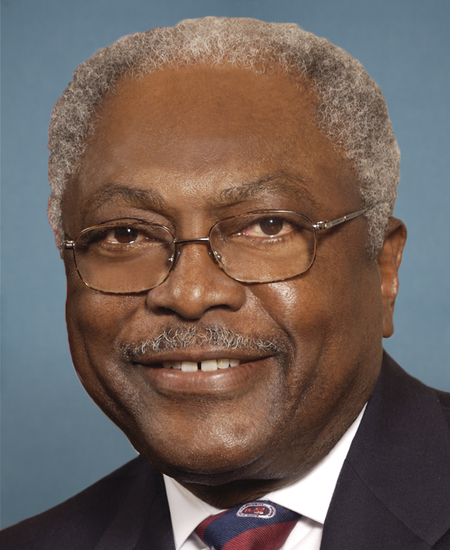
Rep. James E. Clyburn
Sponsored bills
Maddy summaryThis bill prohibits individuals convicted of a misdemeanor hate crime or who received an enhanced sentence for a hate-motivated misdemeanor from obtaining, possessing, shipping, or transporting firearms. It directly affects people convicted under state, federal, or tribal law of a misdemeanor involving physical force or credible threat motivated by bias against race, religion, national origin, gender, sexual orientation, gender identity, or disability. The law amends existing federal gun laws (18 U.S.C. §§ 922(d) and 922(g)) to add this category to the list of prohibited persons, with specific exceptions for cases where the conviction was expunged, the person had proper legal counsel, or civil rights were restored. The bill focuses on concrete policy changes to restrict firearm access for this specific group, not broader speculation.
Maddy summaryThe Break the Cycle of Violence Act establishes federal grants to fund community-based violence intervention programs in areas disproportionately affected by gun violence, particularly communities of color. It authorizes $300 million for 2024, increasing to $700 million annually through 2031, for evidence-informed strategies including trauma-responsive care, violence interruption, and economic opportunities for opportunity youth (ages 16-25 not in school or employment). The bill requires grantees to implement culturally competent services targeting individuals at high risk of violence or victimization, with a focus on reducing gun violence without contributing to mass incarceration. It creates a National Community Violence Response Center to coordinate data collection, research, and best practices for community violence prevention. The legislation also includes provisions for job training and workforce development programs through the Department of Labor to connect opportunity youth with in-demand occupations.
Maddy summaryHR 4965, the Kimberly Vaughan Firearm Safe Storage Act, requires the Attorney General to create voluntary best practices for safe firearm storage in homes, businesses, vehicles, and other locations within 180 days of enactment, with public input. Starting January 1, 2025, firearm manufacturers must include a "SAFE STORAGE SAVES LIVES" notice with each new handgun, rifle, or shotgun, directing buyers to the public website with these guidelines. The bill also establishes a $10 million annual grant program for states and tribes to fund public programs distributing safe firearm storage devices (like locked containers) and requires grantees to use at least 75% of funds for these programs. It does not mandate storage for individuals but provides resources and information to promote safer practices.
Maddy summaryHR 4889, the Raise the Wage Act of 2023, would gradually increase the federal minimum wage for most workers to $15.50 per hour by 2027, with specific annual targets: $9.50 starting in 2023, rising to $11.00 after one year, $12.50 after two years, and $15.50 after four years. It would also phase out the separate lower minimum wage for tipped employees (starting at $6.00/hour) by aligning their pay with the regular minimum wage by 2028, while requiring employers to let workers keep all tips. The bill includes similar phased increases for workers under 20 and transitions toward fairer wages for workers with disabilities under special certificates, which would sunset after 2028. Future annual increases after 2028 would tie the minimum wage to the median hourly wage of all workers.
Maddy summaryThis bill authorizes $30 million annually (2024-2028) for the National Institutes of Health to expand research on uterine fibroids, including studies on racial disparities (noting Black women are 80% likely to develop fibroids by menopause versus 70% of White women). It also requires the creation of a Medicaid database to track treatment services for fibroids and mandates a congressional report on related costs and coverage. The bill directs the Department of Health and Human Services to develop public education materials about fibroid symptoms, treatment options (including non-hysterectomy care), and racial prevalence differences. It directly affects women with fibroids - particularly those from racial minority groups - and aims to improve data collection and awareness around a condition causing significant health burdens and healthcare costs.
Maddy summaryHR 4515, the PRIME Act, provides competitive federal grants to qualifying colleges and universities to improve athletic facilities and equipment. It directly affects small-endowment institutions (with endowments under $900 million) that generate less than $20 million annually from athletic programs. Grants of at least $250,000 can be used to build or upgrade stadiums, gyms, fields, or purchase event-related materials like uniforms and equipment, following NCAA/NAIA guidelines. The bill targets schools with limited athletic revenue, aiming to support infrastructure without funding staff salaries or general operations.
Maddy summaryHR 3849, the Rural Energy Savings Act, amends an existing energy efficiency program to expand access and support for clean energy projects. It directly affects Indian Tribes, nonprofit "green banks" using innovative financing, and rural consumers by adding them as eligible entities for loans and grants. Key changes include allowing loans with terms up to 20 years for energy efficiency measures (like solar systems or appliance replacements), increasing grant rates to 10% for loans in persistent poverty counties, and clarifying that loans can be made to any consumer within an entity's service area regardless of rural location. The bill modifies repayment rules and adds requirements for outreach and technical assistance to support program implementation.
Maddy summaryHR 4466 would rename the National School Lunch Program Act from "Richard B. Russell National School Lunch Act" to "Jean E. Fairfax National School Lunch Act" to honor Jean E. Fairfax, a civil rights activist who advocated for equitable access to the program. The bill would update this name in the law and over 40 other federal statutes referencing the current title, but does not alter the program's operations, funding, or eligibility. It directly affects legal references in federal law without changing how the program serves students.
Maddy summaryHR 4422 (Global Respect Act) requires the President to publicly identify foreign officials responsible for violence, torture, or arbitrary detention against LGBTQI individuals and block their entry to the U.S., including revoking visas for them and their immediate families. It mandates annual reporting to Congress on the list of sanctioned individuals, the reasons for additions/removals, and efforts to coordinate with other countries on similar sanctions. The bill also updates U.S. human rights reporting requirements to explicitly include data on violence and discrimination against LGBTQI people worldwide. These measures aim to increase accountability for human rights violations against LGBTQI individuals without advocating for specific policy outcomes.