

Maddy summaryHR 8192, the High School Voter Empowerment Act of 2024, requires all public high schools (as defined by federal education law) to serve as official voter registration agencies under the National Voter Registration Act. It mandates that each high school conduct at least one annual voter registration drive targeting students enrolled in American Government or Economics courses, aged 17+ by April 10, and eligible to vote for federal office. The bill also establishes a federal grant program to reimburse schools for reasonable costs incurred during these registration drives, including documentation of activities and student registrations. This law directly affects public high schools and state election officials, creating a new requirement for schools to facilitate voter registration for eligible students.
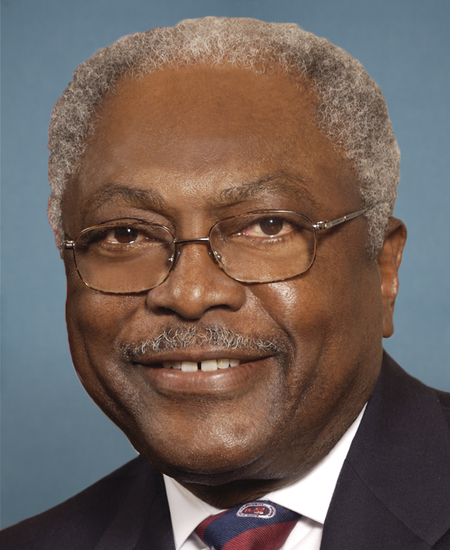
Rep. James E. Clyburn
Sponsored bills
Maddy summaryHR 8061, the Crime Victims Fund Stabilization Act of 2024, ensures stable funding for the Crime Victims Fund by directing certain False Claims Act collections into it from 2024 through 2029. Specifically, it adds a provision requiring that amounts collected under the False Claims Act (excluding whistleblower rewards and government reimbursement for damages) be deposited into the fund during this period. This directly affects crime victims who rely on the fund for services like counseling and emergency aid, as it prevents potential shortfalls in funding. The bill makes a concrete policy change by redirecting specific federal civil penalties into the fund, rather than altering the fund's existing purposes or eligibility rules.
Maddy summaryHRES 1142 is a non-binding House resolution recognizing the 10th anniversary of Boko Haram's 2014 kidnapping of 276 Chibok schoolgirls in Nigeria and urging the Nigerian government to intensify efforts against Boko Haram. It specifically calls on Nigeria to prioritize recovering abducted women and girls, account for missing persons, reduce stigma against survivors, and allow family reunifications. The resolution also urges the U.S. government to implement existing anti-terrorism strategies and track missing persons for inclusion in annual reports. This resolution directly affects the Nigerian government and the remaining 98+ Chibok girls still held captive, alongside other victims of Boko Haram's violence. It does not create new law but formalizes a call for coordinated action to address ongoing captivity and conflict in Nigeria's northeast region.
Maddy summaryHRES 1101 is a non-binding resolution expressing the House of Representatives' support for collaborating with the Congressional Black Caucus to develop a "Black Wealth Agenda." It commits the House to outlining legislative priorities focused on closing the racial wealth gap through key areas like expanding Black entrepreneurship, reforming housing policies, building workforce development programs, and updating the federal minimum wage. The resolution emphasizes addressing systemic barriers in homeownership, education access, employment discrimination, and tax policy to advance economic equity for Black communities. It does not create new laws but directs the House to coordinate with the CBC on policy solutions targeting wealth-building opportunities.
Maddy summaryHRES 1096 is a non-binding resolution expressing support for the House of Representatives to collaborate with the Congressional Black Caucus in developing the "Black Wealth Agenda." It identifies key areas requiring policy action, including closing the racial wealth gap through improvements in homeownership access, education equity, fair employment practices, affordable housing, and tax reform. The resolution outlines priorities such as expanding support for Black entrepreneurship, addressing systemic housing discrimination, raising the federal minimum wage, and investing in historically Black colleges. It does not create new laws or mandate specific actions but commits the House to coordinating legislative efforts focused on these economic equity goals. The resolution was introduced by multiple representatives and referred to relevant committees for review.
Maddy summaryHR 7056, the Access to Family Building Act, establishes federal rights for individuals to access assisted reproductive technology (ART) like IVF without unreasonable restrictions, directly affecting patients seeking fertility treatments and health care providers offering ART services. The bill prohibits states from imposing limitations on ART that are more burdensome than those for comparable medical procedures, fail to advance safety, or unduly restrict access, while allowing health and safety regulations that are necessary and least restrictive. It creates federal enforcement mechanisms, including lawsuits by the Attorney General or affected individuals to challenge violating state laws, and preempts conflicting state regulations. The bill explicitly preserves state authority over health/safety regulations and does not alter existing state insurance coverage laws for ART.
Maddy summaryThe Affordable Connectivity Program Extension Act of 2024 allocates $7 billion in funding for the Affordable Connectivity Program (ACP) during fiscal year 2024. The ACP provides subsidies to low-income households to help cover the cost of internet service and connected devices like laptops or tablets. This funding ensures the program can continue supporting eligible households throughout the year, with the money remaining available until fully spent. The bill extends existing program funding without changing eligibility criteria or service requirements.
Maddy summaryThe Brittany Clardy Missing and Murdered Black Women and Girls Act establishes a new Office within the Department of Justice to address the disproportionate rates of missing and murdered Black women and girls in the U.S. The Office will collect and analyze data on these cases - including case resolution times, Amber Alert usage, and trafficking links - and create a public dashboard for tracking. It also creates a grant program for community organizations to provide culturally appropriate prevention services, law enforcement training, and victim support. The Office must submit biennial reports to Congress with findings and recommendations to improve the criminal justice response to these cases. This bill directly affects Black women and girls facing violence, law enforcement agencies, and community organizations providing related services.
Maddy summaryThe Nuclear Fuel Security Act of 2023 establishes three key programs to increase domestic production of nuclear fuel, specifically high-assay, low-enriched uranium (HALEU) and low-enriched uranium (LEU), to support advanced nuclear reactor development. The Department of Energy must establish a Nuclear Fuel Security Program to boost domestic production, expand the American Assured Fuel Supply Program to maintain uranium reserves for supply disruptions, and create a dedicated HALEU for Advanced Nuclear Reactor Demonstration Projects Program. This program requires the Department to make specific quantities of HALEU available to reactor developers by set deadlines (3 metric tons by 2024, 8 more by 2025, and 10 more by 2026). The bill directs the Department to prioritize domestic uranium production where possible or partner with allied countries when domestic options aren't available, while ensuring reasonable compensation for fuel provided and avoiding market disruption.
Maddy summaryThis bill expands eligibility for VA-furnished headstones, markers, or medallions to include two groups: (1) enslaved individuals who accompanied military personnel during service, and (2) people who performed military functions despite being barred from service due to discrimination based on race, gender, sex, or ethnicity. The VA must create regulations within one year, defining "military function" and accepting evidence like pay records, diaries, or family bibles to verify eligibility. Requests must be made by direct descendants or approved representatives acting on their behalf. The bill requires the VA to submit an implementation report to Congress within 15 months of enactment.