

Rebuilding Communities After Disasters Act This bill requires the Small Business Administration (SBA) to increase the loan limits for the disaster loan program and to communicate certain information about the program following disasters. Specifically, the bill raises from $40,000 to $75,000 the loan amount for repair or replacement of household and personal effects and from $200,000 to $400,000 the loan amount for repair or replacement of a primary residence. Further, the bill requires the SBA to communicate through radio, television, print, and web-based outlets all relevant information needed by disaster loan applicants if a disaster is declared or the SBA declares eligibility for additional disaster assistance. (Currently, the SBA is only required to endeavor to communicate such information.) The SBA must submit a report on the disaster loan program that includes information such as the number and dollar value of program loans and the average estimated dollar value of damage sustained by borrowers.
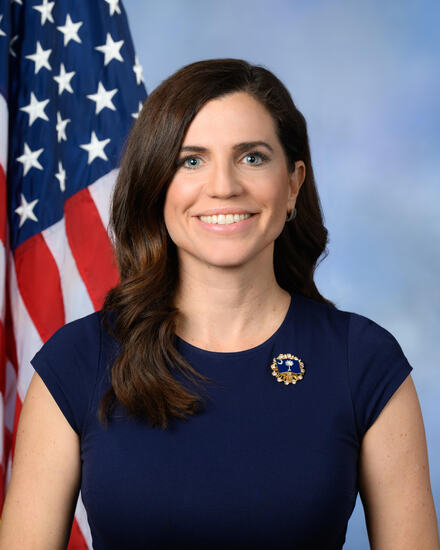
Rep. Nancy Mace
Sponsored bills
Artistic Recognition for Talented Students Act or the ARTS Act This bill directs the Copyright Office to waive various copyright registration-related fees for works that win certain competitions sponsored by the Congressional Institute or established by Congress. To qualify for the fee waiver, the copyright registration application must be filed within a specified time frame, but the Copyright Office may waive fees for a qualifying work even if the application is filed outside the time frame.
Puppy Protection Act of 2021 This bill requires the Department of Agriculture to expand standards that govern the humane handling, care, treatment, and transportation of animals to include new requirements for commercial dog dealers. Specifically, the standards must require dog dealers to provide to dogs adequate housing, exercise, and veterinary care; appropriate and nutritious food; continuous access to potable water; and meaningful socialization with humans and compatible dogs for at least 30 minutes each day. The standards must also include requirements for breeders to use safe breeding practices and make all reasonable efforts to find humane placement for retired breeding dogs.
This bill repeals the Authorization for Use of Military Force Against Iraq Resolution of 2002.
Shark Fin Sales Elimination Act of 20 21 This bill addresses the sale of shark fins and the inclusion of rays and skates in the Seafood Traceability Program. The Seafood Traceability Program has data reporting and recordkeeping requirements at the time of entry for imported fish or fish products entered into U.S. commerce. The bill makes it illegal to possess, buy, or sell shark fins or any product containing shark fins, except for certain dogfish fins. A person may possess a shark fin that was lawfully taken consistent with a license or permit under certain circumstances. Penalties are imposed for violations under the Magnuson-Stevens Fishery Conservation and Management Act. The Department of Commerce must revise its regulations to include rays and skates as species that are subject to the Seafood Traceability Program.
This bill expands eligibility for Post-9/11 GI Bill benefits to members of the National Guard who perform certain full-time service at the request of the President or the Secretary of Defense (i.e., full-time National Guard duty). Specifically, the bill eliminates the existing requirement that eligible full-time service must be in response to a declared national emergency. The bill also specifies that training is not included as full-time service for purposes of eligibility for these members.
Strengthening and Amplifying Vaccination Efforts to Locally Immunize All Veterans and Every Spouse Act or the SAVE LIVES Act This bill authorizes the Department of Veterans Affairs (VA) to furnish a COVID-19 (i.e., coronavirus disease 2019) vaccine to covered individuals during the COVID-19 public health emergency. Under the bill, covered individuals are veterans who are not eligible to enroll in the VA health care system; specified veterans who are eligible for hospital care, medical services, and nursing home care abroad; beneficiaries who are eligible for care due to a specified disability or death of a veteran; family caregivers of veterans who are participating in the VA's Program of Comprehensive Assistance for Family Caregivers; caregivers of veterans participating in the VA's Program of General Caregiver Support Services; caregivers of veterans participating in the VA's Medical Foster Home Program, Bowel and Bladder Program, Home Based Primary Care Program, or Veteran Directed Care Program; and the spouses of veterans. The VA must prioritize the vaccination of (1) veterans who are enrolled in the VA health care system, (2) veterans who fail to enroll but receive hospital care and medical services for specified disabilities in their first 12 months of separation from service, and (3) caregivers accompanying such prioritized veterans. Under the bill, the VA is authorized to determine the timing for offering a vaccine to the spouse of a veteran.
Trillion Trees Act This bills establishes a variety of requirements and incentives to plant trees and conduct other land management practices for the purposes of capturing and storing carbon in domestic and international trees and forests. Additionally, the bill provides incentives to research or develop other carbon sequestration tools. Specifically, the bill directs the Department of Agriculture (USDA) to set targets to increase forest carbon stock through January 1, 2100, for the purposes of sequestering and storing carbon in U.S. forests. It also establishes and provides funding for the Trillion Trees Challenge Fund to provide grants to nonfederal entities for activities related to reforestation efforts on public or private lands. In addition, it raises the cap on the Reforestation Trust Fund to enhance forest health in the National Forest System and requires the USDA to establish a Tree City USA Grant Program. The bill also allows the U.S. Agency for International Development to enter into an agreement with a nonprofit organization to establish an International Forest Foundation to promote reforestation and prevent deforestation. Additionally, it establishes requirements and incentives to address seedling shortages and support nurseries. Finally, the bill provides market incentives to research or develop other carbon sequestration tools relating to biochar, sustainable building practices, biochemical and bioplastic products, and biomass energy.
Flexible Financing for Rural America Act This bill allows rural utility service providers to submit to the Department of Agriculture (USDA) a request to adjust the interest rate or modify the terms of certain loans. The request shall include a report summarizing how the adjustment or modification will assist the borrower in providing critical utility services to a rural community. Specifically, on receipt of a request, USDA or the Department of the Treasury (in the case of a loan owned by the Federal Financing Bank) must adjust the interest rate on the loan to match certain interest rates for obligations of comparable maturity to the term remaining on the loan (or a higher rate requested by the borrower), and make modifications to the loan terms as necessary to address changes in the financial position of the borrower due to the COVID-19 public health emergency and to promote the financial sustainability of the borrower. In carrying out the adjustments or modifications, USDA or Treasury shall not impose or collect any fee from, or impose any penalty on, a borrower. The bill also provides funding to implement the adjustments and modifications and for the liquidation of residual intragovernmental amounts owed by the Federal Financing Bank in connection with certain loans.
Hamas International Financing Prevention Act This bill imposes sanctions targeting Hamas, the Palestinian Islamic Jihad, and any affiliate or successor groups. The President shall periodically report to Congress a list of each foreign person or instrumentality that knowingly assists, provides significant support or services to, or is involved in a significant transaction with a senior member or supporter of any of the targeted groups. The President shall impose two or more sanctions on the named persons. Specifically, the person may be (1) denied credit and services from the Export-Import Bank, (2) barred from purchasing certain controlled defense articles, (3) denied exports of items on the U.S. Munitions List, (4) prevented from receiving exports of certain goods or technology controlled for national security reasons, (5) prohibited from receiving financing of more than $10 million from any U.S. financial institution, or (6) subject to property-blocking restrictions. The President shall periodically report to Congress a list of foreign governments that have repeatedly provided material support for the targeted groups' terrorist activities. The President shall bar these governments from receiving for one year (1) U.S. assistance, or (2) exports of controlled munitions. The Department of Treasury shall instruct U.S. leadership of international financial institutions to oppose the provision of assistance to an identified government for one year. The bill provides for certain exceptions and waivers, such as for transactions that would serve U.S. national interests. The President shall report to Congress and periodically provide briefings on other specified topics related to the targeted groups, such as where these groups secure financing and surveillance equipment.