

Maddy summaryHR 6989, the Public Health Nursing Act, provides $5 billion annually (2026-2035) to expand the public health nursing workforce through grants to state, local, and territorial health departments. It directly affects underserved communities by funding the recruitment, hiring, and training of registered nurses in areas with high chronic disease rates, maternal mortality, low-income populations, or rural settings. Key provisions require grant recipients to use funds for nurse wages, medical supplies (like PPE), and administrative costs, while prioritizing services for medically underserved groups and culturally appropriate care. The bill also mandates maintaining pre-grant funding levels and defines public health nurses as those providing preventive care, maternal health services, and chronic disease management.
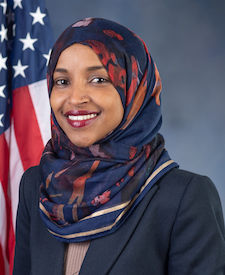
Rep. Ilhan Omar
Sponsored bills
Maddy summaryHR 670, the Lady Liberty Act of 2025, sets a minimum annual refugee admission target of 125,000 people for fiscal years after 2026. It directly affects the U.S. refugee resettlement program by overriding the President’s usual authority to set admission numbers. The key provision amends the Immigration and Nationality Act to require that the number of refugees admitted each year cannot fall below 125,000, regardless of presidential determination. This creates a fixed minimum floor for refugee admissions starting in fiscal year 2027.
Maddy summaryThis bill prohibits states from pursuing or collecting Medicaid recovery claims against individuals' estates for payments made during their lifetime. It requires states to withdraw all existing recovery liens within 90 days of enactment and notify affected individuals or their estates. The law specifically ends state efforts to reclaim Medicaid funds from beneficiaries' estates after death, applying to claims initiated before the law's effective date. It directly affects Medicaid beneficiaries and their estates who were subject to prior state recovery actions. The key mechanism is a mandatory 90-day withdrawal of all existing liens and a permanent ban on new recovery claims for correctly paid assistance.
Maddy summaryHR 4611 (EACH Act of 2025) requires all federally funded health programs - including Medicaid, Medicare, military health plans, and the Indian Health Service - to cover abortion services without restrictions, repealing the Hyde Amendment's long-standing ban on federal funding for most abortions. This directly affects millions of people enrolled in these programs, particularly low-income women, women of color (including 25% of Black women and 22% of Hispanic women on Medicaid), and young people. The bill mandates coverage in all federally administered health plans and prohibits state or private insurers from restricting abortion coverage in health insurance. It aims to eliminate current federal and state barriers that deny abortion access to people who rely on government health programs.
Maddy summaryThis bill prohibits landlords from charging application fees, tenant screening fees, and excessive late fees on "covered" rental properties - those with federally backed mortgages (like FHA, VA, or USDA loans) or HUD assistance. It caps late fees at 3% of monthly rent after a 15-day grace period and requires landlords to disclose total monthly costs, past tenant litigation, maintenance issues, and rent history for the past decade before signing leases. The law directs regulators like HUD to define "junk fees" and ban reporting unpaid fees to credit agencies. It directly affects renters in federally supported housing by limiting unexpected costs and increasing transparency.
Maddy summaryHR 1404, the CHAMPVA Children’s Care Protection Act of 2025, expands healthcare eligibility under the CHAMPVA program for children of veterans. It increases the maximum age for children to receive medical benefits from 21 to 26 years old, regardless of marital status. This change directly affects dependent children of veterans who were previously eligible until age 21, extending coverage through their mid-twenties. The policy amendment applies to medical care provided on or after the bill’s enactment date.
Maddy summaryThis bill amends Section 287(g) of immigration law to restrict immigration enforcement authority exclusively to U.S. Immigration and Customs Enforcement (ICE) officers and DHS employees. It removes state and local law enforcement agencies' ability to verify immigration status, investigate, or arrest individuals for immigration violations under current 287(g) agreements. The change directly affects local police departments that previously participated in immigration enforcement through federal partnerships. The bill does not create new policies but alters existing authority to limit enforcement to federal officers only.
Maddy summaryHCONRES 64 is a congressional resolution directing the President to withdraw U.S. military forces from any hostilities against Venezuela that lack explicit congressional authorization. It applies to ongoing military operations in Venezuela not approved by Congress through a declaration of war or specific law authorizing force. The resolution invokes the War Powers Resolution (50 U.S.C. 1544(c)), requiring the removal of troops within the timeframe specified by that law. This bill does not affect military actions already authorized by Congress but mandates the end of unapproved operations.
Maddy summaryHCONRES 61 directs the President to withdraw U.S. military forces from hostilities against any terrorist organization designated by the president in the Western Hemisphere. This bill specifically applies to military operations involving U.S. armed forces in the region targeting such groups. The key provision requires the withdrawal unless Congress has passed a formal declaration of war or specific authorization for that military action. The resolution invokes Section 5(c) of the War Powers Resolution to compel this change in military deployment.
Maddy summaryThis bill amends federal housing laws to ensure that tenants using marijuana legally under state law are not discriminated against in federally assisted housing. It removes federal prohibitions on state-compliant marijuana use, distribution, possession, sale, or manufacture from definitions of "drug-related criminal activity" and "illegal use of a controlled substance" in housing regulations. Public housing agencies and federally assisted housing providers must now follow state marijuana laws and cannot deny admission or evict tenants based solely on legal state-legal marijuana activity. The bill also requires HUD to establish smoke-free zones for marijuana similar to existing tobacco rules within 90 days of enactment.