

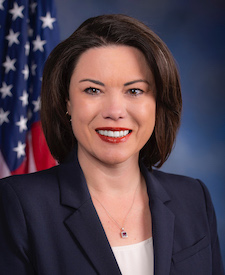
Photo of Angie Craig
D United States House · District 2 · Minnesota

Rep. Angie Craig

Compare
Total votes
2,818
all sessions
Attendance
98%
60 missed
Near the chamber average
With party
93%
of cast votes
Near the chamber average
Bipartisan score
4%
crosses aisle rarely
Near the chamber average
Sponsored
1,825
bills & resolutions
Higher than 96% of chamber peers
Committees
1
assignment
1,825 bills and resolutions

Sponsored bills

Total
1,825
Primary
87
Co-sponsor
1,738
This page
1,825
matching current filters
Co-sponsor HR 8494
In committee · Ohio House · Co-sponsor
To prohibit the Department of Homeland Security from entering into, modifying, extending, or renewing, any contract or intergovernmental service agreement to establish or operate any new immigration detention model, including the use of warehouses, modular facilities, soft-sided structures, tent systems, and processing centers.

Maddy summaryThis bill prohibits the Department of Homeland Security from using federal funds to create or expand new immigration detention facilities, including warehouses, tents, and modular structures. It directly affects immigration enforcement agencies by banning the construction, renovation, or operation of non-traditional detention centers and preventing the transfer of funds to such projects. The legislation requires any money previously allocated for these facilities to be redirected toward affordable healthcare and housing services instead. Effective immediately upon enactment, the ban applies to all existing federal funds and prevents the use of current budgets for establishing or operating alternative detention models.

In committee Apr 24, 2026 1 co-sponsor
Co-sponsor HRES 1209
In committee · Ohio House · Co-sponsor
Recognizing the significance of "Community College Month" in April as a celebration of more than 1,000 institutions throughout the United States supporting access to higher education, workforce training, and more, broadly sustaining and advancing the Nation's economic prosperity.

Maddy summaryThis resolution designates April as "Community College Month" to recognize the significance of community colleges across the United States. It celebrates over 1,000 institutions for their role in providing accessible higher education and workforce training, and for contributing to the nation's economic prosperity.

In committee Apr 23, 2026 1 co-sponsor
Co-sponsor HR 8487
In committee · Ohio House · Co-sponsor
Ensuring Excellence in Mental Health Act

Maddy summaryThe Ensuring Excellence in Mental Health Act expands federal support for certified community behavioral health clinics (CCBHCs) by modifying how these facilities are funded under Medicaid and Medicare. Under the new rules, states and the federal government will use a prospective payment system to pay CCBHCs based on the cost of providing care rather than per-visit fees, while also extending coverage to additional services like primary health care. The legislation establishes a new grant program to help clinics operate and expand, creates a national data system to track clinic performance, and introduces an accreditation requirement to ensure quality standards are met. Additionally, the bill extends liability protections to clinicians working in these clinics and removes certain financial barriers for Medicare patients seeking care at CCBHCs.

In committee Apr 23, 2026 1 co-sponsor
Co-sponsor HR 8475
In committee · Ohio House · Co-sponsor
Savings Opportunity and Affordable Repayment Act

Savings Opportunity and Affordable Repayment Act This bill creates a new income-driven repayment plan for student loans called the Savings Opportunity and Affordable Repayment (SOAR) plan. The SOAR plan has similar provisions to, but further expands on, the Department of Education's (ED's) final rule published on July 10, 2023, that created the Saving on a Valuable Education (SAVE) plan. The SAVE plan was blocked by federal courts. The bill directs ED to carry out a SOAR plan program that complies with specified requirements. The bill allows all federal student loan types to be eligible for repayment under the SOAR plan, including Parent PLUS Loans and Federal Family Education Loans. Under the SOAR plan, a federal student loan borrower whose income is at or below 250% of the federal poverty level (FPL) has $0 monthly payments. A borrower whose income is over 250% of the FPL pays 5% of their discretionary income on loans obtained for undergraduate study and 10% of their discretionary income for all other outstanding loans (e.g., loans obtained for graduate study). Additionally, under the SOAR plan, holders of eligible federal student loans (e.g., ED or private lenders) must apply 50% of the borrower's monthly payment toward outstanding principal. The other 50% must be applied in the following order: (1) accrued charges and collection costs on the loan, (2) outstanding interest, and (3) outstanding principal. ED must forgive any loan balance that remains outstanding after a specified maximum repayment period (e.g., 10 years or 15 years).

In committee Apr 23, 2026 1 co-sponsor
Co-sponsor HR 8465
In committee · Ohio House · Co-sponsor
Funding Early Childhood is the Right IDEA Act

Maddy summaryThe "Funding Early Childhood is the Right IDEA Act" proposes to increase authorized funding for specific programs under the Individuals with Disabilities Education Act (IDEA). This bill sets new appropriation levels for Part C of IDEA, which provides early intervention services for infants and toddlers with disabilities and their families. It also increases authorized funding for Section 619 of IDEA, which supports preschool special education for children aged three to five. These funding authorizations are scheduled for fiscal years 2027 through 2031, directly affecting children with disabilities and the state and local agencies that provide these services.

In committee Apr 23, 2026 1 co-sponsor
Co-sponsor HR 8092
In committee · Ohio House · Co-sponsor
Native American Housing Assistance and Self-Determination Modernization Act of 2026

Maddy summaryThis bill modernizes housing assistance programs for Native American tribes and Native Hawaiians by streamlining environmental reviews, extending funding authorization through 2032, and expanding loan guarantee options. Key provisions include consolidating environmental review requirements to reduce paperwork for tribes, allowing 99-year leasehold interests on trust lands for housing, and creating new rental assistance specifically for homeless or at-risk Native American veterans. The legislation also clarifies rent rules, waives certain housing counseling certifications for tribal entities, exempts tribal housing projects from some federal civil rights and Buy America requirements, and establishes a direct loan guarantee process for tribal housing projects.

In committee Apr 23, 2026 1 co-sponsor
Co-sponsor HR 8457
In committee · Ohio House · Co-sponsor
Homegrown Fertilizer Act

Maddy summaryThe Homegrown Fertilizer Act directs the U.S. Department of Agriculture to provide grants and loans to domestic businesses, nonprofits, cooperatives, tribes, and local governments that manufacture, process, or store fertilizer and nutrient alternatives. To qualify, recipients must be independently owned, located within the United States, and certify that they do not hold a market share equal to or greater than the fourth-largest company in the fertilizer industry. Funds can be used for building or expanding facilities, purchasing equipment, improving production efficiency, reducing emissions, and training workers, with grants capped at $100 million requiring matching non-Federal funds. The program prioritizes projects that enhance innovation, increase domestic production capacity, and improve competition to reduce fertilizer prices and volatility for American farmers, while requiring repayment if the recipient facility is sold to a larger competitor within 10 years.

In committee Apr 22, 2026 1 co-sponsor
Primary HR 8442
In committee · Ohio House · Lead sponsor
Patient Refunds for Bad Denials Act of 2026

Maddy summaryThis bill establishes penalties for health insurance companies that deny a high percentage of patient claims, aiming to protect consumers from frequent rejections. Under the new rules, the government could fine insurers up to $10 million plus additional amounts for every percentage point their denial rate exceeds 25 percent, provided the denials are not based on proven fraud or lack of medical necessity. If a company pays these fines, the money is distributed proportionally among the patients enrolled in that insurer's plans during the year. The legislation also requires insurers to explain why they denied claims as medically unnecessary and to report their overall denial rates to the government annually. These measures take effect for plan years starting on or after January 1, 2027.

In committee Apr 22, 2026 0 co-sponsors
Co-sponsor HR 8402
In committee · Ohio House · Co-sponsor
Civics Learning Act of 2026

Maddy summaryThe Civics Learning Act of 2026 amends the Elementary and Secondary Education Act to expand federal funding and support for civics education in K-12 schools. The bill directs the Department of Education to distribute $70 million in grants to schools, with at least 60 percent reserved for elementary and middle schools and a preference for programs that include hands-on civic engagement, constitutional history, and civil rights education. It also requires grant recipients to submit annual reports detailing how they meet civics education goals and ensures geographic diversity in funding distribution across urban, suburban, and rural areas.

In committee Apr 21, 2026 1 co-sponsor
Co-sponsor HR 8397
In committee · Ohio House · Co-sponsor
Protecting Moms and Babies Against Climate Change Act

Maddy summaryThis bill establishes a grant program to help vulnerable mothers and babies in areas with high climate-related health risks, such as extreme heat and air pollution. It directs the Department of Health and Human Services to award up to $105 million over four years to community groups, healthcare providers, and local organizations for initiatives that provide cooling resources, health education, and support services. The program prioritizes areas with high rates of maternal and infant health disparities and requires grantees to address racial and ethnic inequities. Additionally, the bill creates a research consortium at the National Institutes of Health to study climate impacts on birth outcomes and funds training programs for health profession schools to better prepare providers for these risks.

In committee Apr 21, 2026 1 co-sponsor
Showing 101 to 110 of 1,825 bills
Previous 1 10 11 12 183 Next