

Maddy summaryThe Extreme Temperatures Injustice in Prisons Act of 2026 requires the Bureau of Prisons to upgrade heating, ventilation, and air conditioning systems in all correctional facilities and install temperature monitoring devices in every occupied space. The bill mandates the creation of written standards to prevent heat and cold stress, provides free cooling and heating supplies to inmates during dangerous weather, and establishes specific protective rules for medically vulnerable populations. Additionally, the legislation requires regular reports to Congress on system costs and temperature-related illnesses, while authorizing funding through fiscal year 2031 to support these safety improvements.
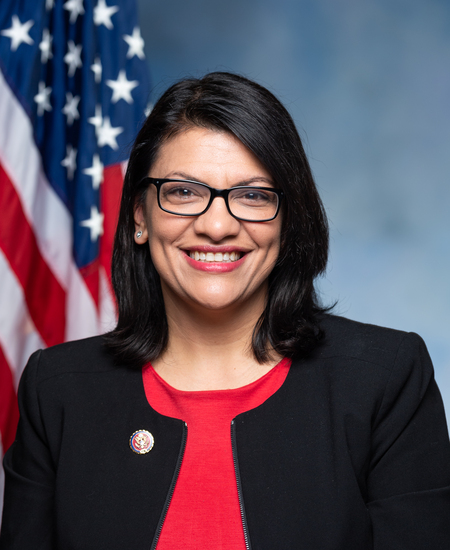
Rep. Rashida Tlaib
Sponsored bills
Maddy summaryThis resolution formally acknowledges Michigan's contributions to the United States as the nation celebrates the 250th anniversary of the Declaration of Independence. It recognizes that Michigan became the 26th state in 1837 and highlights the lasting impact its residents have had on the country's success. The measure encourages all citizens to reflect on the ideals of the Founding Fathers and the fight for independence. As a commemorative action, the bill does not create new laws or change existing policies but serves to honor historical events and state achievements.
Maddy summaryHRES 1405 is a non-binding resolution that encourages the U.S. House of Representatives to recognize June as LGBTQIA+ Pride Month. The document acknowledges the historical significance of events like the Stonewall Inn uprising and highlights the ongoing struggle for equality faced by lesbian, gay, bisexual, transgender, queer, intersex, and asexual individuals. It includes a detailed list of historical milestones and legislative achievements related to LGBTQIA+ rights to provide context for the celebration. Because this measure is a resolution of recognition rather than a law, it does not create new legal obligations or change federal policy.
Maddy summaryThe Community Housing Act of 2026 aims to increase the supply and affordability of housing by directing significant new federal funding to programs like the Housing Trust Fund and the Capital Magnet Fund. It establishes a new Office of Community Land Use and Zoning within HUD to help states and localities reform restrictive zoning laws that limit housing development. The bill also expands financial support for rural areas, creates a new fund to promote shared equity and community land trusts, and removes a legal cap on the number of public housing units agencies can manage. Additionally, it provides grants to protect tenants from eviction and authorizes low-cost financing options for affordable housing projects.
Maddy summaryThe LIFT the BAR Act aims to restore access to federal benefits for lawfully present noncitizens by repealing several restrictions imposed by the 1996 welfare reform law and a 2024 reconciliation bill. Specifically, it would allow eligible noncitizens to receive SNAP food assistance, Medicaid, CHIP, and child nutrition programs, while also updating legal terminology to refer to "noncitizens" rather than "aliens" in relevant statutes. The legislation includes provisions to ensure these individuals can qualify for premium tax credits and would require federal agencies to issue implementation guidance within 180 days of enactment.
Maddy summaryThis bill, titled the Encouraging Public Service in Our National Parks and Public Land Act, requires the Secretary of the Interior to make specific federal recreational lands and waters free of admission fees on designated dates throughout the year. The key provision mandates that these free access days include Martin Luther King Jr. Day, the first day of National Park Week, Juneteenth, Great American Outdoors Day, National Public Lands Day, and Veterans Day. Additionally, the legislation grants the Secretary the authority to establish extra fee-free days beyond those listed. These changes directly affect visitors to national parks and other federal recreational areas by providing them with guaranteed free entry on these holidays and observances.
Maddy summaryThis concurrent resolution directs the President to withdraw all U.S. armed forces from hostilities in Lebanon within seven days of the bill's adoption. It uses the War Powers Resolution to mandate this withdrawal while explicitly allowing continued security cooperation with Lebanese forces and the protection of diplomatic facilities. The measure clarifies that it does not authorize the use of military force, serving as a specific instruction to end active combat operations in the region.
Maddy summaryThis resolution seeks to impeach Linda M. McMahon, the Secretary of Education, for three specific articles of misconduct: willfully violating federal laws, making false statements to Congress, and breaching the public trust. The bill alleges that McMahon illegally transferred the operations of six essential offices within the Department of Education to other federal agencies without congressional approval, contrary to the Department of Education Organization Act. It also claims she misled the Senate by promising to spend all congressionally appropriated funds while simultaneously canceling hundreds of grants and freezing funding for various educational programs. Additionally, the resolution accuses her of terminating approximately 2,000 employees, which disrupted the department's ability to manage federal funds and deliver services. If the House votes to adopt this resolution, the articles of impeachment would be sent to the Senate for a trial that could result in her removal from office.
Maddy summaryThe Bank Failure Accountability Act requires large financial institutions to set aside a significant portion of senior employee compensation into a special fund to ensure accountability for future misconduct. Specifically, the law mandates that executives and high-earning staff defer at least half of their pay that exceeds seven times the median worker's salary, holding this money in reserve for a period ranging from two to eight years depending on the bank's size. If the institution faces fines for illegal actions or fails, these withheld funds must be used first to pay penalties or to return money to depositors, preventing the use of taxpayer resources. Any deferred compensation that cannot be repaid due to the fund running out of money will simply be cancelled, ensuring that employees do not receive full bonuses if their firm causes harm. This measure directly targets high-asset banks, credit unions, and other major financial entities to align executive incentives with long-term stability.
Maddy summaryThe Health and Location Data Protection Act of 2026 prohibits data brokers from buying, selling, or sharing specific types of personal information, including an individual's health data and location history. This ban applies to any entity that resells data it did not collect directly from the person, though it allows exceptions for actions compliant with existing HIPAA rules, newsworthy reporting, and disclosures where the individual has given valid consent. The Federal Trade Commission is tasked with defining exactly what counts as "data" and issuing final rules within 180 days of the law's enactment. Violations of these restrictions can lead to enforcement actions by the FTC, state attorneys general, or private individuals, potentially resulting in civil penalties of up to 15 percent of the violator's annual revenue. The legislation also includes a funding provision that appropriates $1 billion to the FTC for fiscal year 2027 to support its work under this act.