

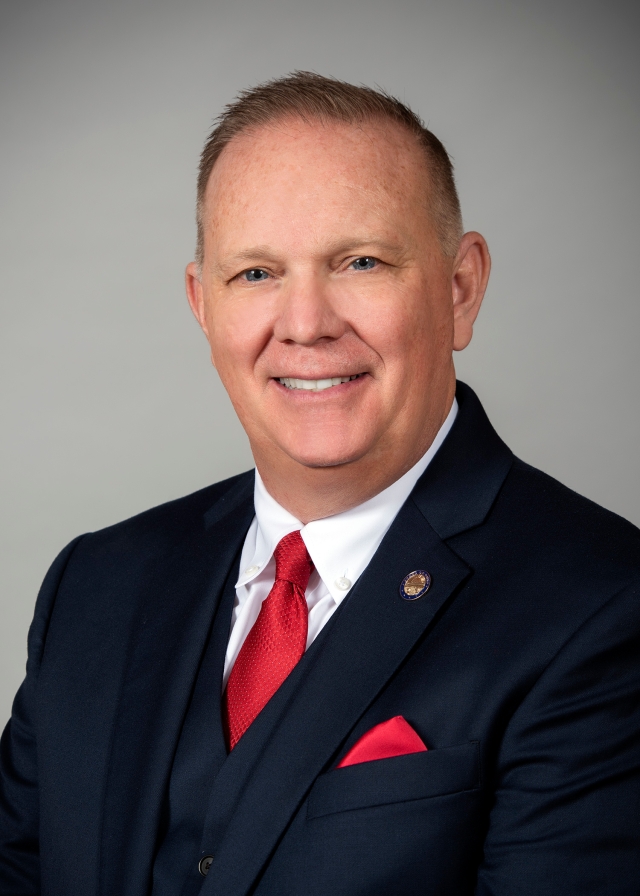
Maddy summaryThis bill formally recognizes Jena Powell for her service as a member of the Ohio House of Representatives. It directs the Clerk of the House to send an official copy of the resolution to her as a gesture of appreciation. The measure does not change any laws or policies but serves as a commemorative acknowledgment of her legislative work and leadership in Miami and Darke Counties.
Sponsored bills
Maddy summaryThis bill formally recognizes Elliot Forhan for his distinguished service as a member of the Ohio House of Representatives. It designates him as an esteemed representative and directs the House Clerk to send an official copy of the resolution to him. The measure serves as a commemorative gesture honoring his legislative work and community leadership rather than enacting new laws or policies.
Maddy summaryThis bill formally recognizes Mike Loychik for his distinguished service as a member of the Ohio House of Representatives. It honors his background as a U.S. Air Force veteran, business owner, and community leader who served constituents in Trumbull, Ashtabula, and Knox counties. The resolution commends his work on various committees and his leadership roles, including co-chairing the Sportsmen's Caucus for Ohio. Finally, it directs the House Clerk to send an official copy of this commendation to Loychik.
Maddy summaryHB 602 exempts home education learning pods from county and township zoning restrictions that would otherwise limit where they can be located. The bill prevents local zoning boards from imposing extra rules specifically targeting these groups, though it maintains the requirement that properties must still meet general zoning standards applicable to all buildings. Additionally, the legislation updates definitions within child care regulations to clarify terms such as "child care," "child day camp," and "chartered nonpublic school." These changes directly affect families organizing home education pods and local governments responsible for zoning and child care oversight.
Maddy summaryThis bill honors the Fort Loramie High School girls volleyball team for winning the 2024 Division VII State Championship. It formally commends the players and their coach, John Rodgers, for their athletic achievement and sportsmanship. The resolution directs the Clerk of the House to send an official copy of the commendation to the team.
Maddy summaryHB 638 modifies how Ohio handles refunds for local sales taxes and certain fees by removing the requirement to pay interest on those refunds. The bill also gives the state tax commissioner more time to recover refunded money from local governments, allowing up to three years to collect the funds. These changes apply to taxes and fees that were illegally or erroneously collected or overpaid.
Maddy summaryHB 671, titled the America First Act, amends Ohio's criminal sentencing laws to allow judges to impose community control sanctions on individuals convicted of certain driving under the influence offenses. This bill affects courts, probation departments, and offenders facing fourth-degree or higher felony OVI charges by giving judges the option to add community control to mandatory prison time or fines. Under the new provisions, offenders must adhere to strict conditions such as random drug testing, staying within the state, and avoiding drug use, with supervision provided by county probation departments or the adult parole authority. The legislation also establishes a reporting system where program administrators must notify courts or probation officers immediately if an offender violates any conditions or leaves the jurisdiction without permission.
Maddy summaryHB 328 amends state laws to specifically address the theft of catalytic converters by elevating such offenses from general theft to a distinct felony charge. The bill mandates that stealing a catalytic converter is automatically classified as a fifth-degree felony, with the severity increasing to a fourth-degree felony if the offender has a prior conviction for catalytic converter theft. Additionally, the legislation imposes specific fines ranging from $10,000 to $50,000 for business entities involved in these thefts and directs that these fines be paid to local law enforcement agencies. By creating these targeted penalties, the bill aims to provide stricter legal consequences for individuals and companies stealing these vehicle parts.
Maddy summaryHB 672 seeks to license and regulate the practice of naturopathic medicine by amending existing sections of the state's Revised Code. The bill primarily affects naturopathic practitioners by establishing a legal framework for their practice, while also clarifying definitions related to pharmacy, drugs, and prescriptions to ensure consistency in healthcare regulations. Key provisions include updating the definition of "pharmacy" and detailing what constitutes "pharmacist care," such as interpreting prescriptions and counseling patients on drug therapy. Additionally, the bill refines the definition of "compounding" to specify circumstances under which drugs can be prepared, mixed, or assembled, and expands the list of licensed health professionals authorized to prescribe drugs. By making these changes, the legislation aims to create a more structured environment for naturopathic medicine and related healthcare services.
Maddy summaryHB 349 creates a program called EnergizeOhio to encourage the development of natural gas pipelines and related infrastructure by offering two main types of support to local governments and development organizations. First, it allows municipalities and counties to request that specific areas be designated as incentive zones, which would exempt up to 75% of qualifying property within those zones from certain taxes if the director determines that a lack of natural gas infrastructure is hurting local economic growth. Second, the bill establishes a loan fund that can provide interest-free loans for up to five years to help eligible entities purchase or lease land easements for building these pipelines, with the expectation that the loans will be repaid using revenue from selling or leasing those easements. Local governments must apply for these designations and loans, and the director of development is responsible for reviewing applications, making decisions, and managing the fund.