

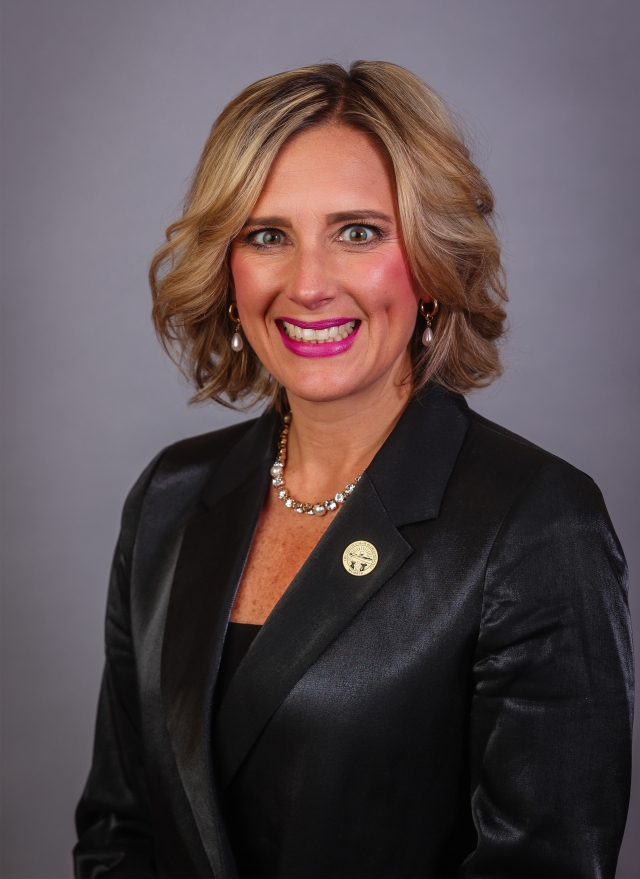
Maddy summaryHB 688 designates September 20 as "Speaker Jo Ann Davidson Day" to honor Jo Ann Davidson, the first female speaker of the Ohio House of Representatives. This legislative measure officially recognizes her historic achievement and birth date within the state government. The bill does not alter existing laws or policies but serves as a commemorative designation to acknowledge her legacy.
Rep. Monica Blasdel
Sponsored bills
Maddy summaryHB 469 establishes the Ohio River Commission of Ohio as an independent state agency within the Department of Development to advance economic growth, marine cargo terminal operations, and tourism along the Ohio River and its tributaries. The commission is composed of state directors, public representatives, and industry experts appointed by the governor and legislative leaders, with specific rules governing their terms and voting procedures. Once formed, the commission will develop a master plan for river infrastructure, coordinate with various government and private entities, collect economic data, and seek federal funding to support projects that promote commerce and job creation in the region.
Maddy summaryHB 89 strengthens the Ohio Board of Nursing's authority to discipline nurses and dialysis technicians who commit fraud, engage in substance abuse, or fail to meet safety standards. The bill allows the board to impose penalties such as license revocation, fines, or reprimands for specific misconduct, including assaulting patients, misusing drugs, or practicing while impaired by alcohol or mental health issues. It also prohibits advanced practice nurses from advertising or waiving patient copayments as an incentive to receive care. These changes aim to ensure public safety by providing clearer grounds for disciplinary action against healthcare professionals who violate ethical or legal obligations.
Maddy summaryThis bill allows county commissioners to contract with an engineer from another county to fill vacant engineering positions when local elections or appointments fail to produce a replacement. It permits a single individual to serve as the county engineer for multiple adjacent counties and establishes a system for supplemental pay based on population size when an engineer works in a county other than their home jurisdiction. Additionally, the legislation sets new standards for real estate deeds, requiring specific boundary survey plats for split or altered land parcels before they are recorded. The bill also creates a mechanism for counties where engineers hold private engineering licenses to designate a substitute official to perform public duties while the primary engineer avoids potential conflicts of interest. Finally, it mandates that county auditors and engineers jointly adopt and publicly review standards for property conveyances to ensure compliance before deeds are transferred.
Maddy summaryHB 683 provides additional funding to soil and water districts and the Farm Financial Management Institute through the Department of Agriculture. The bill allocates specific operating appropriations for the 2024 and 2025 fiscal years to support these entities' ongoing work, including analysis of the upcoming federal farm bill. It also authorizes a $500,000 cash transfer from the Controlling Board Emergency Purposes/Contingencies Fund to the OSU Extension Fund. These financial resources are intended to supplement existing budgets and ensure continued operations for the affected agricultural programs.
Maddy summaryHB 296 increases the mandatory contributions that employers of full-time municipal police officers and members of the Ohio Police and Fire Pension Fund must make to the pension system. The bill establishes a schedule where employee contributions rise gradually from 12.5% to 15% between 2025 and 2030, while employer contributions increase from 19.5% to 23.25% over the same period. To help fund these higher payments, the legislation requires certain municipalities to levy a new property tax of three-tenths of one mill, with revenues prioritized for the pension fund and related liabilities. Additionally, the bill allows the pension fund board to adjust contribution rates in the future if an actuarial study determines such changes are needed to maintain the fund's financial health.
Maddy summaryThis bill is a resolution honoring the memory of Barbara C. Pringle, a former Cleveland City Council member and long-serving Ohio state representative. It formally acknowledges her contributions to public service and directs the House Clerk to send a copy of the tribute to her family. The measure does not enact new laws or policies but serves as a ceremonial gesture to express sympathy and respect for her life and legacy.
Maddy summaryThis bill requires the Ohio Department of Natural Resources to ask residents about their willingness to become organ donors when they apply for hunting or fishing licenses. It expands the ways people can register as donors by allowing them to indicate their choice on driver's licenses, vehicle registrations, or through specific forms and online links for hunting and fishing permits. The legislation also clarifies that a donor's choice remains valid even if their driver's license is revoked or suspended and provides legal protections for state officials who follow these new procedures.
Maddy summaryThis bill modifies the rules for suspending local elected officials who face felony charges related to their official duties. It requires prosecutors to notify the state's highest court when such charges are filed, triggering a review process by a special panel of retired judges. The legislation also allows the accused official to request a provisional suspension of their duties while the case is under review, but it prevents courts from considering whether the defendant showed genuine remorse if they entered an Alford plea. Additionally, the bill updates procedures for sealing and expunging criminal records.
Maddy summaryThis bill establishes a formal process for public-use airports in Ohio to sell aircraft that have been abandoned on their premises. An aircraft is considered abandoned if it has remained on the airport for at least ninety consecutive days without the owner paying any associated fees. The legislation outlines specific steps for airports to identify owners, notify them of accrued costs, and eventually sell the aircraft if those costs are not paid within thirty days. Additionally, the bill clarifies the rights of service providers to place liens on aircraft for unpaid labor, storage, or materials, while ensuring these liens do not hinder the sale of truly abandoned planes.