

Maddy summaryHB 161 removes the legal protection that previously prevented spouses from being charged with or prosecuted for specific sexual offenses against each other. This change directly affects married couples by allowing a spouse to testify against their partner in court for crimes such as rape, sexual battery, and sexual imposition. The bill eliminates the defense that a crime did not occur simply because the victim and offender were married or living together at the time. Additionally, the legislation permits a person to give testimony against their spouse in any prosecution involving these listed offenses.
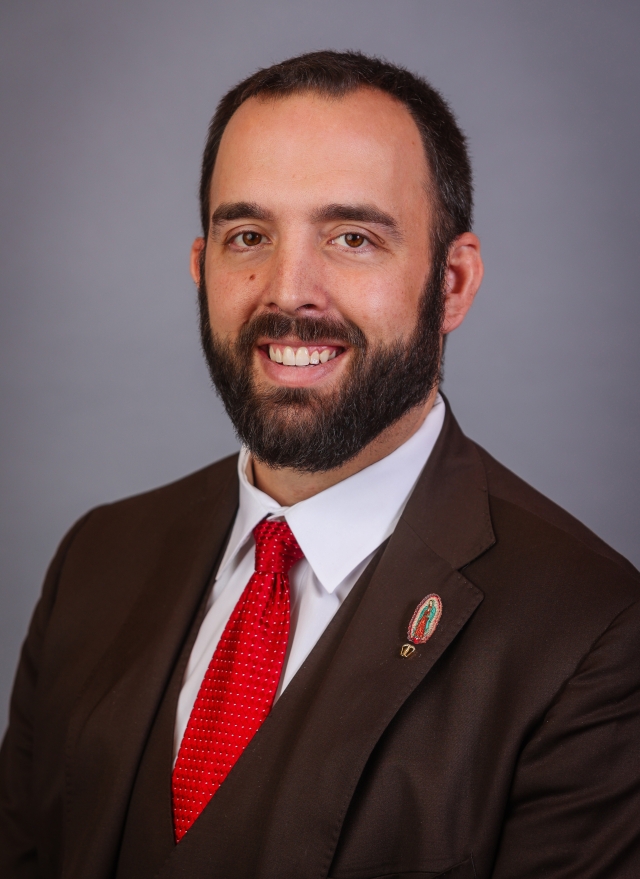
Rep. Adam Mathews
Sponsored bills
Maddy summaryHB 195 creates a new adaptive mobility dealer license to regulate businesses that sell electric personal assistive mobility devices and low-speed micromobility devices. The bill amends existing vehicle definitions to explicitly exclude these specific devices from the standard "vehicle" and "motor vehicle" categories used in state law. By establishing a distinct classification, the legislation allows dealers to operate under a separate license tailored to the unique needs of adaptive mobility equipment rather than general vehicle sales regulations. This change directly affects businesses selling mobility aids and ensures these items are handled through a specialized licensing framework.
Maddy summaryHB 269 designates a portion of State Route 7 in Muskingum County as the "Sgt Bradley J. Harper USMC Memorial Highway" to honor a Marine. The bill also amends the law governing the "ALS Awareness" specialty license plate fund, specifying that contributions collected for this plate must be transferred to the ALS Association of Ohio. These funds are restricted to supporting programs that provide assistance, education, and clinical trial access to individuals with ALS, while explicitly prohibiting their use for abortion-related activities. The legislation is effective as of August 9, 2024.
Maddy summaryThis bill formally honors the Mason High School boys baseball team as the 2024 Division I State Champions. It commends the players and their coach, Curt Bly, for their athletic success and sportsmanship, marking the program's first state title. The resolution directs the House Clerk to send an official copy of the commendation to the team.
Maddy summaryThis bill allows mothers who are breastfeeding infants one year of age or younger to be excused from jury service. It achieves this by adding breastfeeding to the list of conditions that constitute "undue or extreme physical or financial hardship" under existing state laws. To qualify for an exemption, a mother only needs to provide a signed affidavit stating she is breastfeeding, which serves as sufficient documentation for the court. The exemption applies only for the specific jury year in which the request is made and does not grant permanent immunity from future jury duty.
Maddy summaryHB 2 amends state laws to allow the Ohio Department of Transportation to provide loans, grants, and credit support to local governments for specific infrastructure projects. These projects include building or improving roads, bridges, water systems, and waste disposal facilities that benefit communities. The bill requires that any financial assistance be approved by local committees and stay within the district's allocated budget from the state capital improvements fund. By defining terms like "capital improvement" and "credit enhancement," the legislation clarifies how state funds can be used to help local subdivisions finance public works.
Maddy summaryThis bill is a state-level resolution from the Ohio House of Representatives that urges the U.S. Environmental Protection Agency to withdraw its proposed rules on greenhouse gas emissions from power plants. The measure asks Congress to pass legislation preventing these regulations from taking effect, citing concerns that they rely on unproven technologies and unrealistic timelines that could harm energy reliability and economic stability. By transmitting copies of the resolution to federal officials and the media, the Ohio delegation seeks to formally express its opposition to the EPA's regulatory authority in this area.
Maddy summaryThis bill requires hospitals in the state to publish a list of standard charges for services that patients can schedule in advance, known as shoppable services. Hospitals must make this list available in a machine-readable format and update it to include at least 400 services within two years, increasing to 500 services within four years. The legislation also restricts hospitals from selling or using personal data collected from their online price tools for targeted advertising. Additionally, the state health director is tasked with monitoring compliance and maintaining a public list of hospitals that fail to meet these new requirements.
Maddy summarySB 117 establishes two new academic entities at Ohio State University and the University of Toledo to focus on American constitutional thought, civics, and leadership. The bill creates the Salmon P. Chase Center for Civics, Culture, and Society at Ohio State and the Institute of American Constitutional Thought and Leadership at the University of Toledo, both of which will offer specific courses, develop degree programs, and host events related to free speech and civil discourse. These new units are designed to recruit faculty with diverse intellectual backgrounds, appoint directors with tenure protections, and operate with a dedicated academic council to oversee hiring and curriculum development. The legislation also includes funding to support the creation of these centers and their initial operations within the respective universities.
Maddy summaryHB 378 expands the definition of a qualifying homestead to include surviving spouses of service members who were killed in the line of duty, allowing them to receive a full property tax exemption. The bill specifically defines "killed in the line of duty" to cover deaths from injuries sustained during service, including heart attacks or illnesses caused by service-related stress. To be eligible, the surviving spouse must occupy the home and acquire ownership after the service member's death, provided the deceased was not discharged under dishonorable conditions. This legislation aims to provide financial relief to families of fallen service members by reducing their real estate tax burdens.