

Maddy summaryThe Farmers Protection Act (SB 554) aims to prevent discrimination in financing against agriculture producers. It makes it unlawful for banks to deny or cancel services to farmers based on their greenhouse gas emissions, use of fossil-fuel derived fertilizer, or fossil-fuel powered machinery. If a bank has an environmental, social, or governance (ESG) commitment related to agriculture, there is a rebuttable presumption that such a denial violates the act, unless the bank proves it was solely for financial reasons. The bill requires banks to submit annual compliance reports and allows for civil penalties for violations, which are also considered an unfair or deceptive trade practice.
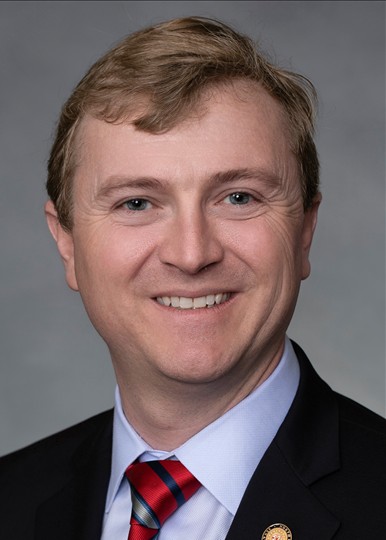
Sen. Benton Sawrey
Sponsored bills
Maddy summarySB 605 makes two key changes related to water management and environmental regulations. First, it eliminates subbasin designations and removes the requirement for an Interbasin Transfer certificate for water transfers that occur between subbasins within the same major river basin, simplifying the process for water resource managers. Second, the bill revises how nutrient offset credits are calculated for wastewater permits in the Neuse River Basin. It specifies that a "TMDL transport factor" must be applied to both the permitted wastewater discharge and the nutrient offset credits, and it broadens the applicability of this calculation by removing a previous customer connection limit for local governments. The bill also directs the Department of Environmental Quality to develop new modeling for nutrient transport in the Neuse River Basin, which could lead to updated rules.
Maddy summarySB 336 establishes the Interstate Medical Licensure Compact, creating a streamlined pathway for qualified physicians to obtain licenses in multiple participating states. This compact aims to enhance the portability of medical licenses and improve patient access to healthcare by allowing eligible physicians to apply for an "expedited license." To qualify, physicians must meet specific criteria, including holding an unrestricted license in a member state, passing medical exams, completing graduate medical education, and maintaining a clean disciplinary and criminal record. The bill also defines how physicians designate a 'state of principal license' and outlines the role of an Interstate Commission in managing the compact.
Maddy summarySB 345 establishes a "team-based practice" model for Physician Assistants (PAs) in North Carolina. It defines specific requirements for medical practices to qualify as team-based settings, including physician ownership and participation in patient care design. PAs must meet extensive clinical experience criteria to practice in these settings, allowing them to operate with a modified supervision arrangement that emphasizes team collaboration rather than a named supervising physician in some contexts. However, physician supervision is still explicitly required for team-based PAs providing surgical or anesthesia services.
Maddy summaryThis bill provides local boards of education with a new alternative for setting their school calendars, directly affecting public schools and students. It allows schools to start as early as the Monday closest to August 19, provided fall and spring semesters have an equal number of instructional days, and end no later than the Friday before the last Monday in May. The bill also establishes stricter enforcement mechanisms, enabling the State Board of Education to investigate non-compliance and withhold central office administration funds from local boards that fail to follow calendar requirements. Additionally, it permits residents or businesses to file civil actions against non-compliant local boards, potentially leading to court-ordered remedies, attorney's fees, and civil penalties.
Maddy summarySB 357 expands and modernizes collaborative practice agreements between physicians and pharmacists. It allows licensed pharmacists, designated as "clinical pharmacist practitioners," to provide a broader range of "health care services" under a physician's supervision, including modifying drug dosages, ordering tests, and managing drug therapy for patients. These services must be conducted under specific, written collaborative practice agreements and adhere to rules set by the North Carolina Medical Board and Board of Pharmacy. The bill also permits therapeutic drug substitutions by pharmacists with physician authorization and allows for multi-provider collaborative agreements in institutional settings.
Maddy summarySB 369 aims to ensure that certain telehealth providers can enroll as Medicaid providers in North Carolina. The bill specifies that individual health care providers, licensed by the state and offering services exclusively through telemedicine, do not need a physical presence in the state to be eligible for Medicaid enrollment. Additionally, medical provider groups that exclusively offer telemedicine services will not be required to have an in-state service address to enroll as Medicaid provider groups. This measure directly affects telehealth providers and Medicaid recipients by clarifying requirements for remote healthcare services.
Maddy summaryThis bill proposes to repeal North Carolina's Certificate of Need (CON) laws, which currently require healthcare providers to obtain state approval for certain projects. These projects include building new facilities, expanding existing services, or acquiring major medical equipment. By eliminating these requirements, the bill would remove a regulatory step for various healthcare facilities, such as hospitals, nursing homes, and diagnostic centers, looking to establish or grow their operations. The bill achieves this by amending several state statutes to remove references to the Certificate of Need process.
Maddy summarySenate Bill 335 allows pharmacists to order and perform CLIA-waived tests to treat influenza, provided they follow statewide protocols and do not use controlled substances. The bill mandates that health benefit plans cover healthcare services provided by pharmacists if the services are within their licensed scope of practice and would be covered if performed by another healthcare provider. It also ensures consistent application of prescription drug and pharmacy service coverage requirements across insurers, third-party administrators, and pharmacy benefits managers. These changes aim to expand access to certain healthcare services through pharmacists, affecting patients, pharmacists, and health insurance providers. Most provisions become effective October 1, 2025.
Maddy summarySB 63 establishes a nine-member Board of Motor Vehicles to oversee North Carolina's Division of Motor Vehicles, replacing the current structure where the Commissioner is appointed by the Transportation Secretary. The Board will appoint the Motor Vehicles Commissioner and include members from the Transportation Secretary, Information Technology Secretary, Highway Patrol, and appointments by the Governor and General Assembly. The bill also mandates a study by the Department of Transportation to evaluate creating a separate Motor Vehicle Authority (replacing the current Division), including feasibility, required legal changes, a timeline, and implementation steps. The study must be completed and reported to the General Assembly by January 1, 2026, but does not create the Authority itself.