

Maddy summaryThis is a commemorative resolution (not a policy bill) honoring former North Carolina House Representative Joseph "Joe" Robert John, Sr., who served District 40 from 2017-2025 and died January 20, 2025. The resolution expresses the House's appreciation for his public service, extends sympathy to his family, and formally recognizes his contributions to North Carolina's judiciary, criminal justice, and community. It has no policy impact or new legal provisions - its purpose is solely to memorialize his career and legacy. The resolution was adopted unanimously by the House on January 29, 2025.
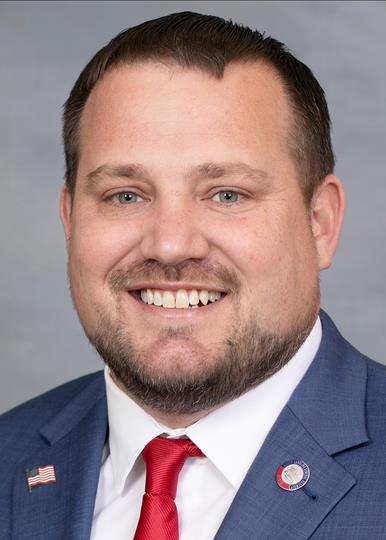
Rep. Ben Moss
Sponsored bills
Maddy summaryThis resolution directs North Carolina's Secretary of State to formally request Congress to call a constitutional convention aimed at imposing term limits on members of the U.S. House of Representatives and the U.S. Senate. The bill specifies that this application will be combined with similar requests from other states to reach the two-thirds threshold required to trigger the convention, while remaining separate from applications for other constitutional changes. It establishes this request as a continuing application that remains active until enough states have submitted identical petitions. Ultimately, the measure does not change any current laws but serves as an official step in the process of potentially amending the U.S. Constitution.
Maddy summaryThis amendment to House Bill 10 allocates $278,994 annually from the state's General Fund to hire two full-time jail inspectors for the 2023-2025 fiscal period. The funds are directed to the Department of Health and Human Services to support the Division of Health Services Regulation in its construction section. These positions become effective on July 1, 2023, and the amendment also updates the bill's title to reflect the addition of these inspector roles.
Maddy summaryThe Disaster Recovery Act of 2024 establishes two separate state funds to manage financial relief for damage caused by Hurricane Helene and Potential Tropical Cyclone #8. The first fund, for Hurricane Helene, is restricted to counties declared major disasters by the federal government plus Nash County, while the second fund is dedicated exclusively to Brunswick and New Hanover Counties. Both funds are administered by the Office of State Budget and Management and require state agencies to justify expenses based on demonstrated needs. Additionally, the bill extends the statewide state of emergency declaration until March 1, 2025, to support ongoing recovery efforts. Any unspent money in these funds must be returned to the state treasury by June 30, 2030, unless the General Assembly decides otherwise.
Maddy summaryThis bill amends North Carolina's existing rules for issuing titles to off-road and low-speed vehicles. It requires the title document to include specific details such as the vehicle's make and model, the owner's name, and a complete list of any liens with their holder information. The amendment also clarifies that standard rules for perfecting security interests do not apply to these specific vehicle titles. By updating the required information on the title, the bill ensures that ownership and financial claims on these vehicles are clearly documented.
Maddy summaryThis bill allows patients with life-threatening or severely debilitating conditions in North Carolina to access custom-made investigational drugs, biological products, or devices that are not yet approved by the federal government. To qualify, a patient must have a doctor confirm that standard FDA-approved treatments are unlikely to help and must provide written informed consent acknowledging the risks and potential costs. The law requires that the patient or their guardian understands they are personally responsible for any expenses related to the treatment unless a separate contract states otherwise. Additionally, the bill clarifies that using these individualized treatments may temporarily remove a patient's eligibility for hospice care, though that eligibility can be restored if the treatment stops.
Maddy summaryThis amendment to House Bill 250 modifies North Carolina's rules for obtaining a limited driving privilege for individuals required to use an ignition interlock device. Specifically, it mandates that if a person commits an interlock violation within the 90 days before their initial compliance period ends, their required compliance time must be extended. The change directly affects drivers subject to these safety requirements by ensuring that violations immediately preceding a license restoration attempt result in a longer waiting period. Additionally, the amendment removes the previous text that established the criteria for obtaining a limited driving privilege under these specific circumstances.
Maddy summaryThis bill, known as the SHALOM Act, adds a new section to North Carolina law that officially adopts the International Holocaust Remembrance Alliance's definition of antisemitism. The law requires state agencies and organizations to use this definition as a guide for training, education, and identifying hate crimes or discrimination against Jewish people. It also establishes a framework for tracking and reporting incidents of antisemitism within the state. The legislation includes a specific provision stating that adopting this definition does not violate free speech rights protected by the U.S. and state constitutions.
Maddy summaryThis bill proposes a constitutional amendment to North Carolina that would restrict voting rights exclusively to United States citizens who are at least 18 years old. The legislation does not change current law immediately but instead sets up a statewide vote on November 5, 2024, where voters will decide whether to adopt this new rule. If approved by the majority of voters, the amendment will permanently update the state constitution to remove the ability of non-citizens to vote in any election. If voters reject the measure, the existing voting qualifications will remain unchanged.
Maddy summaryThis amendment to House Bill 75 makes the entire bill contingent on the passage of a separate Senate Bill 3 in the 2023 Regular Session. It does not establish new rules for physician assistants or change their practice standards directly. Instead, it functions as a procedural condition, ensuring that the proposed team-based practice changes only take effect if the related Senate legislation is also approved. If Senate Bill 3 fails to become law, this amendment renders the current House Bill void and inactive.