

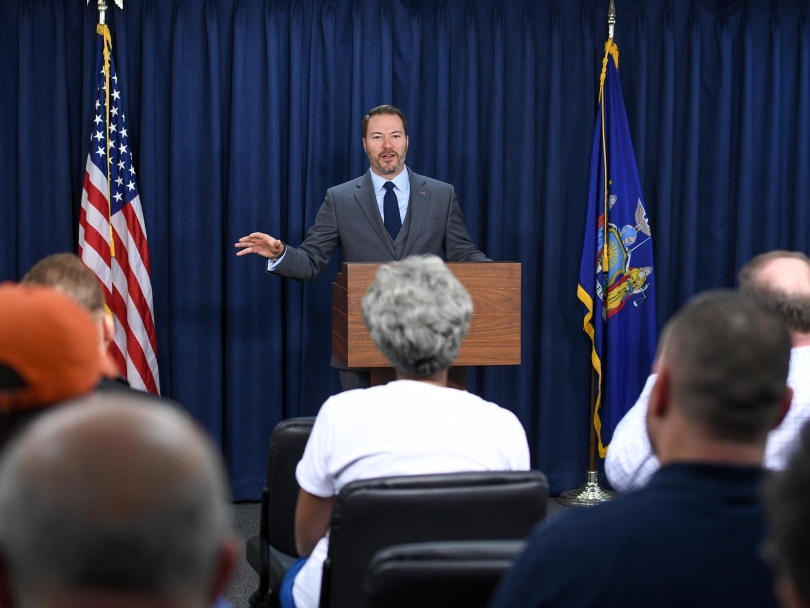
Photo of Rob Ortt
R New York Senate · District 62 On the 2026 ballot

Sen. Rob Ortt

Compare
Total votes
20,778
all sessions
Attendance
99%
91 missed
Near the chamber average
With party
94%
of cast votes
Lower than 87% of chamber peers
Bipartisan score
4%
crosses aisle rarely
Higher than 81% of chamber peers
Sponsored
1,393
bills & resolutions
Lower than 79% of chamber peers
Committees
2
assignments
1,393 bills and resolutions

Sponsored bills

Total
1,393
Primary
585
Co-sponsor
808
This page
1,393
matching current filters
Primary S 3025
In committee · New York Senate · Lead sponsor
Relates to providing for the recall of a district attorney

Maddy summaryS 3025 establishes a process for voters to recall a district attorney (DA) through a petition and election. It requires petition signatures equal to 20% of the last vote for the DA office in their county, verified by the state board of elections within 160 days. If approved, a recall election must occur 60-80 days later (or consolidated with a future election), with removal requiring majority "yes" votes; a successor is elected by plurality if a candidate runs. The current DA is reimbursed for election costs if not recalled, and no new recall can be filed for six months after the election. This constitutional amendment applies directly to elected or appointed county DAs and their voters.

In committee Feb 3, 2026 0 co-sponsors
Co-sponsor S 1586
In committee · New York Senate · Co-sponsor
Relates to term limits for the office of governor; term limits for the offices of comptroller and attorney-general; and to limiting the terms of office as a member of the legislature any person may serve

Relates to term limits for the office of governor; term limits for the offices of comptroller and attorney-general; limits the terms of office as a member of the legislature any person may serve.

In committee Feb 3, 2026 1 co-sponsor
Primary S 2428
In committee · New York Senate · Lead sponsor
Relates to a constitutional right to hunt, trap and fish

Maddy summaryThis bill proposes adding a new constitutional article (Article XX) that would establish a protected right for residents to hunt, trap, and fish using traditional methods. It requires state laws to preserve these activities as part of the state's heritage while mandating that wildlife management aligns with the state's duty to conserve species and protect the heritage. The amendment would not change existing regulations but would require future state laws governing these activities to explicitly support continued access for hunters, anglers, and trappers. It is a constitutional amendment, not a direct law, and would need approval through the legislative process and a public vote.

In committee Feb 3, 2026 0 co-sponsors
Co-sponsor S 4683
In committee · New York Senate · Co-sponsor
Allows the alteration or repeal of real property tax exemptions for certain private institutions of higher education

Allows the alteration or repeal of real property tax exemptions for certain private institutions of higher education by the passage of a private bill by the legislature and approval by the governor.

In committee Feb 3, 2026 1 co-sponsor
Co-sponsor S 270
Passed Feb 3, 2026 1 co-sponsor
Primary S 3034
In committee · New York Senate · Lead sponsor
Prohibits the legislature from transferring funds from the power authority of the state of New York into the general fund

Maddy summaryS 3034 is a constitutional amendment proposal that would prevent New York's legislature from moving funds generated by the state-owned power company (the New York Power Authority, or NYPA) into the general state budget. This bill directly affects the state legislature's budgeting process by prohibiting the diversion of NYPA's revenue streams - such as electricity sales income - into other state programs or general funding. The key provision is a constitutional change requiring that NYPA's revenues remain separate from the general fund, ensuring they are used only for the power authority's intended purposes. This is a procedural bill focused on fiscal accountability, not a policy change to public services or regulations.

In committee Feb 3, 2026 0 co-sponsors
Co-sponsor S 960
In committee · New York Senate · Co-sponsor
Relates to items of appropriation

Maddy summaryThis constitutional amendment (S 960) requires governors to submit budget bills containing all appropriations, plus separate non-appropriation bills for recommended policy changes. It mandates that all appropriation bills cover only one specific purpose with clear descriptions of each funding item, prohibiting multiple unrelated items or program rules within a single bill. This affects state agencies submitting budgets and the legislature reviewing them, aiming to improve transparency by separating funding requests from policy proposals. The changes would standardize how budget items are presented and reviewed under state constitutional rules.

In committee Feb 3, 2026 1 co-sponsor
Co-sponsor S 4800
In committee · New York Senate · Co-sponsor
Relates to special elections of federal officers

Maddy summaryThis bill amends the state constitution to establish specific rules for filling vacancies in U.S. House and Senate seats. It requires special elections for House vacancies occurring more than three months before a general election (held 70-80 days after a governor's proclamation) and sets temporary appointment periods for Senate vacancies based on calendar year timing. These rules directly affect how federal offices are filled when vacancies arise, ensuring vacancies are addressed within defined election cycles. The changes apply specifically to federal elected positions, not state offices.

In committee Feb 3, 2026 1 co-sponsor
Primary S 8788
In committee · New York Senate · Lead sponsor
Relates to mandatory continuing education requirements for coroners and coroner's deputies

Maddy summaryThis bill requires New York coroners and coroner's deputies to complete 30 hours of state-approved continuing education in medical-legal investigation every three years. It directly affects all elected or appointed county coroners and deputies by mandating ongoing training to maintain their certification. Key provisions include triennial registration with the Department of Health, maintaining compliance records for seven years, and exemptions for the first year after initial training or for military service. The law specifies that counties may reimburse costs but places responsibility for course fees on the individual. Failure to meet requirements bars practice until compliance is verified.

In committee Jan 29, 2026 0 co-sponsors
Showing 171 to 180 of 1,393 bills
Previous 1 … 17 18 19 … 140 Next