

Maddy summaryS 1080, the "Supportive Interventions Act," updates New York's mental health laws to improve outpatient treatment access for people with severe mental illness who may not recognize their need for care. It revises definitions of "likely to result in serious harm" to explicitly include risks like untreated psychosis, self-neglect, and psychiatric deterioration - expanding beyond current narrow interpretations. The bill requires clinicians to assess whether a person could adhere to outpatient treatment and consider long-term health impacts before recommending involuntary hospitalization. This aims to reduce unnecessary hospitalizations, support community integration, and strengthen the existing Kendra's Law assisted outpatient treatment program.
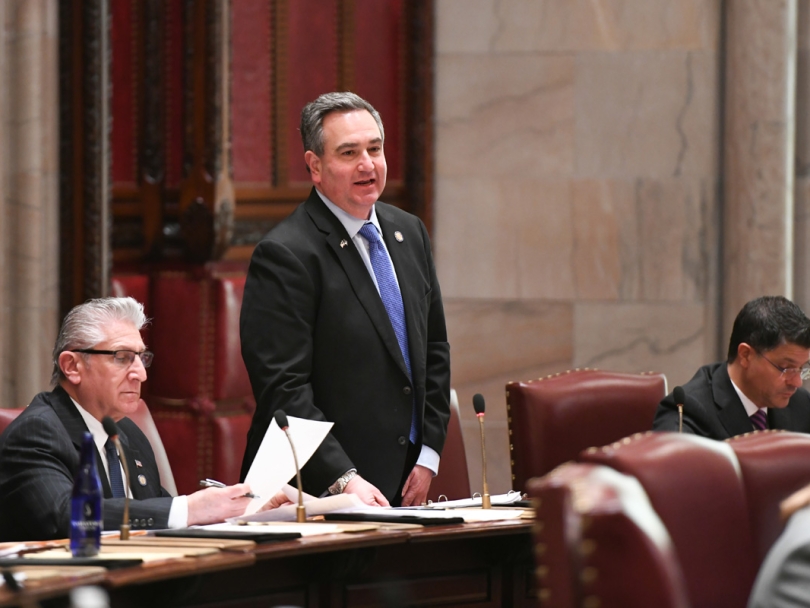
Sen. George Borrello
Sponsored bills
Maddy summaryThis bill creates a "YMCA member" distinctive license plate for New York residents who are YMCA members. To obtain the plate, applicants must provide proof of YMCA membership and pay a $25 annual fee in addition to standard registration costs. The $25 fee is deposited directly into the New York State YMCA Foundation Fund, which supports YMCA programs and services across the state. The bill establishes this fund in state law and outlines how the money will be managed and spent, with no impact on existing license plate fees or state budgets.
Maddy summaryThis bill requires grocery stores offering digital coupons to automatically apply those coupons at checkout for two groups: seniors (65+) and customers enrolled in loyalty or rewards programs. It mandates that stores apply any digital coupon already valid for a specific product being purchased, without needing customers to manually redeem them. The law covers digital coupons distributed via store websites or apps, including those tied to loyalty programs. This policy directly affects grocery stores that use digital coupon systems, ensuring automatic savings for eligible shoppers during checkout.
Maddy summaryThis bill, S 3144, expands the required service area for accessible paratransit transportation. It mandates that accessible buses be available within a service area measuring three miles from any bus line operated by a transportation authority or its subsidiaries. This provision applies to both existing requirements for a percentage of accessible buses and the mandate for 100% accessible fixed-route buses, aiming to ensure broader geographical access for transportation-disabled persons, including those in wheelchairs.
Provides that in the event child protective services receives a duplicate report on an open case that has not been founded, indicated or referred to services, such duplicate report shall merge with the open case and remain open an additional thirty days for further investigation.
Grants school districts the ability to implement telehealth school-based mental health clinics; establishes the student mental telehealth reimbursement fund; relates to funding the student mental telehealth reimbursement fund.
Establishes grocery store wine licenses permitting the licensee to sell from the licensed premises wine produced in New York state or produced from ingredients grown or produced in New York state, in sealed containers for consumption off such premises.
Prohibits the use of state funds for non-residents seeking an abortion or any other procedure that results in the intentional termination of a pregnancy at any stage of gestation.
Maddy summaryThis bill amends New York's penal law to clarify and strengthen penalties for illegal cannabis sales. It creates three criminal offenses based on quantity sold (e.g., selling over 3 ounces triggers a third-degree crime) and restricts sales to minors (e.g., selling to anyone under 21 is prohibited, with limited exceptions for caregivers). Businesses selling cannabis without a license face criminal charges and are barred from obtaining future cannabis permits. Additionally, commercial establishments violating these rules face escalating civil fines ($10,000-$50,000 per violation) payable to local counties. The changes take effect immediately.
Establishes the study commission on preventing snow emergencies to evaluate the impact of grid electrification on the safety and reliability of heating systems in snowstorms that cause power outages, and to develop strategies and best practices to maximize grid reliability and resiliency during extreme winter weather events.