

Maddy summaryThis bill allows individuals with sincere religious objections to the photograph requirement for driver's licenses or learner's permits to obtain them without a photo. It directly affects people whose religious beliefs prohibit having their photograph taken. The law requires that licenses issued under this exemption cannot be used as proof of age for entering age-restricted establishments or purchasing age-restricted products. The exemption is limited to religious beliefs that genuinely conflict with photographing, and the bill takes immediate effect.
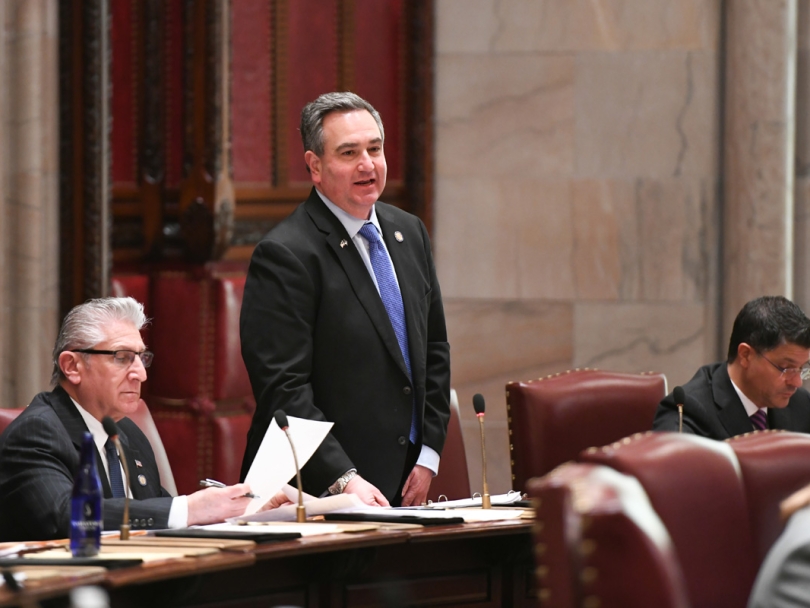
Sen. George Borrello
Sponsored bills
Maddy summaryThis bill (S 8282) allows existing retail licensees who sell liquor or wine for off-premises consumption (like grocery stores or liquor stores) to apply for a separate retail food store license. It authorizes these businesses to seek food store licensure through the standard process outlined in the Agriculture and Markets Law. The bill amends two state laws to explicitly permit this application pathway, without changing what businesses can sell once licensed. It directly affects current liquor license holders seeking to expand into food retail. The change becomes effective 60 days after enactment.
Establishes the offense of aggravated reckless driving and allows for the seizure and forfeiture of vehicles used in connection with reckless driving or aggravated reckless driving.
Directs the office of mental health to develop materials relating to suicide prevention and identifying signs of depression for school-aged children; authorizes school districts to include suicide prevention in health class curriculum.
Establishes the offense of aggravated reckless endangerment; includes aggravated reckless endangerment as a qualified offense the court must consider and take into account for securing an order.
Maddy summaryThis bill establishes New York State's requirements for mental health counselors seeking licensure from other states. It allows out-of-state applicants to obtain a license if their home state's standards are similar to New York's, they demonstrate recent competency (through work or education), and have no disqualifying disciplinary history. The bill also creates a temporary "provisional license" enabling practice while completing final requirements, valid until a license is denied, expires, or terms are violated. It does not override existing reciprocity rules but clarifies the process for cross-state licensure.
Creates a school resource officer working group to study appropriate standards and training for a person to serve as a school resource officer; provides for the repeal of such provisions upon the expiration thereof.
Provides that a person is guilty of criminal mischief in the third degree when such person intentionally damages property of another person to promote or suppress a political ideology, or otherwise as an expression of political ideology.
Maddy summaryThis bill increases payments to rural critical access hospitals (CAHs) by setting their reimbursement rates at 101% of reasonable costs for covered services like emergency care, inpatient care, and outpatient treatments. Starting April 1, 2027, these hospitals will receive payments calculated using the same method as Medicare uses for outpatient CAH services under federal law. The rate applies to services provided to patients eligible for state-funded payments under the public health law. Implementation depends on annual state funding appropriations.
Maddy summaryThis bill allows towns, cities, and villages to create local rules governing where and how cannabis can be consumed in public spaces. Municipalities may establish time, place, and manner restrictions for public cannabis use (such as prohibiting consumption near schools or parks), but cannot ban licensed dispensaries. The law does not override state licensing rules for cannabis businesses but gives local governments authority to regulate public consumption directly. It also includes provisions for inspections of unlicensed cannabis activity and civil penalties for violations. This affects all local governments and cannabis businesses operating in public areas within their jurisdictions.