

Maddy summaryBill S 3474 enhances New York's Assisted Outpatient Treatment (AOT) program, commonly known as Kendra's Law, by strengthening oversight and eliminating its scheduled expiration to ensure the program continues without interruption. The bill adds specific requirements for program coordinators to monitor treatment compliance, coordinate services with community providers, and review clinical needs before court orders expire, while mandating community service directors to conduct timely investigations and document processes. It also requires the state to create an educational pamphlet explaining the AOT petition process in plain language for the public. This bill directly affects individuals under court-ordered AOT, mental health program staff, and the public seeking information about the program.
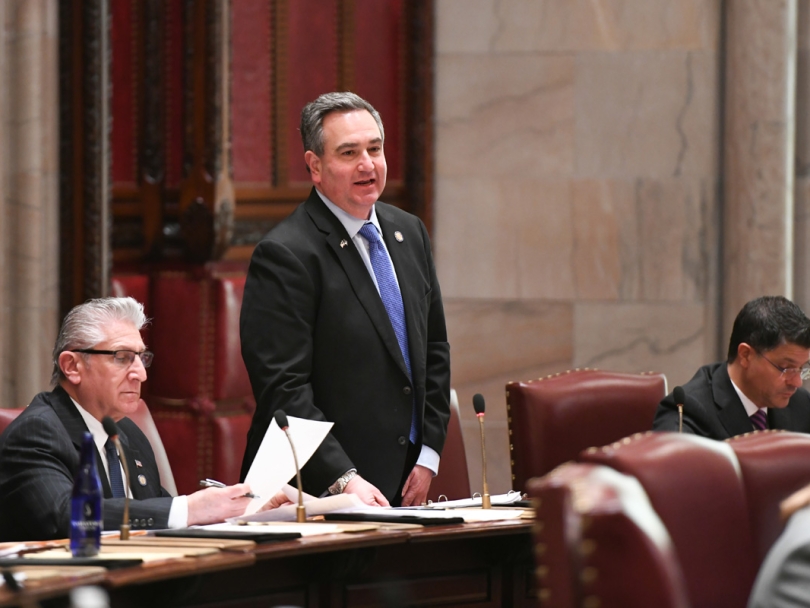
Sen. George Borrello
Sponsored bills
Makes provisions relating to the joint nomination of candidates for the offices of governor and lieutenant governor; provides candidates be designated jointly either by the state committee or by petition; provides said petition will be valid only if it jointly designates both candidates.
Increases the reimbursement amount authorized to be paid to localities maintaining incarcerated individuals convicted of felonies to $300 per day per capita for the first 10 days, and $600 per day per capita for each day thereafter, or the actual per day per capita cost, whichever is more.
Requires voters voting by affidavit ballot to produce an identification document to verify residency in the election district; requires absentee ballots to be received by election day, or be post-marked by the first day of early voting.
Maddy summaryS 2603 expands the definition of "aggravated cruelty to animals" to include intentionally causing injury with a deadly weapon (like a gun or knife) or a dangerous instrument (like a broken bottle). This specifically targets individuals who use such objects to harm companion animals, making it a more severe offense. The law defines "aggravated cruelty" as conduct meant to cause extreme pain or carried out in a depraved, sadistic way. It directly affects people convicted of animal cruelty involving weapons, increasing penalties for those acts. The bill takes effect immediately upon enactment.
Directs the commissioner of health to conduct an investigation of the department's performance, compliance and enforcement of applicable state laws, rules, regulations, and directives or executive orders, with respect to mitigating the impact of COVID-19 in nursing homes, adult care facilities, and assisted living residences, and to propose a pandemic response plan for future disease outbreaks.
Creates the New York state independent budget office with a director to be appointed, upon the recommendations of an independent budget office advisory committee, by the speaker of the assembly and the temporary president of the senate; establishes such office shall provide objective, non-partisan and timely analyses of state revenue, expenditures and management practices to members of the legislature for any legislation with fiscal impact or at the request of a leader or a committee.
Maddy summaryThis bill amends New York law to allow courts to issue **lifetime orders of protection** when the respondent is convicted of specific violent felonies, including sexual assault under Penal Law sections 255.25-255.27 or felonies in Penal Law articles 120, 125, 130, 135, or 263 (or attempts to commit them). Previously, such orders had fixed time limits (up to 8 years), but this change adds "lifetime" as a duration option for these high-risk cases. The law directly affects victims of domestic violence or abuse where the perpetrator received one of these felony convictions. It does not apply to lesser offenses or non-felony cases.
Relates to safe staffing levels at nursing homes; requires the department of health to give significant weight to labor supply shortages in particular regions during any declared statewide disaster emergency.
Maddy summaryThis bill requires New York's legislature to approve any extension or modification of pandemic-related executive orders issued by the governor. It specifically prohibits governors from extending or modifying certain restrictions that impact businesses, such as mandatory closures, curfews, alcohol service rules requiring food purchases, or capacity limits on venues like restaurants, bars, and gyms. The bill allows continued enforcement of basic public health measures like face coverings and sanitation. It does not affect current health guidelines but mandates legislative review for future pandemic directives.