

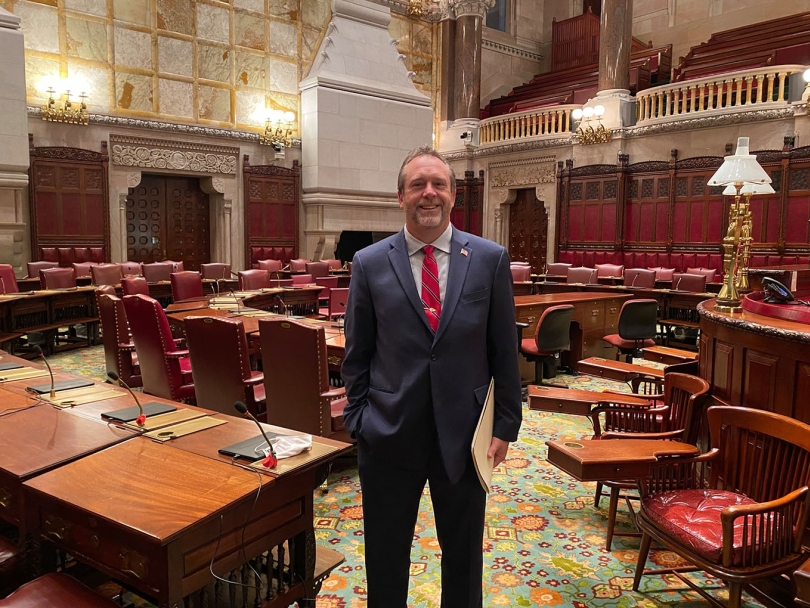
Requires proportionally equivalent appointees of both the majority and minority houses of the legislature in all legislatively enacted workgroups, task forces, commissions, councils, advisory boards, committees and any other legislatively enacted and appointed groups or workgroups; requires that the number of appointees by the legislature shall be proportionally equivalent to the number of appointees by the governor.
Sponsored bills
Maddy summaryThis bill increases penalties for aggravated cruelty to animals when committed during a domestic violence incident. It raises the maximum prison sentence from two years to four years for offenders who harm animals during domestic violence, including the period of tension before or stress after the violence. The law directly affects individuals convicted of animal cruelty who also commit domestic violence, as defined by state law. The change applies to specific acts of animal cruelty committed in the context of domestic violence, not general animal cruelty cases.
Maddy summaryThis bill creates a tax credit for New York individual taxpayers who pay for spaying or neutering their cats or dogs. It allows an 80% credit on the actual service cost, capped at $200 per pet per year, requiring a receipt from a licensed state veterinarian. The credit applies to services performed in taxable years beginning on or after January 1, 2025. It directly affects pet owners seeking to offset these veterinary expenses through their state tax return.
Grants an exemption for the purchase of energy efficient snow making equipment, ski lift equipment, snow grooming equipment, and the production of snow by a recreational ski facility from state sales and compensating use tax.
Requires a government photo identification card to be presented when casting a ballot; provides for a method to receive a government photo identification card at no charge; provides that notaries are not permitted to collect a fee for collecting the documents required.
Allows individuals to request a notation on their driver's license indicating that they have autism spectrum disorder, or any other medical, mental, or behavioral condition that may alter or impair their behavior; requires medical documentation to be submitted as proof upon such a request; directs the commissioner of motor vehicles to consult with the commissioner of health and the commissioner of mental health to determine a list of such conditions and disorders that may be indicated on an individual's driver's license.
Authorizes lifetime sporting licenses, which includes hunting and fishing licenses and turkey permits, to be purchased by permanently disabled veterans at a discounted rate of sixty-five dollars.
Maddy summaryBill S 7703 mandates that school districts in Sullivan County provide or reimburse for transportation services for certain students after 4 PM, beginning with the 2025-2026 school year. This requirement applies to public and nonpublic school students in grades K-12 who attend school until at least 4 PM and live beyond specified distances from their school (over 2 miles for K-8, over 3 miles for 9-12, up to 15 miles). Districts can either provide the transportation directly or reimburse licensed carriers for the service. These expenditures are eligible for state transportation aid, but districts are not required to incur costs exceeding the amount eligible for aid.
Maddy summaryThis bill (S 3383) amends New York State's existing firearm licensing rules by updating eligibility requirements for individuals seeking a license to carry or possess firearms. It specifies that applicants must be at least 21 years old (with exceptions for honorably discharged veterans), have no felony or serious offense convictions, pass mental health and substance use screenings, and complete safety training (with limited exemptions). The changes apply directly to anyone applying for or renewing a firearm license in New York, modifying provisions in the penal law related to background checks, residency, and documentation. The bill focuses on procedural updates to licensing standards rather than introducing new restrictions.
Maddy summaryS 2206 prohibits hospitals and transplant centers from denying organ transplants or related services solely due to a person's physical or mental disability. It requires covered entities (like hospitals and transplant programs) to make reasonable accommodations - such as involving support networks or using accessible communication methods - to ensure individuals with disabilities can access transplants. The bill explicitly bans discrimination in listing patients on waiting lists, referrals, or insurance coverage for transplant-related care. It aligns with the Americans with Disabilities Act by requiring individualized medical evaluations rather than assumptions about disability. This law directly affects New York residents with disabilities who need organ transplants, ensuring they receive fair consideration based on medical suitability, not disability status.