

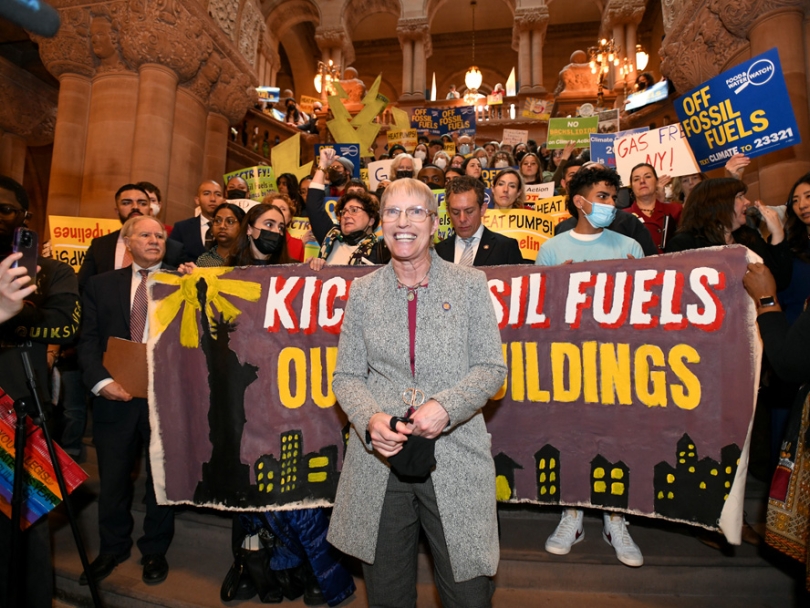
Enacts the climate and community investment act; prioritizes the allocation of public investments in disadvantaged communities; addresses climate change challenges through the expansion and growth of clean and renewable energy sources; adopts best value requirements for the solicitation, evaluation and award of renewable energy projects; establishes a community just transition program; establishes a climate pollution fee and a household and small business energy rebate; creates the climate and community investment authority.
Sen. Rachel May
Sponsored bills
Authorizes and directs the commissioner of transportation to conduct a study on the feasibility of removing all existing 3-cable guide rails on New York roadways and replacing such guide rails with safer alternatives; requires a report to be submitted to the governor, the temporary president of the senate, the speaker of the assembly, the minority leader of the senate, and the minority leader of the assembly containing the findings and recommendations for legislative or other actions.
Repeals the rebates for stock transfer tax paid; dedicates funds of the stock transfer tax fund and stock transfer incentive fund to various funds; establishes the safe water and infrastructure action program.
Maddy summaryBill S 1189 establishes new licensure requirements for entities providing fiscal intermediary services for personal assistance programs. Beginning April 1, 2027, these fiscal intermediaries must obtain a license from the commissioner, a process that includes an application fee and an assessment of their character, competence, and compliance. The bill also broadens the definition of fiscal intermediaries, modifies their annual reporting obligations, and creates a confidential state registry for personal assistants that these intermediaries must maintain. This legislation directly affects fiscal intermediaries, personal assistants, and consumers utilizing these services.
Maddy summaryThis bill establishes a new progressive income tax structure for high earners in New York, replacing current tax brackets. It directly affects New York residents with significant taxable income, particularly those earning above $17,000 annually for single filers (with higher thresholds for married couples). The key mechanism uses tiered tax rates that increase as income rises - starting at 4% for lower incomes and reaching up to 24% for earnings over $20 million. The bill amends existing tax law to implement these rates, which apply to taxable years beginning in 2023 through 2027 and will be adjusted for 2028 onward.
Requires SUNY and CUNY campuses to hire energy management, materials management, and sustainability education and engagement employees at each SUNY and CUNY campus in numbers proportionate to campus size.
Establishes a school ventilation and energy efficiency assessment, repair and verification program to require each school to: obtain an HVAC Assessment Report performed by qualified testing personnel documenting the functionality of the existing system or lack thereof, and obtain a report from a mechanical engineer identifying any upgrades, replacements or other measures recommended to improve the functionality, health and safety and/or energy efficiency of the HVAC system; adjust, and, if necessary, repair existing building HVAC systems, and install or replace HVAC systems, if necessary, to ensure proper and efficient operation, as well as compliance with health and safety standards; obtain an HVAC Verification Report performed by qualified testing personnel documenting any upgrades, replacements, installations or any other work performed on the HVAC system functions as designed and/or in compliance with health and safety standards; install CO2 sensors in classrooms, assembly areas, kitchen or cafeteria areas or building office spaces to provide ongoing verification that proper ventilation is maintained during operation; makes related provisions.
Specifies that low-income housing tax credits may be issued both for projects creating new housing and projects renovating and preserving existing housing, nullifying a DHCR determination that projects for the renovation and preservation of existing housing do not qualify.
Requires instruction in civic education for grades 5 through 12 including instruction on the NYS constitution; federal, state and local government; civic literacy; methods of public participation; and the rights and responsibilities of citizenship.
Establishes new targets for offshore wind electricity generation; includes the requirements that there is at least 15 gigawatts of offshore wind electricity generation by 2040, at least 18 gigawatts of offshore wind electricity generation by 2045 and at least 20 gigawatts of offshore wind electricity generation by 2050.