

Prohibits public employers from diminishing health insurance benefits provided to Medicare-eligible retirees and their Medicare-eligible dependents or the contributions such employer makes for such health insurance coverage below the level of such benefits or contributions made on behalf of such retirees and dependents by the public employer as of December 31, 2021.
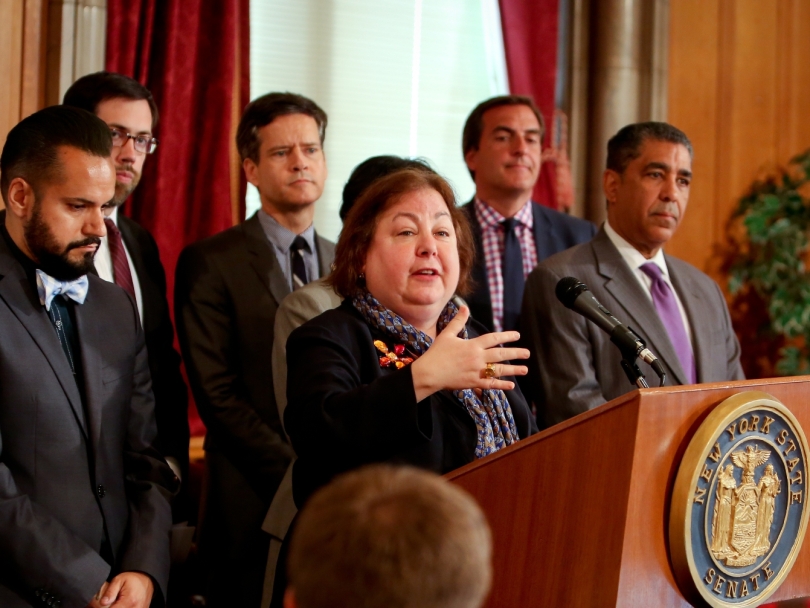
Sen. Liz Krueger
Sponsored bills
Provides that in any jurisdiction in which a party is eligible under local law for free legal counsel, if such party has in good faith attempted to secure such counsel and is unable to obtain counsel through no fault of their own, the court shall adjourn the trial of the issue for consecutive periods of not less than fourteen days each until the party is able to secure counsel.
Maddy summaryBill S 7459 provides emergency funding to maintain state government operations for an extended period. It authorizes the state comptroller to make payments for state officer and employee salaries, benefits, and agency operational costs. This temporary appropriation ensures continued government function from April 1, 2025, through April 22 or 23, 2025, while the full annual budget for the fiscal year is awaiting enactment. The bill increases the amounts allocated for these purposes across the executive, legislative, and judicial branches.
Requires school districts to conduct mandatory early screening for dyslexia for all children commencing in pre-kindergarten or kindergarten and continuing thereafter on an annual basis until each child successfully completes second grade; requires school districts to designate an individual to maintain complete and accurate records containing early screening reports for each child, and to provide resources and materials to the parent and/or guardian of any child who displays indications of dyslexia.
Maddy summaryBill S 7458 aims to support international debt relief initiatives for developing countries experiencing significant debt by regulating the recovery of certain claims in New York. It proposes that claims against these "eligible states," incurred before they seek international debt relief, can only be recovered if specific conditions are met. These conditions include adhering to international standards for equitable cost-sharing among all creditors, meeting robust disclosure requirements, and limiting recovery to the proportion the U.S. federal government would recover under the same initiative. The bill seeks to ensure that debt relief costs are allocated fairly among all creditors, rather than falling disproportionately on New York residents and taxpayers.
Relates to prohibiting contract provisions that waive certain substantive and procedural rights relating to a claim of discrimination, non-payment of wages or benefits, retaliation, harassment or violation of public policy in employment.
Provides protection to employees and former employees from retaliatory actions by employers for the reporting of illegal or dangerous business activities.
Maddy summaryThis bill provides emergency funding to cover state government operations from April 1-17, 2025, until the regular budget for the 2025 fiscal year is enacted. It appropriates $986.8 million for payroll and benefits for state employees (including executive branch, legislature, and judiciary), $32 million for non-personal service liabilities, and $537.1 million for employee benefits like health insurance and retirement contributions. The funds are specifically designated to pay salaries and cover operational costs incurred during the specified period, including liabilities from the previous fiscal year. This temporary measure ensures continuity of government services without altering existing budget authority.
Maddy summaryThis bill provides emergency funding to cover state government payroll and operational costs for the period April 1-15, 2025. It directly affects state employees (including executive branch staff, legislators, and judiciary personnel) by authorizing payments for salaries and pre-existing liabilities incurred before April 1. Key provisions include $668 million for personal services (payroll) and $516 million for employee benefits like health insurance, social security, and retirement contributions. The funding is temporary, intended to bridge the gap until the full fiscal year budget is enacted, and applies specifically to the state's 2025 fiscal year beginning April 1. It does not create new policy but ensures continuity of essential government operations during a budget transition period.
Maddy summaryS 3437 prohibits the approval of any new for-profit hospices or expansions of existing for-profit hospice capacity. It directly affects for-profit hospice operators by banning new licenses and preventing increases in beds or services for currently operating for-profit facilities. The bill amends public health law to require all hospice approvals (on or after its effective date) to exclude for-profit models entirely. The measure takes effect immediately upon enactment.