

Imposes a moratorium on the issuance of permits for new data centers; requires the public service commission to issue an order or orders to minimize the impact of new data centers on electricity and gas rates for residential, commercial, and industrial users; clarifies that certain provisions are applicable to the Long Island power authority.
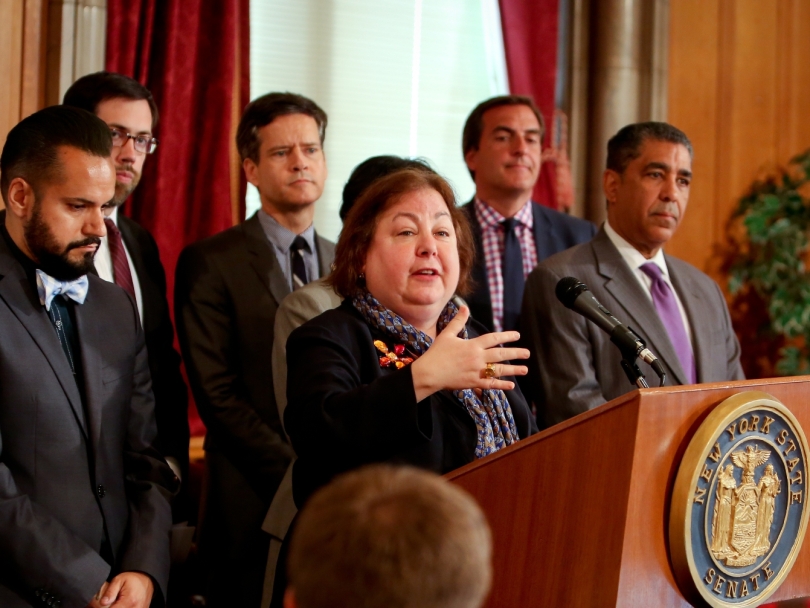
Sen. Liz Krueger
Sponsored bills
Directs the commissioner to publicly publish an annual report on the environmental radiation surveillance program and analyze such report showing trends and cumulative impact, as well as notify other relevant agencies if contamination has exceeded EPA standards for maximum amounts of contamination allowed in drinking water or food.
Prohibits state reimbursement of campaign and political committees, or legal defense funds, for payments made on behalf of the criminal or civil defense of a state employee.
Enacts into law components of legislation that relate to live event ticket sales; establishes an annual professional reseller renewal fee; requires professional ticket resellers to provide their New York state ticket reseller license number as a condition of utilizing an online resale marketplace to resell tickets (Part A); provides criteria for when a purchaser may obtain a full refund of the amount paid for a ticket (Part B); relates to resale requirements for tickets; requires that if a licensee or other ticket reseller doesn't have possession of the ticket, then they shall have a written contract to obtain the offered ticket at a certain price from a person or entity in possession of the ticket or from a person or entity who has a contractual right to obtain such ticket, and tickets to the event have been placed on sale by the venue or entity hosting the event or its authorized agent before the licensee or reseller can advertise the sale of the tickets (Part C); relates to unlawful charges in connection with tickets; permits reasonable charges for costs actually rendered or otherwise in connection to customer support, technological and software infrastructure, and actual operational costs for sales away from the box office; defines terms (Part D); relates to the availability of tickets for sale to the general public; defines a term (Part E); relates to paperless ticketing systems options (Part F); extends the effectiveness of certain provisions relating to tickets to places of entertainment (Part G).
Maddy summaryS 363, the "New York junk fee prevention act," requires businesses selling goods or services in New York to clearly disclose the total price - including all mandatory fees - before a purchase. It defines "mandatory fees" as unexpected charges consumers can't reasonably avoid (like default add-ons), excluding taxes, delivery costs based on consumer choice, or certain financial fees. Businesses must display total prices prominently in ads and at checkout, avoiding misleading fine print. Violations can trigger penalties up to $1,000 per intentional violation, with enforcement by the attorney general or affected consumers. The law exempts businesses already complying with federal broadband or cable disclosure rules, and certain financial service disclosures.
Maddy summaryS 1209, the "Marvin Mayfield Act," eliminates mandatory minimum sentences for felony convictions by amending sentencing laws. It requires courts to issue written sentencing decisions explaining individualized findings, rather than applying fixed minimum terms. The bill also expands pre-sentence reports to include analysis of incarceration costs and increases access to these reports for defendants and their attorneys before sentencing. This directly affects individuals convicted of felonies in New York State, shifting sentencing focus toward rehabilitation and community safety over rigid minimum terms.
Relates to fair pricing for low-complexity, routine medical care to more closely align payment rates across ambulatory settings for selected services that are safe and appropriate to provide in all settings.
Maddy summaryS 703 amends New York's animal cruelty law by removing the requirement that injury must be "serious" to qualify as aggravated cruelty. This change means prosecutors no longer need to prove severe physical harm to charge someone with aggravated cruelty to animals. The bill defines "aggravated cruelty" as conduct intentionally causing extreme pain or carried out in a depraved or sadistic manner, applying to companion animals. The law directly affects individuals accused of animal cruelty, broadening the scope of what constitutes a punishable offense under this specific charge.
Requires school districts to conduct mandatory early screening for dyslexia for all children commencing in pre-kindergarten or kindergarten and continuing thereafter on an annual basis until each child successfully completes second grade; requires school districts to designate an individual to maintain complete and accurate records containing early screening reports for each child, and to provide resources and materials to the parent and/or guardian of any child who displays indications of dyslexia.
Maddy summaryThis bill amends election law to establish rules for designating polling places used during early voting periods. It prohibits public school buildings from being used as early voting locations and requires that if a public building (other than a school) is selected, the controlling entity must provide an accessible, suitable room for voting unless they file a cancellation request within 30 days. The bill also allows religious organization buildings as polling places (with exemptions for Saturday voter registration if it conflicts with religious beliefs) and bans alcohol-serving establishments from being designated on registration or voting days. Boards of elections must finalize these designations by March 15th each year, with adjustments permitted if locations become unsuitable.