

Maddy summaryThis bill (S 5418) allows New York cities, counties, towns, and fire/police districts to waive citizenship requirements for police and firefighter candidates who provide proof of an honorable military discharge from U.S. or New York military service (including National Guard or Naval Militia). It directly affects non-citizen applicants with military service history who would otherwise be ineligible due to citizenship rules. The key provision amends state law to permit local governing bodies to exempt these candidates from citizenship requirements if they submit verified military discharge documentation. This creates a pathway for qualified military veterans to serve in local emergency services roles without U.S. citizenship.
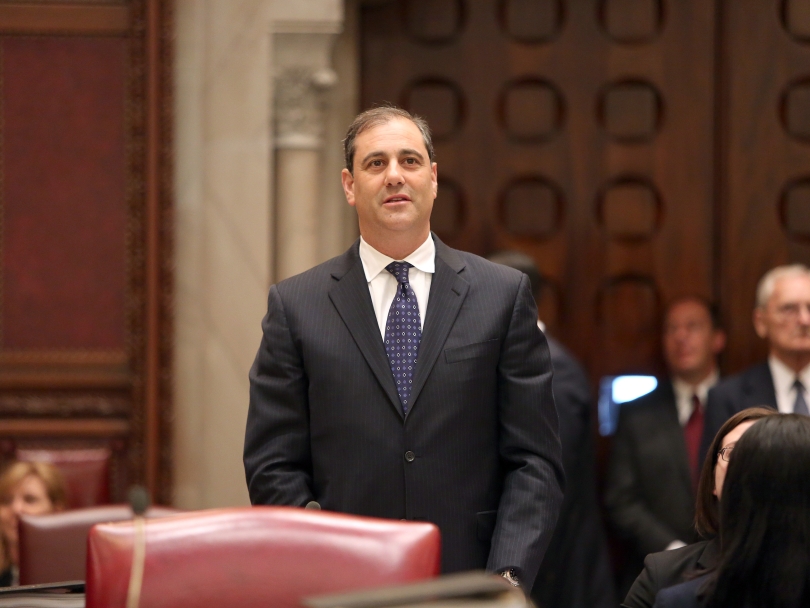
Sen. Andrew Lanza
Sponsored bills
Maddy summaryThis bill modifies New York State's veterans' property tax exemptions specifically for New York City (population over 1 million). It reduces the maximum annual tax exemption for veterans' primary residences from 15% (capped at $12,000) to 6% (capped at $4,800), and lowers the combat-zone service exemption from 10% (capped at $8,000) to 4% (capped at $3,200). It also cuts the exemption limit for property purchased using veterans' funds from $5,000 to $2,000. These changes apply only to New York City residents who qualify as veterans under state law. The bill does not create new exemptions but adjusts existing ones for the city's largest population center.
Maddy summaryThis bill expands the legal definition of "aggravated cruelty to animals" to include causing serious physical injury or using a weapon. It applies to acts against companion animals that intentionally cause extreme pain, are carried out in a depraved or sadistic manner, or involve weapons. The amendment modifies existing law by adding these three specific scenarios to the definition of aggravated cruelty. This clarifies which animal cruelty acts meet the "aggravated" standard under current statutes.
Maddy summaryThis bill, "Michelle and Jordan's law," increases penalties for a second conviction of participating in illegal street racing or speed contests within 12 months. It upgrades the offense to a class E felony, punishable by up to one year in prison, a fine of $525-$750, or both. The law directly affects individuals convicted twice of such traffic violations within a year. It amends New York's Vehicle and Traffic Law to impose these stricter penalties starting 180 days after enactment.
Maddy summaryThis bill, S 1414 (the "utility ratepayer protection act"), requires electric, gas, and water utilities to get legislative approval before raising rates. Utilities must submit a detailed report 180 days in advance, including justification and their financial status, to the legislature. The legislature can deny an increase if it deems it unnecessary to cover service costs, and any approved increase requires a majority vote in both the Senate and Assembly. The bill takes effect immediately upon enactment.
Provides for family members of a crime victim and interested parties to make statements to members of the parole board; provides that such oral statement shall be made to the members of the state board of parole who will determine whether the defendant is released.
Maddy summaryThis bill prohibits election boards from mailing absentee ballots or ballot applications to addresses linked to a candidate's campaign. It amends election law to explicitly state that no ballot application or absentee ballot may be sent to such campaign-associated addresses. The change directly affects election officials who process absentee ballot requests, ensuring they cannot deliver ballots to campaign offices or related locations. This is a procedural adjustment to election administration rules, not a substantive policy change.
Maddy summaryThis bill requires courts to immediately notify complainants when an ex parte order of protection is served on the person against whom the complaint was filed. Complainants must specify their preferred notification method (mail, phone, email, or other electronic means) to the court clerk, and courts must inform them of this option. Once police or court staff serve the order, they must immediately inform the court clerk, who then notifies the complainant in their chosen manner without delay. The law directly affects individuals seeking protection orders in domestic violence or similar cases, ensuring they receive timely updates about the service of the order.
Relates to teen dating violence education programs; requires school districts to create policies, procedures and guidelines to implement education programs for students in kindergarten through twelfth grade to prevent, deter and address incidents of teen dating violence; defines teen dating violence.
Makes life imprisonment without parole mandatory for defendants convicted of murder in the first degree or second degree and the victim is a police officer, peace officer, first responder or correctional officer.