Requires certain information about the facility and what types of plans and procedures such facility has in place to be provided to prospective maternity patients.
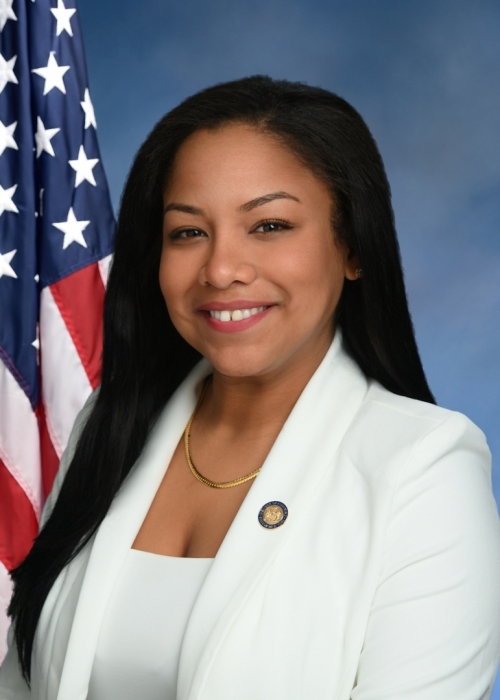
Asm. Amanda Septimo
Sponsored bills
Maddy summaryThis bill mandates the installation of working smoke detectors in shared areas of multi-unit buildings and condominiums across the state. It specifically requires these alarms to be placed in common spaces like hallways, lobbies, and stairwells where the sound is audible to all residents. The law also updates rules for property transfers, ensuring that sellers provide an affidavit confirming compliance when selling a home or apartment. Additionally, the bill clarifies that failing to install these detectors does not void property warranties or insurance claims.
Repeals the rebates for stock transfer tax paid; dedicates funds of the stock transfer tax fund and stock transfer incentive fund to various funds; establishes the safe water and infrastructure action program.
Requires contractors and subcontractors working on covered projects submit their payrolls or transcripts to the fiscal officer; directs the department to create a database for such records that are publicly available for inspection.
Provides for a working families tax credit; directs quarterly prepayment of the credit; provides for a sliding reduction in the credit for incomes which exceed a certain threshold.
Maddy summaryThis bill requires motor vehicle dealerships to receive full and fair payment from their franchisors for all warranty-related work, including repairs, diagnostics, and parts. It mandates that payments for approved claims be made within thirty days and sets a specific method for calculating compensation based on the rates dealers charge their own customers for similar non-warranty services. The law also establishes a process for dealers to declare their reimbursement rates and limits exclusions to items like wholesale parts, tires, and routine maintenance. By defining "reasonable compensation" and outlining dispute resolution steps, the bill aims to ensure dealers are not underpaid for services performed under manufacturer warranties.
Provides that if any employee, engaged in the service of any commuter rail service owned or operated by the authority or its subsidiaries, shall suffer a physical and/or mental injury that is caused by a passenger, customer or member of the public while the employee is performing an assigned duty, the employer shall be held liable for any health care costs attributable to such injury; makes related provisions.
Eliminates court surcharges and fees and probation and parole surcharges and fees; eliminates the requirement that a parolee or releasee receiving a merit termination of sentence be financially able to comply with an order of restitution; eliminates the requirement that a person receiving a discharge of sentence be financially able to comply with an order of restitution and the payment of certain surcharges or fees (Part A); prohibits mandatory minimum fines for penal law and vehicle and traffic offenses (Part B); mandates that courts engage in an individualized assessment of a person's financial ability to pay a fine prior to imposing a fine (Part C); eliminates the availability of incarceration as a remedy for a failure to pay a fine, surcharge, or fee, lifts and vacates existing warrants issued solely on a person's failure to timely pay a fine, surcharge or fee and ends existing sentences of incarceration based on such failure (Part D); vacates existing unsatisfied civil judgments based on a person's failure to timely pay a surcharge, or fee (Part E); prohibits the collection of a fine, restitution or reparation from the funds of an incarcerated person; prohibits the payment of court fines, mandatory surcharges, certain fees, restitution, reparation or forfeitures from the earnings of prisoners (Part F); vacates existing unpaid surcharges, DNA databank fees, crime victim assistance fees, sexual offender registration fees, supplemental sex offender victim fees, or probation or parole supervision fees; repeals certain provisions of law relating to restrictions on remitting such fees (Part G).

Maddy summaryThis bill allows eligible voters in New York to register to vote and cast their ballots on the same day at early voting or election day polling locations. To do this, a voter would fill out an affidavit form at the polling place, which serves as a temporary registration that becomes official only after election officials verify the voter's identity and eligibility using state and federal databases. If the information cannot be immediately verified, officials may still issue a voter ID number and accept the ballot, provided the voter meets other legal requirements. The bill requires election boards to offer this process at all early voting and election day sites while ensuring ballot secrecy and proper handling before the votes are counted.
Maddy summaryThis bill expands the authority of the New York State Secretary of State to improve code enforcement in local governments by creating a new State Code Enforcement Office led by an ombudsperson. The legislation allows the Secretary to place oversight officials in local areas to monitor compliance with building and fire safety standards, provide assistance to local staff, and resolve complaints. The newly established ombudsperson will have the power to investigate complaints, inspect local enforcement programs, and recommend corrective actions or state intervention if minimum standards are not met. Additionally, the office will manage a public complaint submission system and report regularly to the Secretary on the status of investigations and resolutions.