

Requires pharmacies to provide prescription drug readers or other means of access to individuals who disclose they have difficulty seeing or reading standard print labels on prescription drug containers; defines "prescription drug reader" to mean a device which is capable of audibly conveying information contained on the label of a prescription drug; makes exceptions.
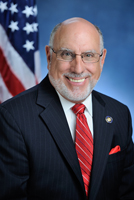
Asm. Michael Benedetto
Sponsored bills
Increases the tax exemption for pensions and annuities for persons age fifty-nine and one-half or greater from $20,000 to $25,000 in 2027, $30,000 in 2028, $35,000 in 2029 and $40,000 for each subsequent year.
Relates to parole eligibility for certain incarcerated persons age fifty-five or older if they have served at least fifteen years of their sentence or sentences.
Enacts the "dialogue and decorum act" which establishes the crime of disruption or disturbance of a lawful assembly; makes such crime an unclassified misdemeanor.
Establishes the rental assistance payment standard pilot program where the owner of a housing accommodation shall be entitled to charge and collect a rent equal to the maximum amount that the rental assistance program prescribes for like housing accommodations, subject to rent reasonableness calculations.
Increases the penalties for leaving the scene of an accident involving an electric scooter without reporting in the first and second degrees; creates the offenses of leaving the scene of an accident involving a bicycle with electric assist without reporting in the first and second degrees.
Designates all agents employed by the city of New York police department in the titles of traffic enforcement agent I and traffic enforcement agent II as peace officers.
Maddy summaryThis bill requires businesses in New York to disclose when prices are set using algorithms that rely on personal data, mandating the clear statement "THIS PRICE WAS SET BY AN ALGORITHM USING YOUR PERSONAL DATA" alongside any personalized pricing offer. It directly affects businesses selling goods or services to consumers (excluding insurers and financial institutions like banks or credit card companies). Key provisions ban the use of protected class data - such as race, gender, or age - to set different prices, preventing discriminatory pricing practices. The law empowers the state attorney general to enforce compliance through injunctions and impose civil penalties of up to $1,000 per violation.
Maddy summaryThis bill prohibits involuntary servitude and forced labor in all New York state and local correctional facilities, directly affecting incarcerated individuals. It amends the Civil Rights Law to explicitly ban slavery, involuntary servitude, and forced labor for all people in New York - including those convicted of crimes - and adds a new Correction Law section prohibiting any labor compelled through force, threats, or adverse actions (like disciplinary measures). The law makes it illegal for facilities to require labor against an individual's will using coercion or fear of punishment. This represents a concrete legal change to end forced labor practices within New York's prison system.
Maddy summaryThis bill establishes a statewide process for cities, towns, and villages to review applications for cell towers and wireless facilities. Municipalities without existing rules must hold public hearings within 90 days of an application and issue a decision within 62 days, while requiring applicants to notify nearby residents and pay fees for permits and technical reviews. The law sets standards for review, including considerations for historic areas, scenic locations, and aesthetics, and defines key terms like "wireless facility" to guide the process. Municipalities may adopt stricter rules than the state minimum if they choose.