

Establishes the agrivoltaics viability pilot program to provide grants to identify the best practices and strategies for agrivoltaics and dual-use solar energy projects that protect soil health during construction and decommissioning of solar arrays, utilize sustainable agricultural production practices, monitor any benefits solar energy may have on farms and to the state, track economic viability, study the commercialization of dual-use solar energy projects, and encourage equitable engagement of stakeholders.
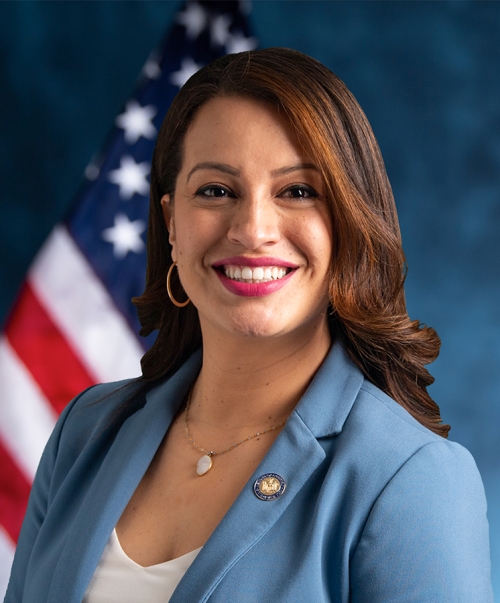
Asm. Catalina Cruz
Sponsored bills
Maddy summaryThis bill requires the state education commissioner to develop age-appropriate curriculum about the historical treatment of lesbian, gay, bisexual, transgender, and gender non-conforming individuals for school districts. Schools may integrate this material into social studies or other subjects as they determine appropriate. The curriculum must be tailored to different grade levels and does not need to be uniform across the state. It applies to school years starting July 1, 2026, with implementation rules to be finalized before that date. The bill directly affects public school districts and students by mandating this historical content in educational programming.
Maddy summaryThis bill establishes a new health coverage option under New York's 1332 state innovation program, allowing the state to create a health plan for specific uninsured New Yorkers who don't qualify for Medicaid or ACA marketplace plans. It directly affects residents under 65 with household incomes between 133% and 250% of the federal poverty line, including some noncitizens ineligible for Medicaid due to immigration status. Key provisions include requiring coverage for essential health services (like cancer care access at Medicaid rates, dental, vision, and chronic illness support), automatic enrollment for children born to eligible parents, and continued coverage during pregnancy for one year postpartum. The program requires federal approval under the ACA's Section 1332 waiver process and operates alongside existing Medicaid and marketplace plans.
Requires the New York city department of corrections and the New York city health and hospitals corporation to adopt safety policies to protect health care workers who treat incarcerated individuals.
Removes from admissibility evidence that proves or tends to prove that a victim has been convicted of a prostitution offense within three years prior to the sex offense which is the subject of the prosecution.
Maddy summaryThis bill establishes a new progressive income tax structure for high-income New York taxpayers by creating multiple tax brackets with increasing rates as income rises. It directly affects New York residents earning above certain thresholds, with the highest rates applying to incomes over $5 million (up to 24% for some filing statuses). Key provisions include setting specific tax rates for different income ranges - for example, 10.90% for incomes over $25 million and 24% for incomes over $20 million for certain filers. The bill modifies existing tax law to implement these bracketed rates, replacing previous structures.
Imposes an additional tax surcharge on certain non-primary residence class one and class two properties in a city with a population of one million or more.
Maddy summaryThis New York bill authorizes state and local governments to create permanent memorials honoring COVID-19 victims, prioritizing input from families and loved ones of those affected. It establishes a dedicated "COVID-19 permanent memorial fund" managed by the state financial officer and parks department, which will hold grants, donations, and investments specifically for memorial creation and maintenance. Municipalities can apply for funding through this grant program to cover memorial costs, with final designs selected via community processes. The fund must keep memorial money separate from other state funds and may invest surplus funds to generate additional support for memorials.
Factors domestic violence convictions into family court decisions regarding visitation, custody and parental rights; provides that any parent undergoing mandatory, batterer specific rehabilitation measures shall only be granted supervised visitation.
Maddy summaryThis bill restructures New York's fraud laws by creating five distinct degrees of "scheme to defraud," each with specific thresholds based on the number of victims, amount of property defrauded, or involvement of vulnerable elderly individuals. It replaces existing sections with new ones (190.60 to 190.68), classifying offenses from a class A misdemeanor (fifth degree) up to a class B felony (first degree) based on severity. The bill directly affects individuals committing fraud, particularly legal professionals or others engaging in systematic schemes, and updates references to these fraud levels in other laws like the General Business Law. It does not establish a new "harassment" crime for legal services clients, as noted in the abstract, but focuses solely on redefining fraud penalties.