

Maddy summaryThis bill requires the MTA to create a half-fare program for eligible New York State veterans using public transportation. It applies specifically to veterans who are New York residents, honorably discharged from U.S. military service, and possess a valid New York veteran ID card. The MTA must establish the program but cannot fund it from its regular operating or capital budgets; instead, it can only implement it using state funds specifically allocated for this purpose. The bill defines "veteran" clearly and mandates that the program be implemented with state appropriations.
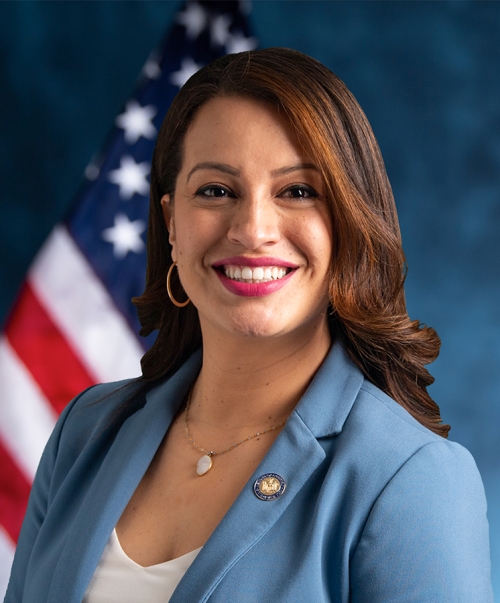
Asm. Catalina Cruz
Sponsored bills
Provides that cities having a population in excess of one million shall not supersede state provisions relating to the state law prohibition on individuals standing or parking a vehicle within twenty feet of a cross walk at an intersection.
Maddy summaryThis bill updates rules for when construction projects must pay local prevailing wages. It applies to projects using at least 20% public funds (or $3 million/$5 million in public funds) for construction costs. Exemptions include single-family homes, small nonprofits, and certain affordable housing developments meeting specific affordability requirements. This affects contractors and developers working on qualifying projects funded in part by public money.
Maddy summaryThis bill increases the state commission of correction from 3 to 9 members. It specifies that 3 members are appointed by the governor (with Senate confirmation), 2 by the Assembly speaker, 2 by the Senate Temporary President, and 2 by the Correctional Association. The commission must now include at least one person formerly incarcerated in a New York correctional facility, a public health professional, a behavioral healthcare professional, an attorney with criminal defense or prisoner rights expertise, and others deemed beneficial. The bill also sets term lengths and removal procedures for commission members.
Relates to authorizing voting by incarcerated individuals in correctional facilities; requires the department of corrections and community supervision, in collaboration with the state and county boards of election, to establish a program to facilitate incarcerated individuals voter registration and voting.
Establishes the green affordable pre-electrification program to assist owners and tenants in residential properties in curing structural and building code defects which render the properties ineligible for improvements or projects relating to energy savings, green-house gas emissions reductions, climate change adaptation and resiliency project grants; establishes the energy efficiency and electrification interagency coordination group to coordinate between certain energy efficiency programs.
Requires certain entities to stock opioid antagonists and to store naloxone nasal sprays with or adjacent to automated external defibrillator cabinets.
Expands eligibility for tax abatement for rent-controlled and rent regulated property occupied by persons with disabilities to include individuals who do not meet the non-medical qualifications for SSDI and SSI but, by reason of the individual's disability, the individual is not able to engage in substantial gainful activity as that term is defined by the federal social security administration.
Repeals the rebates for stock transfer tax paid; dedicates funds of the stock transfer tax fund and stock transfer incentive fund to various funds; establishes the safe water and infrastructure action program.
Maddy summaryThis bill requires health insurers to automatically approve preauthorization requests for specific medical services when healthcare professionals (like doctors or nurses) have received approval for at least 90% of similar requests in the past six months. It directly affects healthcare providers who work with participating insurers and ensures insurers must pay for covered services without delay or reduction once automatic approval is granted. Key provisions include annual reviews (by November 15th) to maintain approval status, a 30-day notice period before rescinding approvals, and a guarantee that insurers cannot deny payment for services covered under the automatic approval. The law aims to reduce administrative delays for providers while maintaining insurer oversight through retrospective reviews.