

Maddy summaryThis bill transfers the regional state park police from the Office of Parks, Recreation and Historic Preservation to the Division of State Police. It directly affects park police officers, their current employer, and the state police division by moving all duties, personnel, facilities, records, vehicles, and assets to the new division. Key provisions ensure employees face no salary reduction, retain accrued leave and seniority, and must pass background checks to join the state police; those with four or more years of service may skip standard promotion waiting periods. The transfer preserves ongoing cases, contracts, and rules without disruption, with the Division of State Police assuming all related responsibilities.
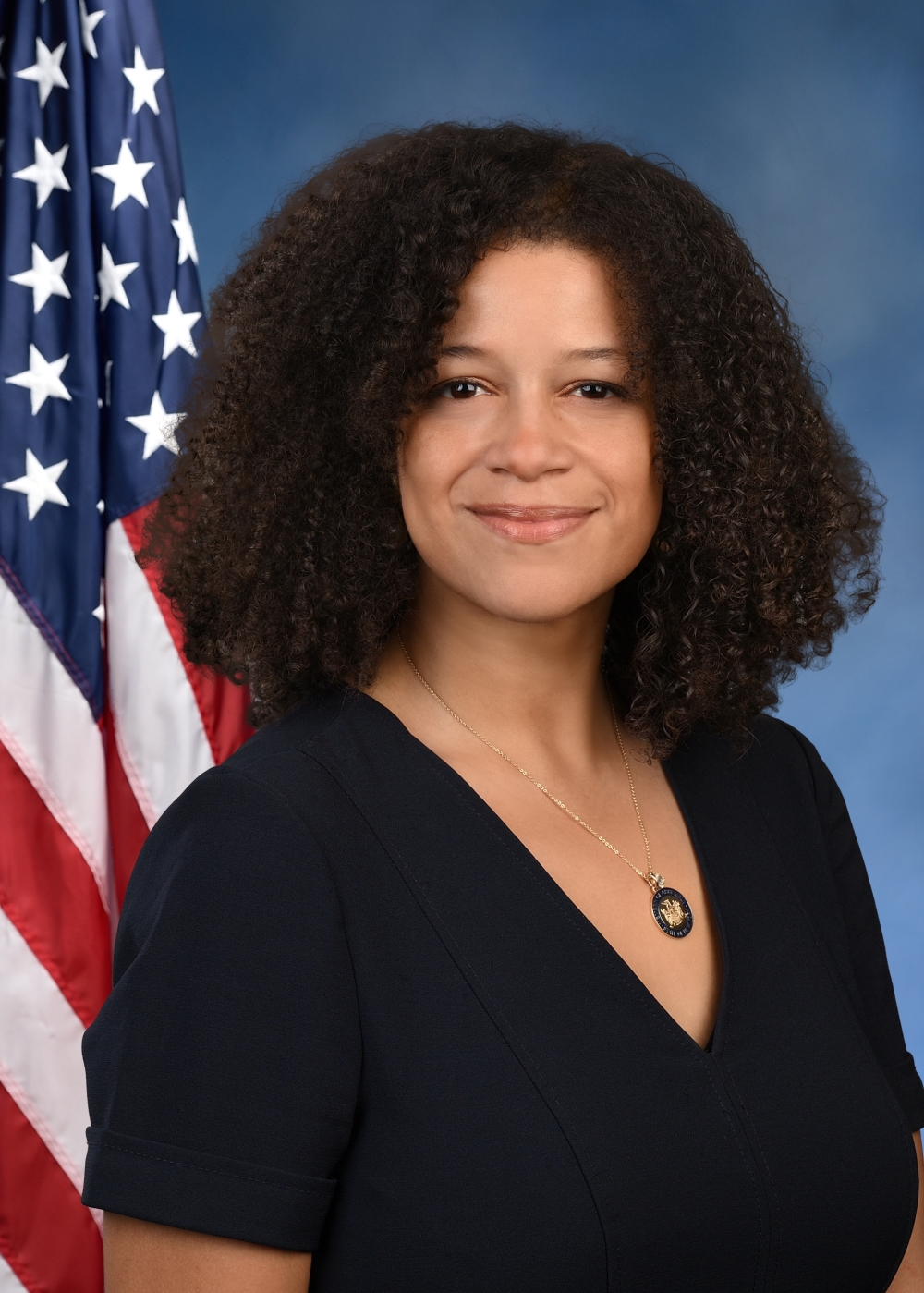
Asm. Michaelle Solages
Sponsored bills
Requires the commissioner of health to consult with the office of addiction services and supports and relevant stakeholders as determined by such commissioner in addition to the office of mental health to publish guidance for incorporating maternal depression screenings into routine prenatal care; changes the effective date to eighteen months.
Requires the department of health to require all maternal healthcare facilities to include and/or post on the maternal healthcare facility's webpage, lobby, and patient waiting areas information stating a birthing parent is allowed to have a doula present in the maternal health care facility for delivery and/or inpatient care post-delivery.
Provides that maternal health care facilities are not required to grant doula access during emergencies or when such access could compromise the safety of the patient or health care team.
Maddy summaryThis bill restricts certain harmful chemicals in menstrual products sold in New York State. It prohibits manufacturers from intentionally adding specific substances like lead, mercury, formaldehyde, phthalates, and PFAS (a class of chemicals including Teflon-like compounds) to products such as tampons, pads, and menstrual cups. Starting immediately upon the bill's effective date (12 months after enactment), these chemicals cannot be added as intentional ingredients, with future safety thresholds for remaining traces to be set by health and environmental agencies by 2029. The law applies to all distributors and sellers of menstrual products within New York.
Provides that a person may operate a fully autonomous vehicle on the public roads of this state without a human driver provided that the automated driving system is engaged and the vehicle meets certain conditions; defines terms; requires insurance and that such vehicle is registered as a fully autonomous vehicle; makes related provisions.
Requires the commissioner of the office of temporary and disability assistance to provide for automated identification of OTDA program participants for participation in utility corporation affordability programs for water service affordability.
Maddy summaryThis resolution (K 34) commemorates the 221st anniversary of Haiti's independence from France on January 1, 1804. It formally recognizes Haiti's historic significance as the first free Black republic and honors the contributions of New Yorkers of Haitian descent to the state's cultural fabric. The resolution calls on the New York State Legislature to pause its proceedings for this commemoration, highlighting Haiti's legacy and strengthening ties between New York and Haitian communities. It does not impose any legal requirements or policy changes, serving solely as a symbolic gesture of recognition.
Maddy summaryThis is a symbolic commemorative resolution (not a policy bill) that formally recognizes the victims of the 2010 Haiti earthquake. The resolution asks the legislative body to pause its proceedings to remember the estimated 230,000-316,000 lives lost, injuries, and displacement caused by the disaster. It acknowledges international and New York State aid efforts, including support for the Haitian diaspora. As a procedural resolution, it has no binding effect or direct impact on affected communities.
Maddy summaryThis bill requires New York state-owned parking facilities with at least 50 spaces to install electric vehicle charging stations in a percentage of spots ranging from 10% to 20%, depending on the facility's total size. The Office of General Services is tasked with installing and maintaining these stations, which must meet specific electrical capacity standards, and is authorized to hire licensed electricians if upgrades to the power system are needed. The law applies to public, employee, and pay-per-use parking areas and would have taken effect on April 1 of the following year. However, the bill was vetoed by the Governor in December 2024 and subsequently tabled, meaning it did not become law.